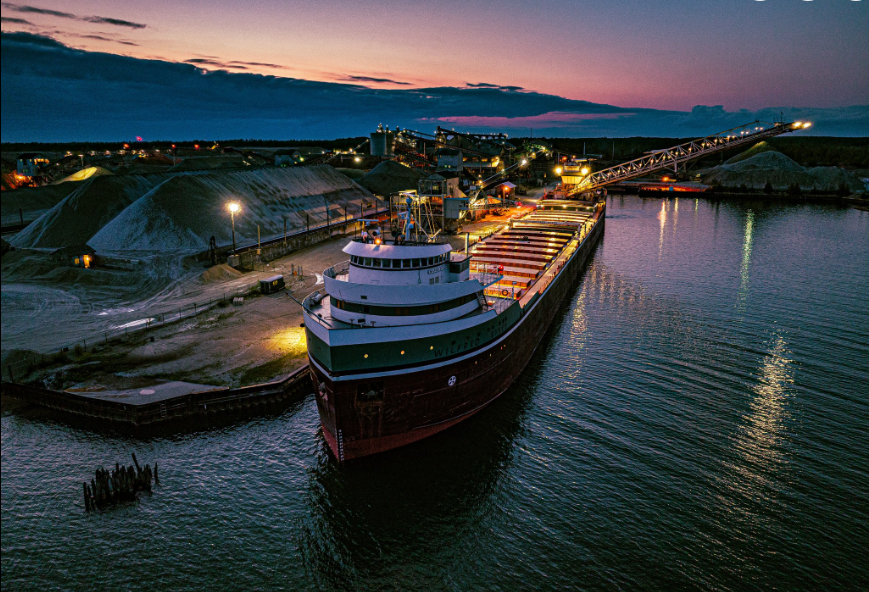
The 2025-2026 winter layup list is now up and running at https://boatnerd3.jasonbowlerdesign.com/winter-lay-up-list-2025-2026
Lake Michigan and Lake Huron lost 3.2 trillion gallons of water in last month
The seasonal decline in the Great Lakes’ water levels is in full force. Here’s how your favorite Great Lake is reacting to the colder, less moisture time of year.
From November to December, all of the Great Lakes have had a lowering of the water levels. This isn’t alarming, as we are in what is called the “seasonal decline” period of Great Lakes water levels. From November to February the Great Lakes typically go down in water level just because the colder air doesn’t support heavy rain. Also, most of the precipitation falls as snow, which means that moisture doesn’t make it into a Great Lake until it melts in March or April.
But Lakes Michigan and Huron, the same lake for water level purposes, did lose a fair amount of water. Those lakes declined four inches from November to December. Remember- according to the U.S. Army Corps of Engineers, one inch of water on Lakes Michigan and Huron is 800 billion gallons. Four inches of water is 3.2 trillion gallons of water that are now not in Lake Michigan and Lake Huron. That’s a lot of fresh water.
Lake Superior is six inches below the long-term average, which is close to a notable deviation from normal. The forecast into summer is for Lake Superior to hover at around six inches below the average water level.
Lakes Michigan and Huron are the lowest Great Lakes right now, when compared to long-term water levels. The water is 14 inches below normal right now, and is expected to remain about 14 inches below normal into summer.
Lake Erie is just four inches below normal, essentially giving it a “normal water level” feel.
Great Lakes water levels
Lake Ontario is also four inches below normal and expected to track between four inches below normal and around normal into summer.
The water level forecasts into summer are based on an average precipitation expectation. If Michigan continues in a less-rain-than-normal situation, and severe drought worsens, the lakes may not rise as much as predicted as we go into summer. Of course if we got into an extremely wet pattern for several weeks this spring or summer, the Great Lakes could track a few inches higher than the forecast.
If we did stay in drought and lack precipitation, Lakes Michigan and Huron could become notably low. Some that live on those lakes right now are already indicating they feel the water levels are very low already.
[M Live – Mark Torregrossa]
Seaway finally closes; Welland Canal not quite yet
The Noelle G. officially cleared the St. Lambert Lock Monday, marking the end of the Seaway’s downbound transits this season, a record for such a late date. The previous record was Jan. 11, 2018 with Federal Biscay transit.
Four domestic ships remain on Lake Ontario awaiting layup: CSL Welland, Captain Henry Jackman, Algoma Equinox and Algoma Buffalo. High winds Monday winds forced the first three to drop anchor in Prince Edward Bay, while Algoma Buffalo exited the Welland Canal and headed to Hamilton to unload. Although a return trip upbound to Port Colborne was initially considered, it now appears likely that all four vessels will complete their season with winter layup in Hamilton, unless any of them are given an extension by the Seaway to follow CCGS Judy LaMarsh up on Wednesday, Jan. 14.
[Janey Anderson, Rene Beauchamp]
Soo Locks season winding down
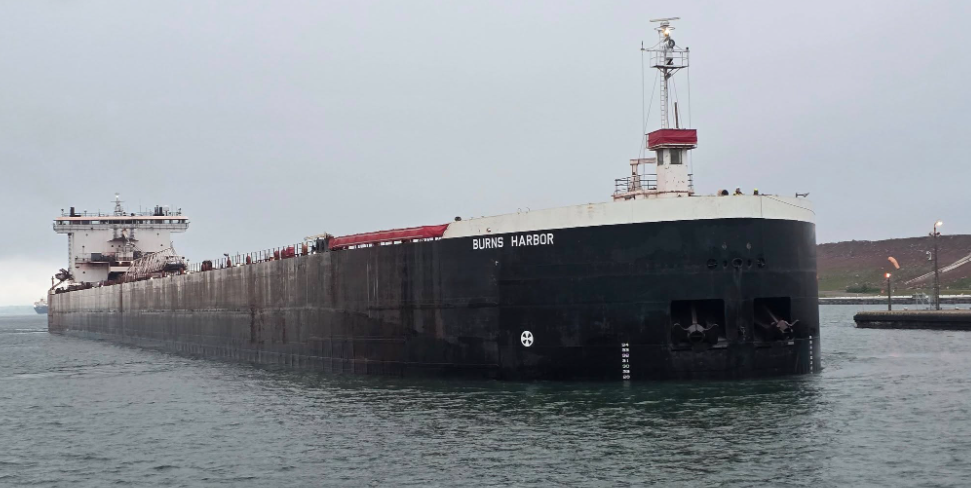
There wasn’t much excitement Monday at the Soo as the shipping season winds down. CCG Vincent Massey was downbound, followed by Thunder Bay, which met the upbound Burns Harbor below 6 Mile Point. Kathy McKeil was above the locks Monday night headed for Windsor. Kaye E. Barker was west of the Mackinaw Bridge Monday with a Marquette destination on AIS, however she took a turn to the south and was headed down Lake Huron Monday evening.
[Know Your Ships]
Soo Locks closing for seasonal repair, maintenance
The Soo Locks in Sault Ste. Marie, Michigan will close to all marine traffic beginning 11:59 p.m. Jan. 15, or until commercial traffic ceases, through 12:01 a.m. March 25 to perform seasonal critical maintenance.
Federal regulation (33 CFR 207.440) establishes the operating season based on the feasibility of vessels operating during typical Great Lakes ice conditions.
“Every year, our lock and dam operators transition from assisting vessels through the Soo Locks to performing maintenance on the locks,” Operations Branch Chief Jeff Harrington said. “The team works alongside Soo Project Office maintenance crews to provide 100% effort in completing all critical maintenance during the 10-week shutdown. They work long hours in harsh northern Michigan winter conditions to complete a significant amount of maintenance during this annual closure period.”
This winter maintenance period, the MacArthur Lock will not be dewatered and will close for the season when the weather or ice conditions make operation unsafe and/or inefficient, or when the Poe Lock closes, whichever comes first. Communication with industry will be made at least 48 hours prior to closure. The MacArthur Lock is scheduled to reopen in late April 2026.
The Poe lock will remain operational (on a 24-hour basis) through January 15, 2026, or until commercial traffic ceases – whichever occurs first. The Poe Lock will be dewatered during the maintenance season and is scheduled to reopen on March 25.
The team will install temporary panel bridges across the MacArthur and Poe Lock. The panel bridges will provide the ability to mobilize materials and equipment to the job sites throughout the winter closure.
Maintenance on the MacArthur Lock will include the Soo Project Office fabricating and replacing spring boxes and lever arms for Gates 3, 4 and 5, constructing a recess cutout for the panel bridge, repairing a Gate 2 strut arm, as well as concrete and deck plate repairs to Gate 5
Maintenance on the Poe Lock will include underfloor cleanout and manhole inspection, a five-year periodic assessment, Gate 1 repairs, Gate 4 lifting lug installation, Gate 3 jacking pedestal repairs and testing of Ice Study wall coating.
In addition to the above, crews will also perform a wide range of other maintenance tasks from the replacement of pier fender timbers to inspections and preventative maintenance on electrical and mechanical systems on both the Poe and MacArthur Locks.
“Reliable Great Lakes navigation and the momentum of the American manufacturing supply chain depend on getting the job done here. In an unforgiving northern climate, our exceptional team tackles the complex maintenance demands of aging infrastructure, proving their skill on systems well past their service life.” Soo Locks Operations Manager LeighAnn Ryckeghem said.
More than 4,500 vessels, carrying up to 80 million tons of cargo, maneuver through the locks annually. Iron ore, coal, wheat and limestone are among the most frequently carried commodities. Opened in 1969, the Poe Lock is 1,200 feet long. The MacArthur Lock opened in 1943 and is 800 feet long.
The U.S. Army Corps of Engineers, Detroit District, maintains a navigation system of 81 harbors, including the Great Lakes Connecting Channels that join lakes Superior, Michigan, Huron, St. Clair and Erie.
Visit the Detroit District Facebook page https://www.facebook.com/USACEDetroitDistrict for information about the last vessel to transit the Soo Locks for the 2025-2026 shipping season and updates on maintenance work.
[U.S. Army Corps of Engineers, Detroit District]
Great Lakes Iron Ore Trade Down 12.8 Percent in 2025
CLEVELAND – Shipments of iron ore on the Great Lakes totaled 4.2 million tons in December, a decrease of 8.8 percent compared to 2024. Shipments were also below the 5-year average for the month by 7.6 percent.
The year-end total for the iron ore trade decreased by 12.8 percent to 43.4 million tons.
2025 iron ore loadings were down 8 percent compared to the trade’s 5-year average.
Since 1880, Lake Carriers’ has represented the U.S.-flag Great Lakes fleet, which today can move more than 90 million tons of cargos annually that are the foundation of American industry, infrastructure, and power: iron ore, stone, coal, cement, and other dry bulk materials such as grain, salt, and sand. More information is available at www.lcaships.com.
[See charts in gallery below]
[Lake Carriers Association]