Unloading ship stranded Maccoa to begin Saturday
The unloading of corn from the Cypriot ship that ran aground on Christmas Eve on the St. Lawrence River in the Verchères area of Montérégie is expected to begin Saturday.
According to the current plan, more than 3,000 metric tonnes of corn from the M/V Maccoa will need to be unloaded. Authorities hope that lightening the ship will allow it to float and then be refloated.
Weather permitting, unloading should begin during the weekend of January 4th and 5th, the Canadian Coast Guard said in an email.
However, the schedule could be changed depending on weather conditions and the availability of Groupe Océan tugs.
Indeed, Fisheries and Oceans Canada said that rain could complicate and slow down operations. Corn cannot be unloaded in the rain and certain conditions must be met for it to remain edible.
The Canadian Press & News
Hands-free mooring coming to Welland Canal’s Lock 8
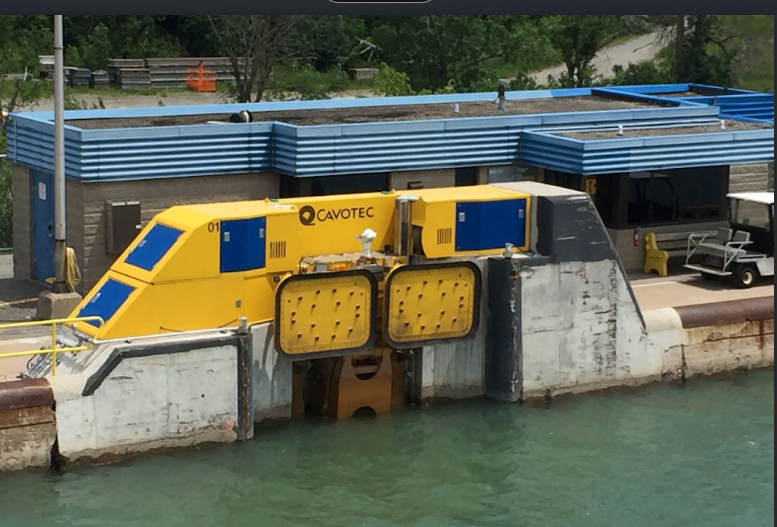
Hands-free mooring is coming to Port Colborne’s Lock 8, making it the final lock on the Welland Canal with the technology, says the St. Lawrence Seaway Management Corp.
A news release from the seaway said the work is part of a $180-million investment over the next three years to maintain critical infrastructure along the canal. The seaway is also investing more than $170 million in the Montreal to Lake Ontario section.
It said the ongoing local investments ensure the safety and reliability of its infrastructure while providing economic benefits to communities, businesses and suppliers in the region.
Hands-free mooring units are remote-operated vacuum pads that hold ships in place during lock transits. The mooring units move up or down on rails recessed within a lock’s wall as a vessel is raised or lowered.
In the release, the seaway said work at Lock 8 starts Jan. 2 and may cause disruptions for local residents and businesses. It said it would make every effort to minimize noise and other impacts.
The project will involve loud construction activities, and the work is typically scheduled for 20 hours per day, with a 24-hour schedule only if necessary.
Workers will begin setting up at the lock on Dec. 30, with concrete/rock drilling operations in early January. Excavator-based demolition is targeted from mid-January to mid-February, and additional construction activities unrelated to drilling or demolition will continue through the end of March.
The seaway said the canal closes to shipping traffic Jan. 10, and the Montreal to Lake Ontario section Jan. 5.
Welland Tribune
Welland looks to canal corridor
for industrial expansion
WELLAND, ON – Mayor Frank Campion says rapid residential development is happening in Welland as city works toward provincial housing goal.
Welland’s big push in 2025 is opening up lands along the Welland Canal to bring new industry and jobs to the city, said Mayor Frank Campion in a year-end interview.
“We have a unique opportunity here. Port Colborne is doing great with it (the canal corridor) because they have facilities there already, and so is Thorold. We need to get caught up because all the facilities we had on the canal are now located downtown in Welland, and there’s no shipping going on there,” said Campion.
The canal made its way through the heart of the Rose City until 1973, when a bypass three kilometres to the east opened up, diverting ship traffic.
In 2020, Welland, Port Colborne and Thorold signed a memorandum of understanding with the Hamilton Oshawa Port Authority (HOPA) to create a network of multimodal hubs along the canal and work together to snap up lands declared surplus by Transport Canada along the waterway.
A multimodal hub was created in Thorold by HOPA and Bioveld Canada Inc., and several businesses moved to the site of a former paper manufacturing facility on the east side of the canal just south of Lock 7.
In Port Colborne, HOPA snapped up eight hectares of unused industrial land on the east side of the canal at the southern end. In November, HOPA and the city announced a $33-million, eight-million-litre biofuel terminal will be built on five hectares of the property.
Campion said the canal is a significant trade corridor in North America, and with limited industrial land available inside the urban boundary, property owned by Transport Canada on the east side of the working waterway is where the city needs to expand.
“There’s a lot of room there. It’s perfect for industrial use.”
He said the city is working with various agencies, like HOPA, Transport Canada and others to secure land and also spread the message that it has the ability to accommodate large industries and get them in the ground quickly.
“We have that reputation Ontario- and Canada-wide and globally to a degree.”
Campion said while working on the canal lands to attract future industry, there’s interest on the industrial and commercial side in Welland now.
“We have two fairly substantial industrial developments coming to the community,” he said. “I can’t talk about them yet.”
As Welland sees more commercial and industrial development, Campion spoke about residential development in the city over the last year and into the future.
With a provincial target of 4,300 housing units to be built by 2031, the mayor said development is happening rapidly in Welland.
Welland Tribune
Win a trip on the Alpena
Information in the gallery below.
MHSD’s Ahoy & Farewell III book
documents 30 years of laker history
Ahoy & Farewell III, the third installment of the Marine Historical Society of Detroit’s long-running series marking the MHSD’s 80th anniversary, is now available. The book documents the vessels we welcomed, and those to which we had to bid farewell, during the last 30 years. This 308-page, hardcover book features many color photos, with multiple images of each vessel referenced.
In a departure from the MHSD’s previous volumes, the nearly 308-page, hardcover book includes color photos, with multiple images of every vessel. The book’s authors are marine historians William Moran and Viktor Kaczkowski, and Know Your Ships publisher Roger LeLievre.
“Putting the book together has been a much greater challenge than any of us had expected,” Kaczkowski said. “With the influx of foreign-built new and used tonnage, writing the histories required a lot more research to ensure the information was correct, particularly due to the wide variety of languages that came into play.”
Order Ahoy & Farewell III now at MHSD.org.