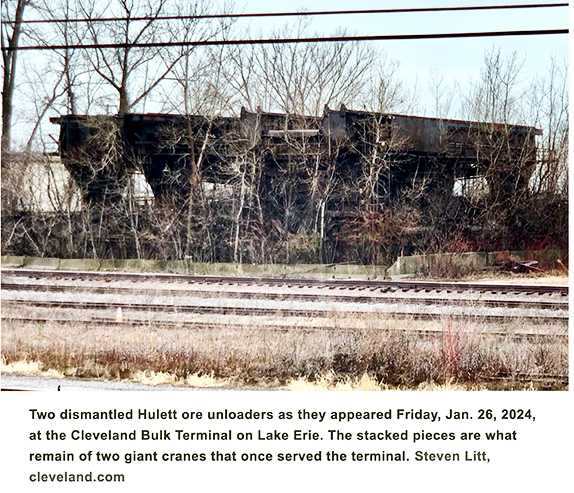
Port of Cleveland seeks to remove, recycle, dismantled historic Hulett ore unloaders
Cleveland, Ohio – The dream of reassembling one of the giant Hulett ore unloaders that
once served Cleveland’s steel industry appears to be over.
Will Friedman, president and CEO of the Port of Cleveland, told cleveland.com and The
Plain Dealer Friday afternoon that the agency is seeking bids for the removal of two
dismantled Huletts that have been stacked in a pile since 2000 at the Port’s Cleveland
Bulk Terminal, just west of Wendy Park on Whiskey Island.
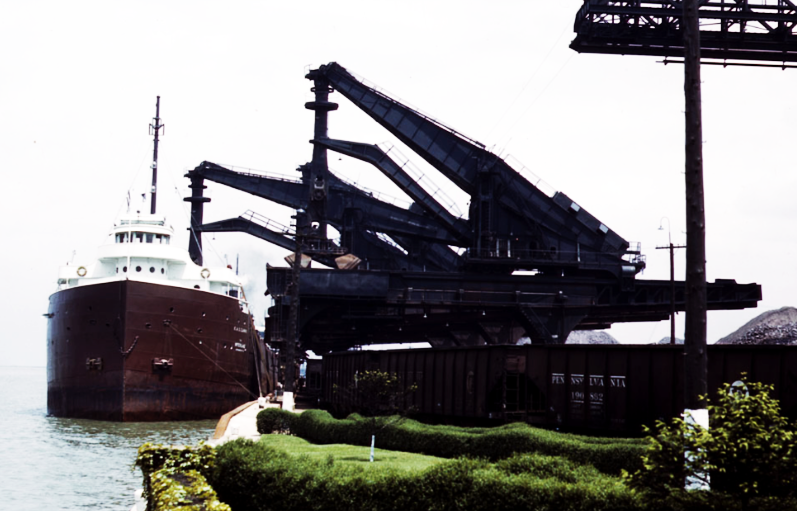
The Hulett was an ore unloader that was widely used on the Great Lakes.
The Hulett was invented by George Hulett of Conneaut, Ohio, in the late 19th century.
The Hulett machine revolutionized iron ore shipment on the Great Lakes. Previous
methods of unloading lake freighters, involving hoists and buckets and much hand
labor, cost approximately 18¢/ton. Unloading with Huletts cost only 6¢/ton. (in 1901
dollars) Unloading only took 5 to 10 hours, as opposed to days for previous methods.
Lake boat designs changed to accommodate the Hulett unloader, and became much
larger, doubling in length and quadrupling in capacity.
By 1913, 54 Hulett machines were in service. Two were built at Lake Superior
(unloading coal) and five at Gary, Indiana, but the vast majority were along the shores
of Lake Erie. The additional unloading capacity they brought helped permit a greater
than doubling of the ore traffic in the 1900–1912 period. A total of approximately 75
Huletts were built.
The lake’s Huletts were used until about 1992, when self-unloading boats were standard
on the American side of the lake. All have since been dismantled. In 1999, only six
remained, the group of four at Whiskey Island in Cleveland, the oldest. Another set was
used unloading barges of coal in South Chicago until 2002 and were demolished in the
spring of 2010.
In spite of the Cleveland machines being on the National Register of Historic Places and
designated as a Historic Mechanical Engineering Landmark, they were demolished in
2000 by the Cleveland Port Authority to enable development of the underlying land. The
Port Authority disassembled and retained two Huletts, to enable their reconstruction at
another site, but the reconstruction never happened.
View a video of the Huletts in operation here:
https://www.youtube.com/watch?v=SGQGh1X0MuA
The warm, dry winter continues.
Sault Ste. Marie, ON – It will be no surprise to anyone that the month of January will be
one of the warmest on record. The daytime highs were only a degree or two warmer
than normal when averaged out over the entire month, but the overnight lows were
about six degrees warmer than normal. Overnight lows dropped below minus twenty
only once during the whole month.
This past month, we counted about half of the snowfall we would typically see in
January. The lack of snow for this month and December, combined with a drier-than-
normal Fall, leaves little snow in the bush, low lake levels and minimal recovery from the
dry conditions last summer.
We might see some brief sun Monday morning before clouds move during the afternoon
as daytime highs reach +2°C. Wet snow arrives in the evening, bringing 2-5cm of
accumulation overnight. A few flurries are possible Tuesday morning, with the rest of
the day being cloudy as temperatures reach +2°C again.
Wednesday and Thursday bring a mix of sun and cloud as daytime highs climb to +3°C.
A northwest wind brings slightly cooler air on Friday under mostly sunny skies.
Soo Today
Happy 125 th anniversary to Algoma Central Corp.
Watch a video here: https://www.youtube.com/watch?v=o1Mfp_ooOZ0
Biden delivers grant for Twin Ports infrastructure
SUPERIOR, WI – A presidential announcement may be the worst-kept secret in the
Twin Ports after a Minnesota congressman who voted against the funding bill let the
secret out. That doesn’t make it any less historic.
After all, the federal government would pay more than $1.32 billion to bridge the Twin
Port cities of Duluth and Superior. It’s the single largest grant the federal government
has ever awarded, made possible by the Bipartisan Infrastructure Law.
President Joe Biden announced the grant from the U.S. Department of Transportation
during a nearly four-hour trip to Superior on Thursday, Jan. 25, that took him to Connors
Point, Earth Rider Brewery, Cedar Lounge and the Superior Fire Department
headquarters.
Biden says his Investing in America agenda is mobilizing private sector investment in
the United States, bringing back American manufacturing after decades of off-shoring,
and creating new, good-paying jobs that don’t require a college degree.
In Wisconsin, private companies have announced more than $2 billion in investments,
including clean energy manufacturing in New Berlin, biomanufacturing in Madison and
Verona, and clean power across the state. Another $6.3 billion in public infrastructure
and clean energy investments have been allocated through the Bipartisan Infrastructure
Law and Inflation Reduction Act. Minnesota has seen similar public and private
investments.
The infrastructure law allocated $110 billion to roads and bridges nationwide. The Twin
Ports would receive less than 1% of that and still receive the nation’s largest grant ever
awarded to rebuild the Blatnik Bridge.
During the White House press briefing Wednesday, Jan. 24, press secretary Karine
Jean-Pierre declined to get ahead of the president’s announcement in Superior. She
wouldn’t say if the president would call out U.S. Rep. Pete Stauber, R-Minn., after he
took credit for advocating for Blatnik Bridge funding made possible by the Bipartisan
Infrastructure Law, a bill he opposed.
On Nov. 5, 2021, Stauber announced his vote in a news release because it was
part of the Democrats; multi-trillion-dollar tax-and-spend package; that is not about
real infrastructure. … I will not be complicit in paving a destructive and irreversible path
towards socialism.”
Biden didn’t call out Stauber, but he noted the many infrastructure of the
Donald Trump administration that didn’t deliver.
In 2023, each state committed $400 million to pay for the estimated $1.8 billion Blatnik
Bridge replacement project. Minnesota has a Democratic legislature and Wisconsin has
a near-Republican super-majority. The president said the state funding is vital to
ensuring the bridge project happens.
The story we’re writing is much bigger than that, Biden said.When you see the
shovels in the ground and the cranes in the sky and people hard at work on these
projects, I hope you feel a sense of pride, pride in your community, pride in what we can
still accomplish in America. … We’re the only country in the world that comes out
stronger after every crisis we’ve been in.
The High Bridge, renamed the Blatnik Bridge in 1971, was built between 1958 and
1961, after decades of efforts to replace the old Interstate Bridge, which carried most
vehicle traffic between Duluth and Superior. The new 7,975-foot bridge opened to traffic
in December 1961 at a cost of $15 million.
Then, the federal government paid 90% of the cost, leaving Minnesota and Wisconsin to
share the remaining 10%.
The bridge was built with the expectation of peak traffic of about 14,000 vehicles a day
but by the early 1990s, the bridge was averaging about 26,000 vehicles a day. Most
recently, daily traffic peaked at 33,000 vehicles per day with more than $4 billion in
goods transiting the bridge.
An early 1990s rehabilitation of the Blatnik Bridge widened its approaches but added a
heavier deck and concrete railings to replace the curb between the northbound and
southbound lanes, increasing the deck load.
The estimated $1.8 billion project calls for the demolition of the existing bridge to
construct the new bridge over a nearly five-year period.
Deb DeLuca, executive director of the Duluth Seaway Port Authority, said Thursday that
the Blatnik is essential to the efficient, safe flow of critical cargoes through our world
port, both on the road and on the water.
It’s a vital artery within the Upper Midwest supply chain, linking North America’s
furthest-inland seaport and helping move the raw materials of everyday life, she said.
We’re grateful for this significant U.S. DOT investment in such an important piece of
infrastructure. This is a bi-state project and it took organized advocacy from both sides
of the bridge to ensure a successful outcome. We greatly appreciate Wisconsin and
Minnesota legislators’ support of the project throughout the process.”
Superior Telegram
Winter lay-up list is now active
You can monitor our annual lay-up listing page here: https://boatnerd3.jasonbowlerdesign.com/winter-lay-up-list-2023-2024/
The page will be updated throughout the winter. Please send lay-up reports to news@boatnerd.net.