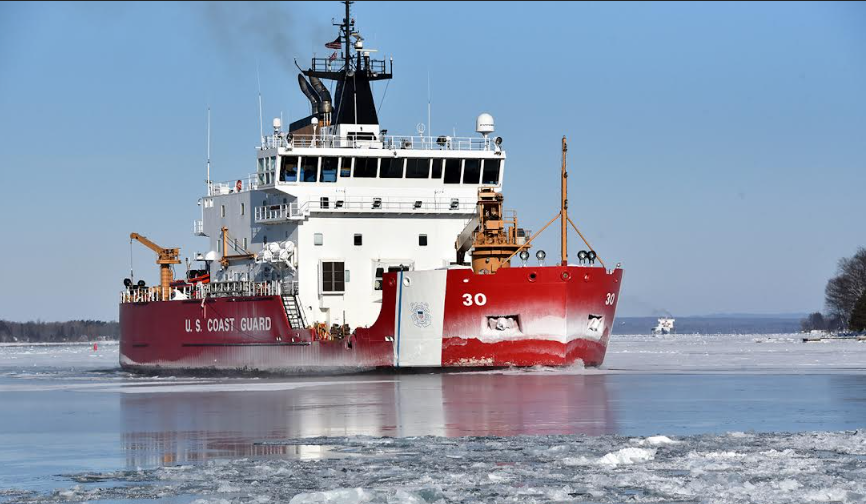
U.S. Coast Guard begins ice breaking operations
SAULT STE. MARIE, Mich. — U.S. Coast Guard Sector Northern Great Lakes commenced Operation Taconite to prevent newly formed ice from hindering commercial vessel traffic at 8 a.m. Monday.
U.S. Coast Guard Cutter Mackinaw (WLBB 30) is assigned to manage the ice breaking needs of western Lake Superior, specifically the twin ports of Duluth, Minnesota and Superior, Wisconsin. As ice coverage expands, U.S. Coast Guard officials will assign additional icebreakers.
U.S. Coast Guard Cutter Mobile Bay (WTGB 103) is assigned to manage the ice breaking needs of Green Bay and U.S. Coast Guard cutters Katmai Bay (WTGB 101) and Neah Bay (WTGB 105) will manage the St. Marys River and the Straits of Mackinac.
Operation Taconite is the U.S. Coast Guard’s largest domestic Ice Breaking operation. The operation encompasses Lake Superior, Lake Michigan, the St. Marys River, the Straits of Mackinac and Georgian Bay.
Various commercial waterways may close after due consideration is given to the protection of the marine environment, the need for cross-channel traffic (e.g., ferries) and the safety of the island residents, who during their daily business use naturally formed ice bridges for transportation to and from the mainland.
The implementation of Operation Taconite places additional movement criteria on commercial vessels transiting the area of operation. These measures may include restricting tanker transits to daylight in presents of ice, reducing speeds by 2 miles per hour in specified locations to reduce incidental ice breaking, and requiring additional voice and position reporting points throughout the operation’s area of responsibility.
USCG
Burns Harbor Leads the Winter Fleet Into Sturgeon Bay
Sturgeon Bay, WI – The first of the fleet to arrive for the 2024-25 winter layup season was the motor vessel (M/V) Burns Harbor.
The 1,000-footer arrived first at the mouth of Sturgeon Bay and Green Bay, pivoted, then backed the six miles up to the Fincantieri Bay Shipbuilding yard in Sturgeon Bay. She was placed in a 1,140-foot by 140-foot graving dock Saturday, Dec. 23.
The vessel was christened here on May 24, 1980, her name coming from Bethlehem Steel’s new (at the time) Burns Harbor plant in Indiana. She has carried her name throughout her life and has been owned and operated by The American Steamship Co. of Buffalo, New York since 2005.
She is 105 feet wide at the beam, with a depth of 56 feet, a carrying capacity of 78,850 tons and a self-unloading rate of 9,000 tons per hour. She is powered by four, 3,600 horsepower EMD V20 diesel engines turning two propellers and bow and stern thrusters. Look for a large vessel with an iron-ore colored hull and white super superstructure, aft mounted pilot house and self-unloading boom.
You can view this giant of the lakes and other vessels at Fincantieri Bay Shipbuilding, from both sides of the bay as well as from the lighthouse tower at the Door County Maritime Museum. Also check out the two large fabrication buildings that are being used to build subassemblies for the new series of U.S. Navy frigates. The pieces are put on a large barge and towed across Green Bay for final assembly at Fincantieri Marinette Marine.
Door County Pulse
Second attempt to free Maccao to take place Wednesday
Part of the ship’s cargo of corn has been unloaded onto a barge, and a second barge is in transit toward the ship, with another unloading to be completed Tuesday morning.
The corn is being unloaded to lighten and help refloat the Cyprus-flagged 185-metre bulk carrier, which ran aground in the early hours of Dec. 24 near Verchères, Que., after a power failure.
The unloading operation was supposed to start last week, after a failed attempt to free the ship late last month, but it was postponed until the weekend because it took longer than expected to prepare the barges in Quebec City.
More than 3,000 metric tonnes of corn must be off-loaded to get the ship floating, and a total of 1,250 metric tonnes have so far been unloaded onto the first barge.
Twenty crew members remain on board the vessel, which is deemed to be in stable condition, with no pollution detected in the area.
Ship Junkies – Lakes, Locks & Rivers (LL&R)
Cargo tonnage lagging at Great Lakes
ports as shipping season nears its end
The amount of cargo moving through ports on the Great Lakes is trailing behind shipments at the same time last year as the shipping season nears its end.
The Port of Duluth-Superior, which moves the most tonnage on the Great Lakes, saw around 26 million tons of cargo shipped through the end of November. That’s down about 5 percent compared to the same time last year and roughly 4 percent from the five-season average.
Iron ore, which is the port’s top commodity, was down roughly 9.8 percent at the end of November compared to the same time last year. Even so, Jayson Hron, spokesperson with the Duluth Seaway Port Authority, said tonnage is largely on par with the five-season average.
“One thing to keep in mind is that last year was a pretty strong year for iron ore,” Hron said.
Around 21.5 million tons of iron ore moved through the port last year — the most since 1995. Iron ore is down as domestic steel production has declined this year. Industries that rely on steel, such as construction and manufacturing, have seen spending slow amid high interest rates, according to Marketplace.
Despite that, Deb DeLuca, executive director of the Duluth Seaway Port Authority, said the port has made gains.
“While not yet back to pre-COVID levels, grain tonnage is on pace for its best finish since 2021, which is a positive for our port and consumers around the world who enjoy high-quality wheat from the Midwest,” DeLuca said.
A total of nearly 600,000 tons moved through the port as of the end of November — up 3.6 percent from last year. All overseas exports increased by 56 percent to 588,354 tons compared to the same time last year driven primarily by grain, the port’s top export.
Officials “break ground” on Port Milwaukee’s new DeLong Agricultural Maritime Export Facility on Wednesday. While construction has not yet started, the crew dug into a bin of dry distiller’s grain, which will be one of the main exports from the new facility. Christine Hatfield/WPR
Meanwhile, a Port Milwaukee spokesperson said the port welcomed an increase in export tonnage through the Agricultural Maritime Export Facility, which is operated by the DeLong Company. The $40 million facility that opened last year has been ramping up operations, which moves bulk agricultural exports. That includes dried distillers grains, a byproduct from beer and ethanol production.
The port did not provide details on the amount of tonnage that has moved through the facility, and DeLong officials didn’t immediately respond to a request for comment. The port’s director, Jackie Q. Carter, previously estimated the facility would increase tonnage moving through the port by about 400,000 tons.
So far, more than 1.6 million tons have moved through the port. Last year, the port handled around 2.35 million tons by the season’s end. Through November, steel tonnage was up 8 percent. Dry bulk cargo was down 15 percent due to a mild winter that reduced demand for salt, in addition to work wrapping on construction projects.
In northeastern Wisconsin, Port of Green Bay Director Dean Haen said the port gained ground on cargo shipments through November. Even so, the port has moved around 1.56 million tons, down about 4 percent from the same time last year. Haen said tonnage through the port had been tracking around 9 percent behind until the end of November.
“We’ve closed that gap significantly,” Haen said. “With a good, strong December, we may be at the same tonnage levels as we’ve seen move through the port in 2023. Nonetheless, we’re a lot closer.”
Limestone made up more than half of cargo tonnage that moved through the port in November. Similar to Port Milwaukee, Haen said salt shipments were down due to the mild winter and leftover reserves. While tonnage is down, Haen noted the number of vessels increased, but they’re carrying smaller amounts. Overall, almost 1.8 million tons of cargo moved through the port during the 2023 shipping season.
Wisconsin Public Radio
Port Colborne’s Clarence Street Bridge
will be temporarily closed twice this week.
St. Lawrence Seaway Management Corp. said the bridge over the Welland Canal will be closed on Wednesday and Thursday 9 a.m. to 4 p.m. for bridge and road maintenance, and there will be no vehicle or pedestrian traffic allowed during the work.
The agency said it will do everything possible to minimize any inconvenience to the public while it performs preventive maintenance. As the seaway winds down the 2024 shipping season — the canal closes Friday — it said Lock 7 will be out of service for three days as it replaces two gates at the Thorold location.
Work will be carried out at the lock from 8 a.m. to 6 p.m. Tuesday to Thursday. Once the canal closes for the season, maintenance work on five Niagara bridges will occur over winter at various times.
All bridges will be closed to vehicle and pedestrian traffic 9 a.m. to 4 p.m., but timelines are subject to change due to weather and other considerations.
In St. Catharines, the Glendale Bridge is the first to close for winter maintenance, from Jan. 13 to 17 for detailed inspections; followed by the Lakeshore Bridge Jan. 20 to 31 for detailed inspections and cable upgrades.
Thorold’s Allanburg Bridge is closed Jan. 20 to 24 for detailed inspections; and Port Colborne’s Clarence St. Bridge is closed three times, Jan. 21 to 23, Jan. 27 to 31, and Feb. 24 and 25, for detailed inspections and cable upgrades.
St. Catharines’ Carlton Street Bridge closes Feb. 3 to 14 and Feb. 19 and 20 for detailed inspections and cable upgrades.
Welland Tribune
Win a trip on the Alpena
Information in the gallery below.