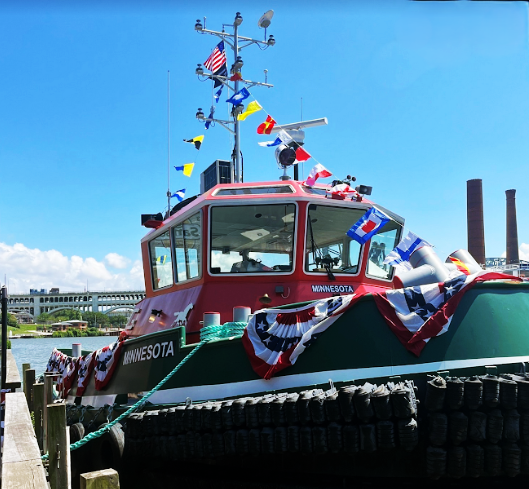
New tug Minnesota christened by Great Lakes Towing Co.
Thursday was a landmark day for The Great Lakes Towing Co. as we christened our newest tug, Minnesota, and celebrated 125 years of business. We were honored to have Natalie Ronayne, Chief Development Officer for the Cleveland Metroparks, as the sponsor for Minnesota. Our fireboat Chief, previously known as Anthony J. Celebrezze, made a special appearance.
The Great Lakes Towing Company / Great Lakes Shipyard
Dredging clears the way for commercial and recreational vessels
Dredging operations are underway in Manistee Harbor. The project, funded for $581,000 will improve ship navigation through the channel, the U.S. Army Corps of Engineers — Detroit District said in a press release last month.
The project has been contracted to King Company of Holland. King Company previously dredged Manistee Harbor in 2022 under a similar contract.
USACE was previously scheduled to maintenance dredge the harbor later in the summer, but quick coordination between staff and the contractor enabled the project to be prioritized with a June start date, USACOE officials said in the release.
The Michigan Department of Natural Resources limits certain activities – including dredging – until after June 15 to protect fish spawning and habitat, as part of a policy popularly known as a “fish window.”
The project will remove shoaling, which is the deposit of sediment in open waterways that reduces the depth of the water. It is a dangerous effect because it limits the navigation channel, causing a problem because of limited water depths. When channels and harbors are properly maintained, navigation in both directions is improved because the water depth is more uniform and allows safe passage, according to
In a report from the USACOE, dredging operations not only help maintain navigable channels, but can also be done to allow for the passage of larger vessels. “Ships access the berthing areas of these harbors through navigation channels. For the prevailing drafts of commercial vessels the required depth of navigation channel varies from about 10 to 15 m (approximately 32 — 50 feet) Dredging is required to provide and maintain these depths.”
A seemingly insignificant loss of four to six feet of channel depth would result in increased transportation costs between $44,000 and $101,000 annually. If a harbor were to close to commercial vessel traffic, commodities would have to be transported by rail and truck, according to the project fact sheet provided by the Army Corps of Engineers, as previously reported in the Daily News.
While Manistee Harbor does not see vessels requiring these depths, the Army Corps of Engineers reported that on April 23, a commercial vessel attempted to enter Manistee Harbor drafting 19 feet (about 5.7 meters) but were halted due to conditions. Surveys found the harbor was unable to be passed at that draft, according to the release provided by the USACE. A notice to vessel traffic was issued that same day and continues to coordinate closely with the U.S. Coast Guard to maintain safe passage in the area.
Once a large-scale dredging project is conducted, the USACOE said routine maintenance is needed to keep sedimentation and other navigational hazards under control.
About 33,000 cubic years of sediment are estimated to be removed from the harbor, according to the contract. Funding for the project is allocated from the Fiscal Year 2022 President’s Budget (PBUD).
Dredged material will be placed along the shoreline 3,000 feet south of the southern breakwater and extend for about 2,000 feet. Some placement will occur at a 4-foot depth nearshore where the dredged material cannot be placed on the shore without disrupting the natural aesthetics of the beach or prevents public users and boats from safely traversing the area.
The project is scheduled to conclude on or before July 31.
Further South in Muskegon, a similar project was completed this spring. About 133,000 cubic yards of sediment was removed from the navigation channel in Muskegon Harbor. According to the USACOE, the Muskegon project marked the start of the 2024 Detroit District dredging season on the Western Michigan shoreline of Lake Michigan to maintain Great Lakes navigation for commercial shipping to harbors along Western Michigan.
“This early dredging project was an important effort to keep harbors free from winter shoaling and keep commercial business flowing efficiently without delay,” said Liz Newell Wilkinson, Grand Haven Resident Office resident engineer.
Spring shoaling – shifting sand and stone sediment due to wave action – caused two ship groundings in the area during the past two years, the Muskegon project press release noted. King Co. was contracted for this project as well, at a cost of $800,000, the USAEOC noted.T he project was expected to finish in late June.
Last fall, a similar project was conducted in Ludington. The Army Corps of Engineers and contractor Sault Ste Marie-based MCM Marine cleared sediment in Ludington Harbor, along the Lake Michigan shoreline. During that time period, thousands of feet of pipe moved sediment from the upstream limit of the dredging, which was near the Badger’s dock all the way south across Pere Marquette Lake to the placement area near Buttersville Campground, said Public Affairs Specialist Brandon Hubbard of the USACE Detroit District, in a previous article in the Ludington Daily News.
For this project, the contractor used hydraulic dredging pipes which eliminated the cost of transporting sediment with barges. This project addressed two goals — improving navigation and replenishing sand
The U.S. Army Corps of Engineers, Detroit District, maintains a navigation system of 81 harbors and channels joining Lakes Superior, Michigan, Huron, St. Clair and Erie.
Shoreline Media