Museum features Detroit company’s 74-year history of ‘pail mail’
In a world where technology is growing by leaps and bounds, old-fashioned mail service continues to be a mainstay on the Detroit River not far from the west end of Lake Erie.
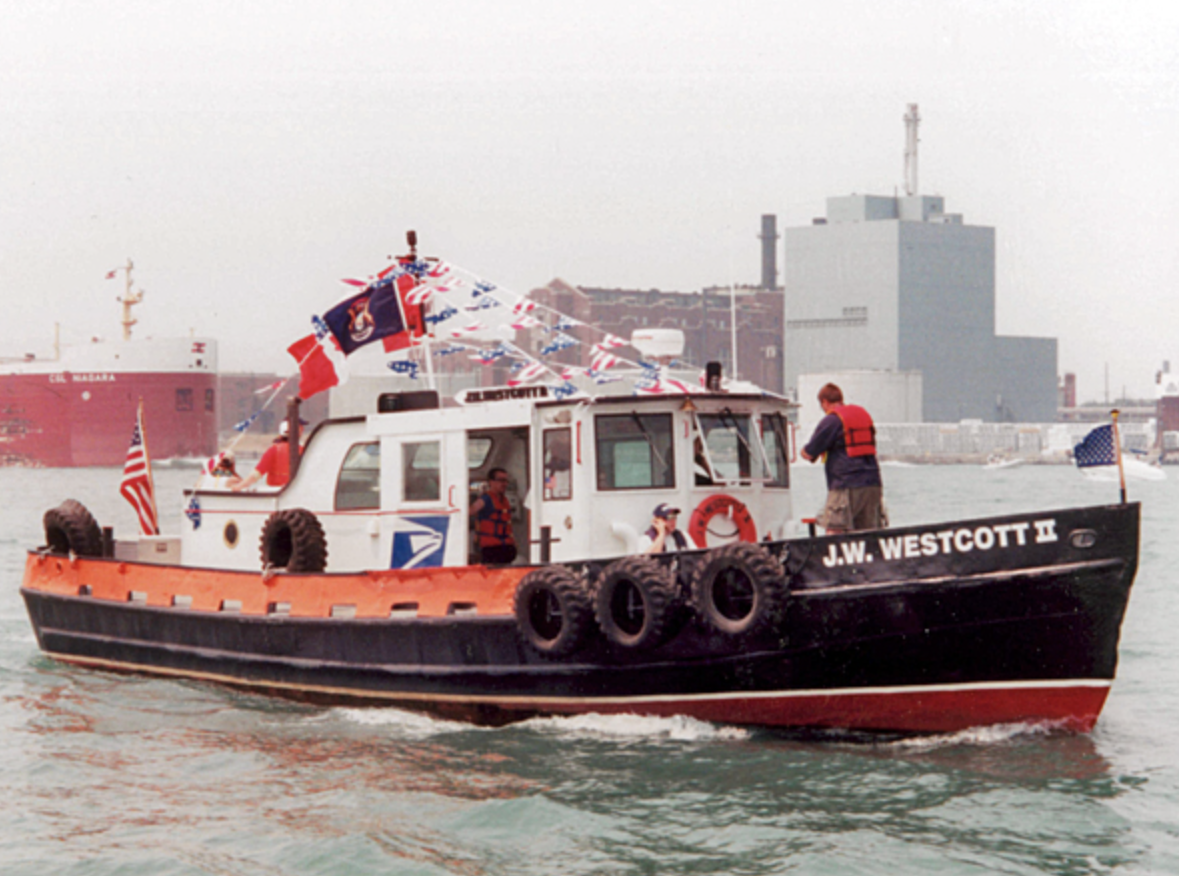
The J.W. Westcott Co. and its flagship vessel, the J.W. Westcott II, runs deliveries of mail, packages, supplies and crew to lake vessels passing through the narrow passage, allowing commerce to flow smoothly and keeping crews connected to the mainland. Jim Hogan, company president, is proud that the maritime firm has continued the service that his great-grandfather, John Ward Westcott, established in 1874.
While the company has built its reputation around deliveries by water and land, it’s the mail service for which it may be the most well-known. And it’s the way the mail is delivered that remains unchanged over the years: in a pail hauled up by a rope. The practice is known as “pail mail.” High-tech it’s not.
Since 1948 the company has held the government contract for postal services — originally with the U.S. Post Office Department and since 1971 with the renamed U.S. Postal Service — on the river. The J.W. Westcott II is the only nonmilitary ship to have its own ZIP code: 48222. “We are the longest-serving contractor in continuing service with the Postal Service,” Hogan said.
The company is among several featured in a temporary exhibit at the National Museum of the Great Lakes in Toledo through Aug. 14. The exhibit, “By the Pail: J.W. Westcott and Great Lakes Service Vessels,” offers a look at the many service vessels on the Great Lakes since the 19th century. The most well-known is the Westcott firm. The exhibit reviews how, beginning in 1895, at least three predecessors delivered mail on the Detroit River prior to Westcott. But none has served as long as the J.W. Westcott II, which has been on the job for more than 70 years.
The company commissioned Paasch Marine Service of Erie, Pennsylvania, to construct it in 1949. It is named in honor of the company’s founder. Hogan is the fourth generation of his family to run the company. It operates its ships from early April to late December, closing down each year just before Christmas.
Today, the Westcott II meets as many as 20 or so vessels a day. The 45-foot ship leaves the company dock along the river on a more or less perpendicular route toward a cargo vessel seeking its service, only to pull up and then travel parallel to it, matching its speed.
Large packages are hoisted via rope. Smaller items, like mail, are placed in a pail. Crew exchanges occur via a ladder. An exchange takes just a few minutes.
Since Hogan joined the firm in 1974 he has adapted the company’s services to meet changing needs. Deliveries today include those for online-ordered goods, groceries, parts and supplies and food from local restaurants for a change of pace for the crews.
He said the nature of the service business has changed, with fewer ships on the Great Lakes because of the prevalence of larger vessels including the mammoth 1,000 footers. But Hogan has managed to keep the business competitive and is preparing his son, Jimmy, vice president, to eventually become the fifth generation to oversee operations.
The exhibit is located in a room near the museum gift shop. It includes artifacts from service vessels, explanatory banners examining their history and even a small collection of collector-inspired covers developed by the Motor City Stamp and Cover Club bearing pictorial postmarks that mark the opening and closing of shipping seasons.
More information, including hours of operation and entrances fees, can be found online at nmgl.org.
The Chronicle
The Boblo boats still exist and a documentary about them is hitting theaters
DETROIT, MI – The roller coasters gave their last thrills and the historic ferries gave their last rides to and from the island amusement park nearly 30 years ago. A documentary is now set to hit theaters looking at the history of Boblo Island amusement park and the two oldest surviving passenger steamboats in the U.S.
“Boblo Boats: A Detroit Ferry Tale,” will be in select Michigan theaters this September. The film is narrated from the perspective of the SS Columbia, one of the Boblo boats, and follows the efforts to save her sister ship, the S.S. Ste Claire. Motown legend, Martha Reeves, voices the Columbia in the movie.
“Boblo Island and the boats that took us there hold a special place in the hearts of many metro Detroiters, but this isn’t just a nostalgia exercise,” said the Freep Film Festival’s artistic director, Kathy Kieliszewski. “This film is about now and the people dedicated to preserving history and memories despite some extreme hurdles.”
The restoration team has completed rebuilding the first three decks which fire destroyed. The rest of the structure is expected to be completed by the end of this year. As for the SS Columbia, it’s currently owned by a New York-based nonprofit which is restoring the ferry into a traveling museum and event space in Buffalo. Read more on those restoration efforts here.
“Boblo Boats: A Detroit Ferry Tale” opens in select Detroit area theaters on September 16 and will expand to more locations in the following weeks.
The film will also have an extended run at The Mariner theater in Marine City where it will be accompanied by a special Boblo museum exhibit for the entire month of September.
To view the trailer click on this link: https://www.youtube.com/watch?v=WBNQruzxkNI
MLive