New Lock project on schedule, if funding keeps flowing
The New Lock project in Sault Michigan will be completed and open to shipping in 2030 as long as U.S. federal government funding keeps flowing in a timely manner to the crucial megaproject.
Officials from the U.S. Army Corps of Engineers Detroit District’s New Lock at the Soo project brought stakeholders and the media up to date on the project in a webinar held Tuesday. The U.S. government approved the New Lock project in America’s Water Infrastructure Act of 2018.
The New Lock at the Soo project is being built in three phases:
- Phase 1 – upstream approach channel deepening to accommodate larger ships passing through the new lock (2018-2021)
- Phase 2 – construction of new upstream approach walls and related infrastructure (2021-2024)
- Phase 3 – Construction of the new lock (2023-2028)
Phase 2 is 95 per cent complete. Phase 3 — construction of the New Lock — got underway in July 2022 and crews are busily working as project officials continue to rely on U.S. government funding to complete the project.
Construction work in 2024 has focused on dewatering the construction site, electrical work, constructing a new bridge to a new power plant, demolition of the old Sabin Lock, filling up the old Davis Lock chamber and excavating bedrock in order to start pouring concrete for the new lock’s walls this fall, officials said Tuesday.
The site’s MacArthur Lock is still operational and can accommodate smaller vessels but only the Poe Lock is able to accommodate the 1,000-foot-long ships that transport millions of tons of iron ore from mines in Minnesota and northern Michigan to steel mills along the Great Lakes.
Crews are actively trying to keep the Poe Lock running while the new lock is being constructed.
“The Poe Lock is currently operating on borrowed time. It’s a 55-year-old lock with a 50-year lifespan and it’s the Achilles Heel of our nation’s supply chain of iron ore,” said Mollie Mahoney, New Lock project manager, at Tuesday’s webinar.
“It’s estimated that within a two-to-six-week unscheduled outage of the Poe Lock, 75 per cent of our nation’s high-strength steel production would cease. That would shut down automobile, appliance and heavy equipment manufacturing across our entire nation. A six-month unscheduled outage would result in 11 million jobs lost and a $1.1 trillion economic impact,” Mahoney said.
Maintenance work on the Poe Lock will continue into 2025, including replacement of some of its components, officials said.
The New Lock at the Soo is being built where the Sabin Lock once was and will be the same size as the Poe Lock (1,200 feet long, 110 feet wide and 32 feet deep).
The New Lock project has been funded in the amount of $1.967 billion (USD) to date.
Officials say that despite the entire New Lock project having been approved there are several rounds of waiting on bundles of government funding to be okayed by Congress in order for the project to be done by 2030.
“The next step really is to continue to work through the budgeting process which is an appropriations process in Congress,” said Kevin McDaniels, U.S. Army Corps of Engineers Detroit District deputy engineer.
“Both the House and the Senate have committees that work on those and there’s also a President’s budget. The President submits a budget, makes its way over to Congress, both the House and the Senate will do an appropriations bill and eventually go to conference to seek resolutions of those. Really at this stage of the game there’s no more authorization needed, it’s just going through competing with all the other priority projects across the country,” McDaniels said.
While $1.967 billion has been approved so far, McDaniels estimated the final price tag for the New Lock will be around $3 billion (USD).
“Estimates are good at one specific point in time but we do think that if we were to find additional (Congressional) funding our current cost estimate would probably be a little bit under the $3 billion mark. At this point in time we’re looking at, if we stay on track, probably in the $2.9 billion range,” McDaniels told SooToday.
The existing Poe Lock will continue to operate alongside the new lock long-term after the New Lock opens, McDaniels said.
Soo Today
Register now for 411-mile Great Lakes relay swim on ill-fated Edmund Fitzgerald route
SAULT STE. MARIE, MI – Registration is now open for a relay swim event that will mark the 50th anniversary of the tragic shipwreck of the Edmund Fitzgerald. Open water swimmers are invited to participate in the Edmund Fitzgerald Memorial Swim on July 26, 2025.
The 17-stage, 411-mile relay swim begins in Lake Superior, where the shipwreck lies, and ends in Detroit, the ship’s intended destination. The event will be the subject of a documentary film.
Seventeen teams of 4 relay swimmers each will symbolically complete the ship’s intended route and cargo delivery. Iron ore pellets – which come from the same dock in Superior, Wis., where the ship took on its last load – will be passed between the participants and delivered to dignitaries in Detroit.
The event is organized by Jim Dreyer, who is known for swimming across all five Great Lakes.
“The Edmund Fitzgerald Memorial Swim presents epic, once-in-a-lifetime experiences for up to 68 swimmers to be part of history, play a role in a documentary film, and swim where no one has ever swum before and may never swim again,” Dreyer said.
The swim is tentatively planned to begin at the Edmund Fitzgerald shipwreck site, starting with a memorial ceremony. It will conclude at Belle Isle in Detroit where dignitaries will receive the iron ore pellets. The bell at the Mariners’ Church of Detroit will then ring 29 times – once for each man who died aboard the ship – just as it did 50 years before.
Participants will swim the St. Marys River, the entire length of the St. Clair River, and across the open waters of Whitefish Bay, Lake Huron between Michigan’s upper and lower peninsulas, the mouth of Saginaw Bay, and Lake St. Clair.
Swimmers will raise funds for the Great Lakes Shipwreck Historical Society (GLSHS) to preserve the Whitefish Point Light Station.
“The Edmund Fitzgerald has come to represent, in many ways, shipwrecks in general on the Great Lakes, and the Whitefish Point Light is the most important beacon for all vessels entering or leaving Lake Superior,” said Bruce Lynn, GLSHS executive director. “Preserving the legacy of the 29 men who lost their lives in this historic maritime tragedy and helping to preserve a lighthouse that safeguards mariners along Lake Superior’s ‘Shipwreck Coast,’ are causes the swimmers can really rally around while they are themselves making history.”
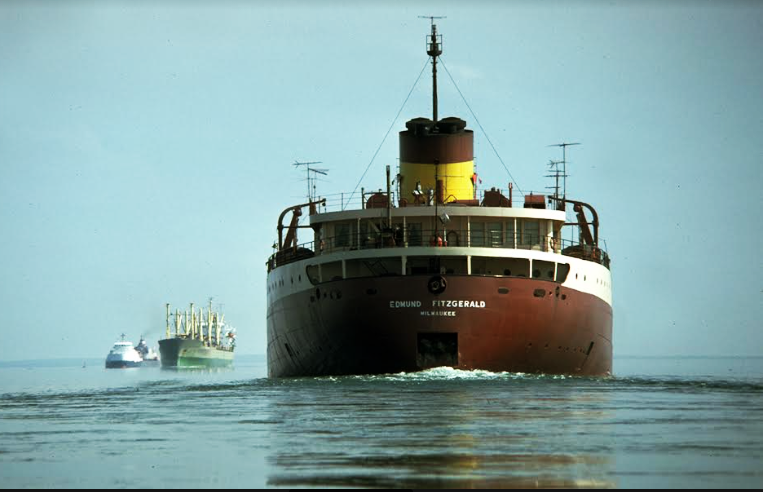
The 729-foot Edmund Fitzgerald was bound for Detroit carrying over 26,000 long tons of iron ore when the ship went down in a violent Lake Superior storm on Nov. 10, 1975. All 29 crew members died in the wreck. The ship lies in Canadian waters, 17 miles north-northwest of Whitefish Point.
M Live