Mark W. Barker embarks on maiden voyage
STURGEON BAY, WI – Nearly three years after the first cut of steel for the first Great Lakes freighter in nearly 40 years, the 639-foot M/V Mark W. Barker embarked on her maiden voyage Wednesday from Fincantieri Bay Shipbuilding.
“This is a monumental day for our company and the US flag fleet as our much-anticipated freighter departs on her first voyage in what will be a long life of service on the Great Lakes,” says Mark W. Barker, President of The Interlake Steamship Company and namesake of the vessel – the company’s first new build since 1981. “The construction of this vessel, which was made from steel manufactured in Indiana, from iron ore delivered by vessel from Minnesota, reinforces our long-term commitment to shipping and delivering essential cargoes for our customers throughout the region.”
The M/V Mark W. Barker departed the Sturgeon Bay, Wisconsin shipyard at 10:36 central time for her 110-mile journey to Port Inland, Michigan where her crew of 21 professional mariners will load stone to deliver to Muskegon, Michigan. Once delivered, that stone cargo will go into ready-mix concrete production.
“This new vessel not only brings with it additional cargo carrying capacity and capabilities, it is the most versatile in our fleet and strategically sized to navigate into nearly any port on the Great Lakes,” says Brendan P. O’Connor, Vice President of Marketing and Marine Traffic. “The M/V Mark W. Barker will give us unmatched ability for cargo operations and to carry unique project cargoes because of both her square-shaped cargo hold and larger hatch openings. She truly was designed to be a vessel for the future.”
Under construction since August 2019, the M/V Mark W. Barker was built by hundreds of dedicated workers at the Sturgeon Bay, Wisconsin, shipyard.
“We couldn’t be prouder to add this skillfully constructed vessel to our growing Interlake fleet,” says Barker, who was at the shipyard this week to personally wish the best to the ship’s crew fitting out the new vessel. “It has been genuinely inspiring to see the dedication and workmanship from all of those involved in this multi-year project, from the design, construction, final outfitting and successful sea trials. We are thrilled to add our newest US-crewed, US-built and US-owned vessel to the Great Lakes fleet.”
ABOUT THE M/V MARK W. BARKER The new River-Class, self-unloading bulk carrier is believed to be the first ship for U.S. Great Lakes service built on the Great Lakes since 1983. Measuring 639 feet in length (78 feet W, 45 feet H, 28,000 DWT), the ship will transport raw materials such as salt, iron ore, and stone to support manufacturing throughout the Great Lakes region.
View Interlake’s video on the Mark W. Barker here: https://www.youtube.com/watch?v=dRoc_rdnCtg
Interlake Steamship Co.
MacArthur Lock at the Soo out of service
The MacArthur Lock at Sault Ste. Marie, which experienced a mechanical failure earlier this week,is not expected to reopen until Friday at the earliest, although vessel captains were being advised by the Lockmaster the closure might last until early next week. With the Mac out of service and only one lock in operation, traffic backups have been frequent, resulting in some long delays for freighters and tour boats. The Canadian lock has been closed to tour boats since last year due to Canada’s COVID protocols.
Oil sensors sound all clear after oil spill
SAULT STE. MARIE – The call went out after a 5,300-gallon (20,062 litre) oil spill on June 9 at Algoma Steel. Responders needed an almost instantaneous awareness of how well containment and clean-up efforts were going.
The conventional way of tracking still entails a “boots on the ground” approach of manual sampling along the shore or from a boat.
Was there anyone with an automatic, continuous way of monitoring?
As it happened, Lake Superior State University’s Center for Freshwater Research and Education (CFRE) was evaluating oil-detection sensors that sell for a fraction of the cost of conventional ones.
So, along with LimnoTech, a company that markets the sensors, within a day after the call went out, CFRE technicians placed three along the north shore of Sugar Island and one further downstream in Lake Muncoscong.
The good news is that none of the sensors detected oil in their area after the spill, and as of the end of July, continue not to see hydrocarbon signatures of anything that would linger.
Read the full article here: https://www.sootoday.com/local-news/oil-sensors-sound-all-clear-after-oil-spill-5627869
Soo Today
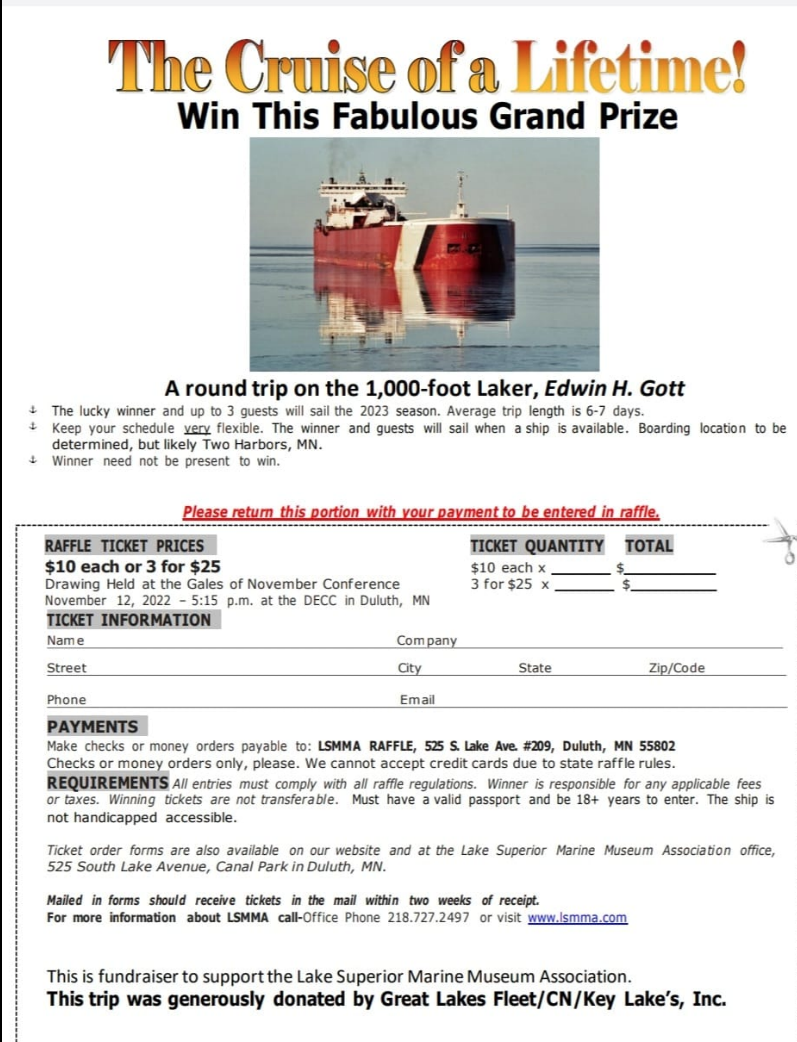
Enter to win the trip of a lifetime
View our gallery section to learn more on how to enter a raffle with the grand prize being a trip aboard the M/V Edwin H. Gott.