Master alone on bridge when bulker grounded while leaving dock
Professional Mariner StaffJuly 23, 2024
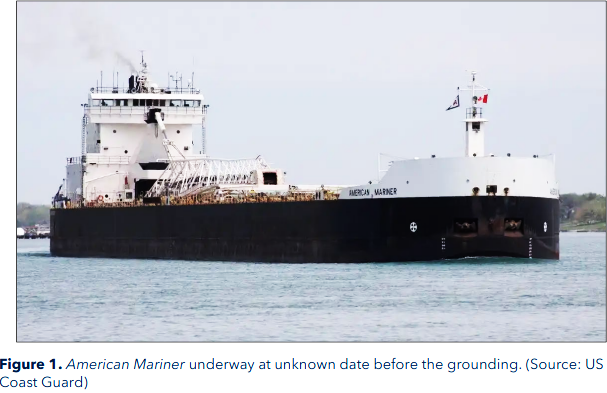
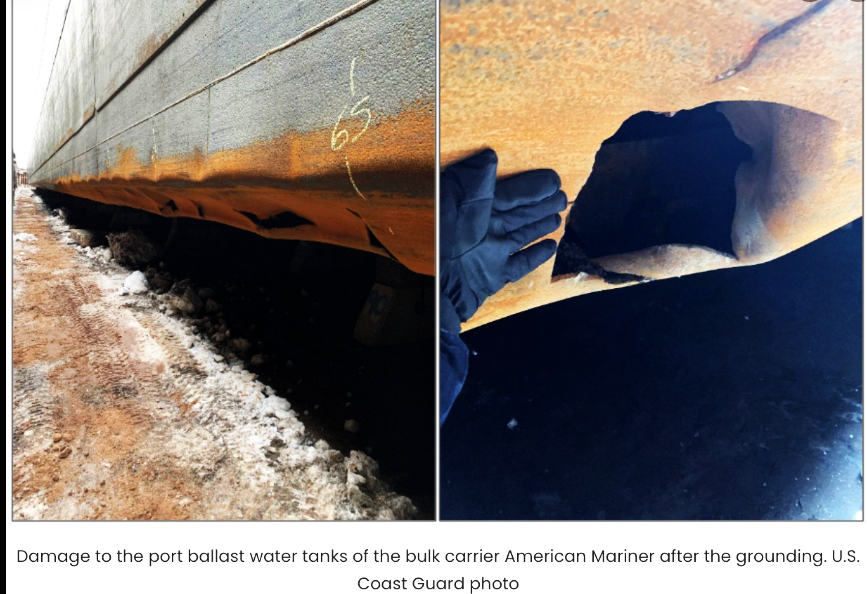
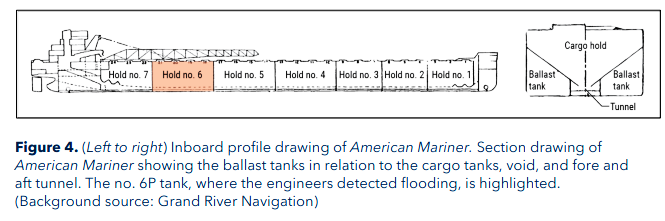
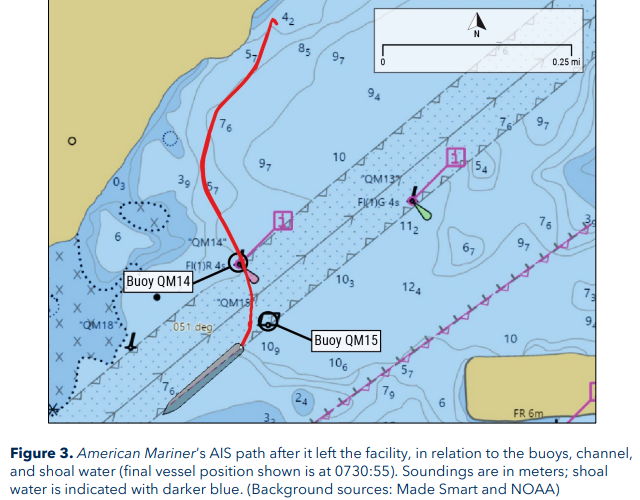
(WASHINGTON) — The bulk carrier American Mariner was leaving a dock near Sault Ste. Marie, Ontario, last year when the master — acting alone on the bridge during complicated maneuvers — overshot a turn and grounded on shoals, damaging three ballast water tanks, the National Transportation Safety Board (NTSB) reported Tuesday.
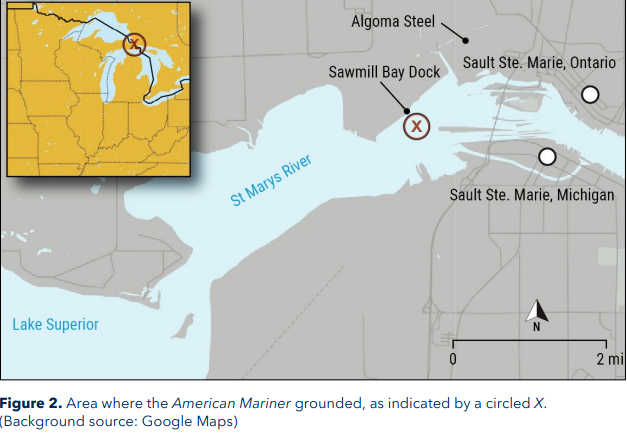
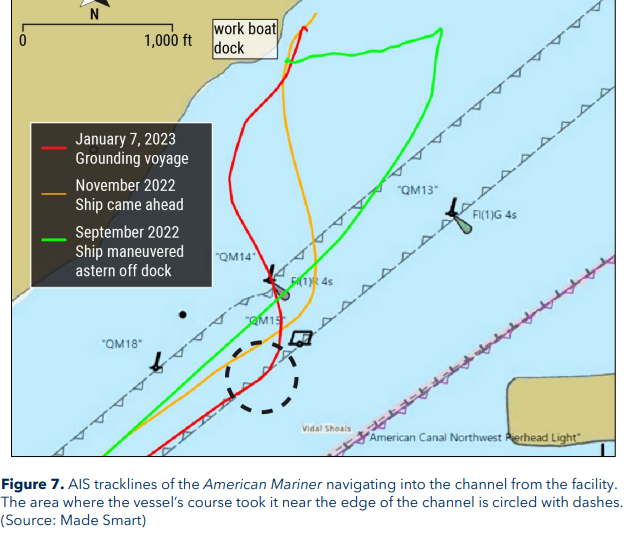
The vessel was heading outbound in the Vidal Shoals Channel en route to Superior, Wis., when it grounded on Jan. 7, 2023. NTSB investigators found that the master of the vessel was alone on the bridge at the time. Other factors compromising the master’s ability to successfully navigate the vessel included transiting in the dark, unlit channel buoys, and not using all available features in the electronic chart system.
Damage to the port ballast water tanks of the bulk carrier American Mariner after the grounding. U.S. Coast Guard photo
The NTSB found that the master’s initial angle of departure from the dock and close approach to the shoal water positioned the vessel at a poor angle to successfully maneuver into the channel, which resulted in the vessel overshooting the turn and grounding on the opposite side of the channel. The grounding resulted in $600,000 of damage to the vessel. No pollution or injuries were reported.
“While maneuvering in confined waters, it is difficult for a single bridge crewmember to effectively drive, look out and monitor and use available bridge equipment,” the report said. “Owners, operators and vessel masters are responsible for ensuring that vessel bridge teams are staffed with a sufficient number of certificated/credentialed mariners who are familiar with all bridge navigation equipment and able to independently take immediate action.”
Click here to read the complete report: Grounding of the Bulk Carrier American Mariner (ntsb.gov)
– National Transportation Safety Board
Toronto to explore “relief” vessels to ease Islands ferry lineups
Jon Woodward
CTV News Toronto Videojournalist
Published July 28, 2024 1:47 p.m. CDT
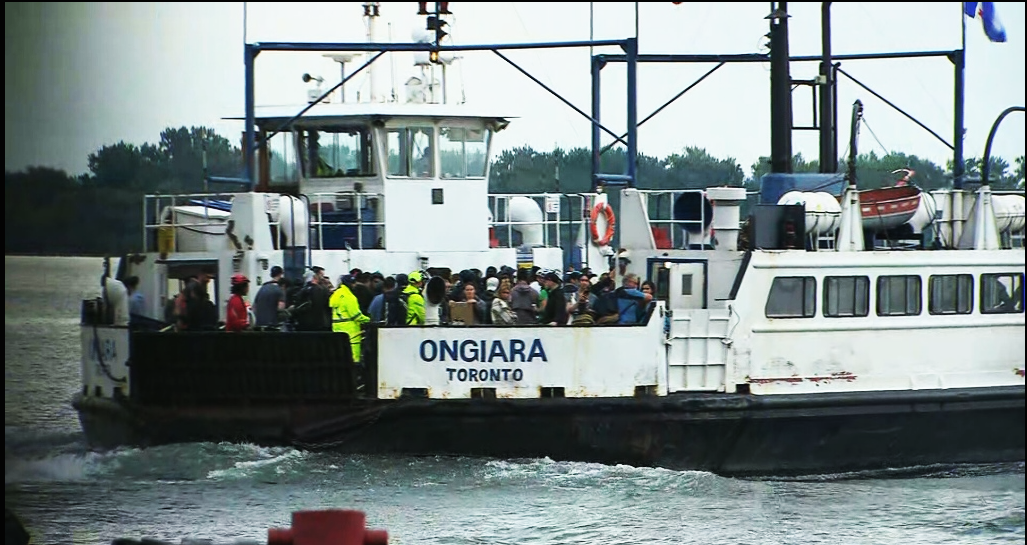
As the city of Toronto waits for delivery of two new electric ferries to ease long lines at the ferry terminal to the Toronto Islands, city staff have now been tasked with finding “relief ferries” to tackle congestion in the meantime.
Mayor Olivia Chow said she’s not sure the best way to get the vessels in place, but said that it’s important to find a solution for ferry lineups which in some cases have stretched from the Jack Layton Ferry Terminal to around the front of the Westin Hotel.
“My motion is to say, “Hey, why don’t we see if we could lease, rent, something in between now and the end of 2026 to get people over to the islands,” Chow told council on Thursday as she advanced a motion to find other vessels.
The motion came as Toronto approved the purchase of two new electric ferries to carry people to the Toronto Islands at a cost of $92 million.
The boats will replace aging ferries that have been in service for between 61 and 114 years. They will be built in Romania by Damen Shipyards Galati.
They’re expected to be delivered in late 2026 to early 2027. City council heard they will take six minutes to charge, can travel four times across the harbour without charging, will save hundreds of thousands of dollars a year on fuel and will increase the capacity of 1,000 passengers per trip for the passenger vessel.
Similar vessels ordered from the same company to Kingston to serve the Kingston-Wolfe Island route have been out of service, but council heard that’s because the charging infrastructure on that route hasn’t yet been built.
Councillor Paula Fletcher urged the city to ensure the chargers are in place for when the vessels arrive. She said another option that is being explored for easier access to the islands, a bridge, would interfere with commercial shipping.
“I’ve done the numbers as far as the number of ships that travel there. There are 200. Economic-wise, let’s put that puppy to bed right now,” she said.
Another motion, proposed by Deputy Mayor Ausma Malik, directed city staff to find new ways of offering tickets to the ferries, including linking it to the regional’s transit payment system, the Presto Card.