Divers find 13-foot crack in hull of Great Lakes ship
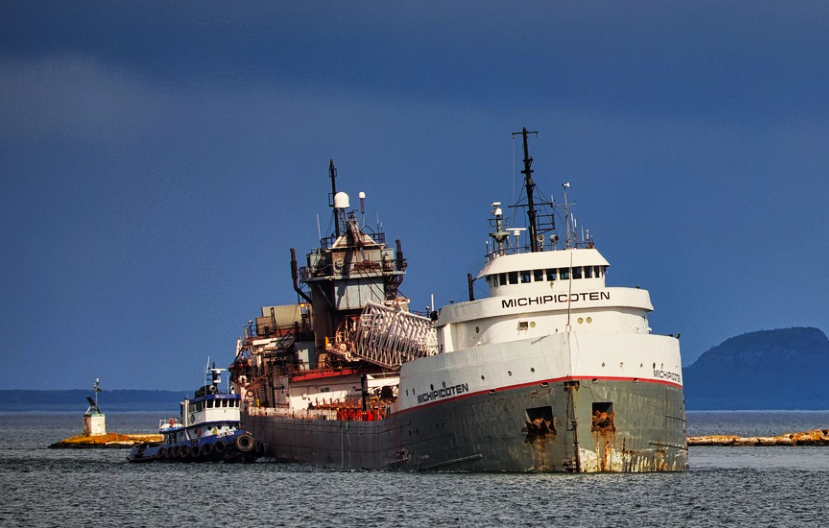
THUNDER BAY — A massive crack has been found in the hull of the Michipicoten, the ship that limped into Thunder Bay on the weekend after water started pouring into it on Lake Superior.
Divers have found a four-metre-long crack during an underwater inspection conducted at Keefer Terminal, where the vessel is now tied up.
“This appears to be a result of fatigue/structural failure,” a spokesperson for the Transportation Safety Board of Canada told TBnewswatch in an email Monday.
In an interview with TBnewswatch, US Coast Guard spokesperson Lorne Thomas said the rupture is from “the turn of the bilge, which is where the side shell turns to the bottom plate. A 13-foot-long crack was detected by the divers, which is clearly indicative of a hull failure.”
Thomas said a loud bang the ship’s crew reported hearing while the vessel was in deep water likely happened at the time of the hull failure.
“It looks like a hull failure, which could be the result of stress, fatigue, age of the vessel,” he said, but cautioned that a full investigation is needed to determine the cause for certain.
“The investigation will look at the entire transit from where the vessel originated its voyage, and to see if there’s a possibility that another event, like striking a submerged object, or running aground, initiated that hull failure which eventually completely failed out in the middle of Lake Superior.”
He added “there’s no indication” at present that the ship struck something first, but that Canadian and US authorities will certainly look at that possibility.
“We won’t definitively know if an event preceded the hull failure until the investigation is complete, and a big part of that is gonna be when the vessel gets up on dry dock, they offload the cargo. de-water the vessel, and take a good look at the damage.”
Initially, Thomas said, Transport Canada and the US Coast Guard contemplated separate investigations, but they are now discussing a cooperative probe in which Canadian officials would take the lead.
The Michipicoten had picked up a cargo of iron ore pellets for Algoma Steel at Two Harbors, Minnesota and was en route to Sault Ste. Marie on Saturday morning when the incident occurred.
At one point it was listing by 15 degrees before pumps alleviated the flooding.
Half the 22-person crew was taken off the 698-foot vessel but it was successfully escorted into Thunder Bay harbor and docked at Keefer Terminal.
TBnewswatch reached out to Lower Lakes Towing of Port Dover, Ontario the subsidiary of U.S.-based Rand Logistics which owns the ship, but was told the company has no statement to make at this time, as it is still assessing the situation.
According to information posted by Rand Logistics, the Michipicoten was launched in 1952, but underwent multiple modifications over the following years. In 1957 it was lengthened by 72 feet, and in 1980 it was converted to a self-unloader to prolong its life. Thirty years later, it was converted from steam power and oil-fired boilers to diesel propulsion.
Chris Heikkinen, CEO of the Thunder Bay Port Authority, said arrangements have been made for the vessel to remain at Keefer for as long as necessary. Heikkinen said it’s not uncommon for ships to require emergency repairs, which is why the port authority maintains a vacant berth at Keefer.
He noted “the great binational effort” into ensuring the safety of the Michipicoten and its crew “because obviously that’s the number one priority, and everyone made it back to shore safe and sound. So we’re just really thrilled with that outcome, and happy to have played a small role.”
TBNewswatch
Grain volumes increasing on St Lawrence Seaway
Grain Brokers Australia, Peter McMeekin, June 11, 2024
Thunder Bay, Ontario, is one of the ports that loads Canadian grain making its way to export customers via the Great Lakes St Lawrence Seaway. Photo: Michael Hull
THE 66th navigation season on the Great Lakes St Lawrence Seaway system commenced on March 22, and early tonnage reports indicate a robust beginning. The world’s longest and most extensive bi-national waterway system has remained a vital deep-draft waterborne transportation link for the movement of goods between North America’s heartland and international markets since it opened in 1959.The waterway is a system of locks, canals, channels and lakes that permits oceangoing vessels to make the 3770km journey from the Atlantic Ocean west to the Great Lakes, as far inland as Duluth,Minnesota, at the western end of Lake Superior. The elevation gain from the Atlantic Ocean to Lake Superior is 183m, and ships can reach ports in all five of the Great Lakes via the Great Lakes Waterway.
The St Lawrence Seaway portion of the system extends from Montreal to the middle of Lake Erie and is named after the St Lawrence River which flows from Lake Ontario, downstream of the Great Lakes, to the Atlantic Ocean. The St Lawrence River section of the waterway is not a continuous canal; rather, it consists of several stretches of navigable channels within the river, a number of locks, and canals along the banks of the river to bypass a number of rapids and dams.
Managed jointly by the US Department of Transportation’s Great Lakes St Lawrence Seaway Development Corporation and the Canadian St Lawrence Seaway Management Corporation, the two collectively advertise the system as Highway H2O. A typical season runs for about nine months from late March to late December each year.
The marine highway currently supports almost 360,000 jobs and contributes around US$47 billion to the economic activity between Canada and the US. It offers shippers direct access to North America’s commercial, industrial and agricultural heartland, a market of over 150 million people and a vast network of more than 40 ports, many of which have critical intermodal connections.
The Great Lakes St Lawrence Seaway System is serviced by a variety of international and domestic vessels that contribute to the efficiency of the waterway. These include multi-purpose oceangoing vessels, often referred to as “salties”, tug and barge units, and a specialised lake fleet, referred to as “lakers”, many of which are equipped with self-unloading devices. It takes the average vessel around 8.5 sailing days to navigate the entire length to open sea.
Vessel size limited
The channels and locks are currently the limiting factor for vessel size, being a maximum of 225.5m in length, a maximum beam (width) of 23.8m and a draft of no more than 8.08m. Each lock holds almost 80 million litres of water, equivalent to roughly 30 Olympic-sized swimming pools, and lockages require around 30 minutes from start to finish, regardless of direction. Proposals 20 years ago to modify the channels and locks to transit earlier generation panamax vessels met with strong environmentalist resistance and the cost was considered prohibitive.
Over 80pc of system traffic comprises bulk cargoes such as grains, iron ore, coal, chemicals and oil. Manufactured goods of all kinds, including finished and semi-finished steel products make up the rest of the seaway payloads. Since its opening, the St Lawrence Seaway has moved more than 2.5 billion tonnes of goods with an estimated value of around US$375 billion. Almost 25 percent of this cargo travelled to and from overseas ports, and ships from more than 50 nations call at Great Lakes and Seaway ports in Canada and the US each year.
Early spring traffic
Early fleet positioning due to unseasonably low winter-ice coverage on the Great Lakes jump-started new-season grain and potash traffic. Canadian and US grain shipments totalled approximately 1.21 million tonnes (Mt) to the end of April, an increase of 39,000t, or 3.32pc, compared to the previous corresponding period.
Similarly, potash traffic posted an increase of 83,000t, bringing the season-to-date total up to 110,000t. Potash, encompassing various potassium-rich minerals, is essential in fertilisers for enhancing plant growth, crop yield, disease resistance and plant water retention.
Grain exports out of the Canadian Port of Thunder Bay have been strong since Great Lakes navigation commenced this year, with 923,700t reportedly moved in May. That marked the second-highest monthly grain shipments of the past two years and compares with 899,100t in May 2023. A total of 2.07Mt of grain has moved through the port on the northern shores of Lake Superior since the season opened, up 14pc from the same time last year.
However, total cargo volumes in the first five weeks of new season operation fell by 379,000t, or 8.85pc compared to the same period in 2023. Total vessel transits fell by 2.04pc from 441 last year to 432 this year. Iron ore traffic saw the biggest fall, down 281,000t, or 34.27pc, to 539,000t.
Long 2023 season
In 2023, nearly 37.56Mt of cargo transited the bi-national system, representing an overall increase of more than 3.37pc from 2022. However, the total number of vessel transits across the season fell from 4008 to 3934, meaning that the average cargo size increased by 5.33pc from 9065t to 9548t. The 2023 Great Lakes St Lawrence Seaway shipping season was one of the longest on record, running from March 22 through to January 7.
At 10.5Mt, grain cargoes made up 27.9pc of total system movements, an increase of 500,000t, or 5.01pc compared to 2022. Wheat accounted for 6.5Mt, or 61.9pc of the total. This was 28pc higher year-on-year, with Canadian origin wheat making up just over 90pc of the wheat volume. Canola shipments were 6.5pc higher compared to 2022 at 666,464t. However, soybean shipments fell by 35.4pc at 1.5Mt, while corn movements dipped by 7.0pc at 1.4Mt.
Dry bulk cargoes, excluding iron ore and coal, were the biggest freight category at 12.32Mt, up 5.43pc from 11.69Mt in 2022. Iron ore shipments were up 1.93pc to 6.32Mt, and coal movements increased by 13.96pc to 2.02Mt.
St Lawrence Seaway tonnage statistics for the month of May are scheduled to be released within the next week and are expected to reveal a continuation of the positive trend exhibited in the early part of the 66th navigation season.
Make Your Plans Now for Soo
Boatnerd Picnic, Freighter-Chasing Cruise
Join us for the Annual Boatnerd Picnic and Freighter-Chasing Cruise on the St. Marys River during the annual Engineers Day weekend at Sault Ste. Marie June 27-38. Find details on both events here: https://boatnerd3.jasonbowlerdesign.com/boatnerd-soo-gathering-june-27-28-2024/