GREEN BAY – The Ocean Navigator cruise ship docked Wednesday morning at Leicht Memorial Park for the first of two daylong visits this year to the Green Bay area.
This is the second year in a row that American Queen Voyages cruise ships scheduled a stop in Green Bay where passengers will get the chance to check out the downtown’s shops, restaurants and the Farmers Market on Broadway. The visitors will have the chance to hop on a bus that will stop at some of the region’s popular attractions.
There are more than 70 passengers on the Ocean Navigator for this trip, and local tourism officials said visitors hail from California, Texas and Oregon, among other states.
The Ocean Navigator has space for up to 202 passengers and more than 80 crew members. The visit to Green Bay is part of a 14-day Great Lakes cruise that departed from Chicago and includes stops in Sturgeon Bay, Milwaukee; Mackinac Island, Michigan; Duluth, Minnesota; and Thunder Bay, Ontario.
The ship is expected to depart from Leicht Park at 7 a.m. Thursday.
Of course they’ll get a look at Lambeau Field, but what other Green Bay attractions will passengers see?
Discover Green Bay, the region’s tourism marketing agency, worked with C&M Presents, a destination management company, to offer bus service to and from popular destinations in the Green Bay area. The bus will make stops at the Neville Public Museum, The Automobile Gallery, Captains Walk Winery and the National Railroad Museum throughout the day.
And while there will be no tours of Lambeau Field, the bus route will take passengers past the home of the Green Bay Packers.
When will the Ocean Navigator return to Green Bay?
The ship is scheduled to return to Leicht park and the Port of Green Bay on June 28 and depart on June 29.
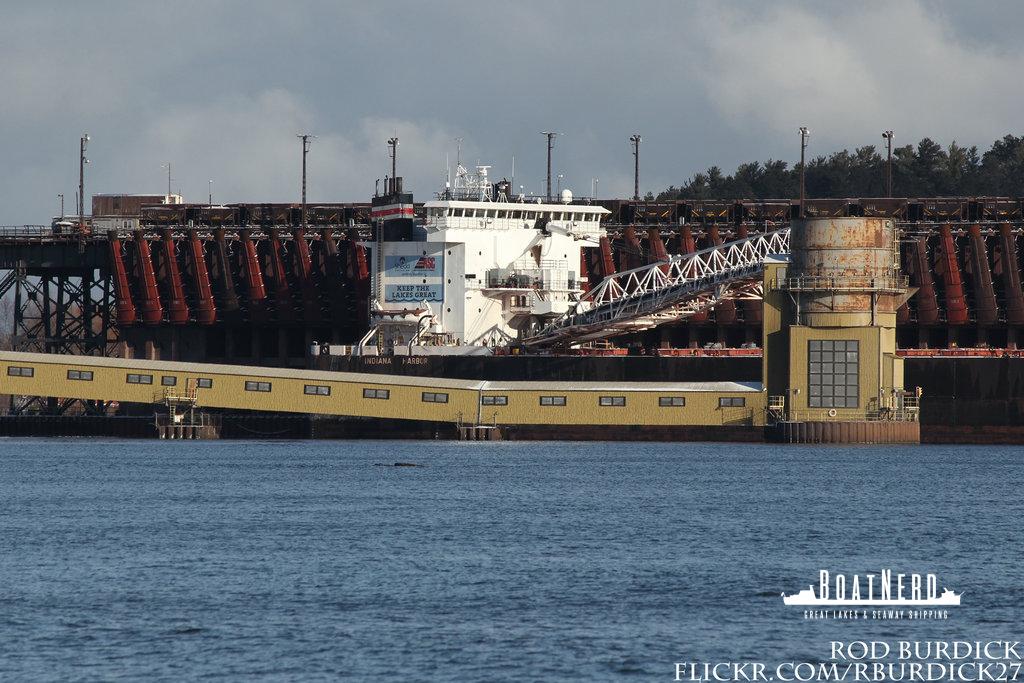
The overall activity established by US Great Lakes-Seaway shipping through the first month of the shipping season continued into May, with iron ore showing especially strong numbers. Iron ore traffic through the system was almost 1.6 million tonnes, an increase of 9.93% from the same period last year.
Overall, approximately 7.97 million tonnes of total cargo traffic have now transited the seaway system for the year to date, which is down slightly but consistent with the 8.2 million tonnes of cargo recorded for the same period in 2022. It should be noted that there has been significant variation in traffic across commodities and across ports, with some ports like The Port of Cleveland being especially busy.
“The Port of Cleveland has had an outstanding start to the year at our bulk terminal due to strong demand for iron ore from the Cleveland Cliffs steel mill. This again justifies the significant recent investment in the extension of our ore tunnel, which has allowed us to mix ore on demand for delivery to the mill and increased the efficiency of our operation,” said David Gutheil, Chief Commercial Officer for The Port of Cleveland.
“At our general cargo terminal, we completed a 2-year project in May, which rebuilt and modernized three of our most used docks and berths,” he added. “Also included in the project was the introduction of a below ground system to filter and clean stormwater before it is introduced back into Lake Erie. We are now also in the design and planning phase of our next large project at the same terminal. This project will modernize our largest warehouse and introduce systems that will set up this warehouse as the electric hub of our port for the eventual transition from diesel to electric cargo handling equipment.”
“While the ebb and flow of economic fluctuations change the backdrop for trade over time, the constant is that Great Lakes/St. Lawrence shipping is always there to meet the needs of businesses and consumers,” said Bruce Burrows, President and CEO of the Chamber of Marine Commerce. “The enhancements at the Port of Cleveland are exemplary of the efforts of all chamber members to maintain a strong supply chain, and keep marine shipping foremost among all modes of cargo transit when it comes to capacity, reliability, efficiency, and sustainability.”
Lake Guardian begins annual research survey of Lake Huron
ALPENA — Residents of Alpena may have noticed a large ship docked in the Thunder Bay River by the 2nd Avenue bridge for about a week.
The vessel, named the Lake Guardian, departed Monday afternoon to start an annual mission to monitor and collect samples of trout, small organisms, and more in Lake Huron.
According to the U.S. Environmental Protection Agency, the Lake Guardian is the EPA’s largest research vessel and is participating this year in the EPA’s 40th annual spring and summer Great Lakes water quality survey of all five of Michigan’s Great Lakes.
A news release from the EPA indicates the Lake Guardian began this year’s survey in mid-April.
Researchers and scientists plan to stay on the ship for about three to four days to take their Lake Huron samples this week with the many labs and pieces of equipment on deck. According to the scientists, the group’s main mission is to analyze chemical contamination in plankton and bottom-dwellers to understand the contamination’s effect on the entire food web.
Those contaminants are older chemicals, also known as legacy contaminants, that may still remain in the air, sediment, and the water. As scientists continue to monitor levels of those contaminants, it gives the Great Lakes National Program Office — a branch of the EPA — a better idea of Lake Huron’s water quality.
Mike Milligan, a biochemistry professor at the State University of New York at Fredonia, is part of the team for the mission. He’s interested in seeing how contaminants cycle through life in the Great Lakes.
“Well, the small fish eat the plankton and small mysis, and the bigger fish eats the smaller fish,” Milligan said. “This continues, so on and so forth, then these contaminants come to us when we eat those fish. We need to see what they’re eating from the start.”
Some of the gear used to capture and collect samples of those organisms are simple concepts such as sleds and nets.
One piece of equipment on board is the benthic sled — a yellow metal sled fashioned with lights and two GoPro cameras so researchers can see what is on the bottom of the lake. It goes on the lake floor and grabs different organisms as the boat slowly moves across. Great Lakes National Program Office scientist Brian Lenell said the sled can obtain items like fauna and smaller creatures.
Megan O’Brien, a research participant of the Great Lakes National Program Office, explained that the vertical net is used for tiny creatures called mysis — small, shrimp-like crustaceans that live at the bottom of the lake.
As O’Brien and Lenell went further into the vessel, Lenell said that researchers and scientists like Milligan and Bernard Crimmins, research associate professor of Clarkson University, are funded through the Great Lakes Restoration Initiative. That fund goes through the EPA and brings researchers together to study, monitor, and bring attention to the Great Lakes.
“In addition to monitoring, there’s habitat restoration work,” O’Brien added. “There’s invasive species work, nutrient reduction work, storm runoff projects … Some of it is emerging contaminants, but, mostly, we study the contaminants that are well documented.”
The Lake Guardian has more than one dozen rooms filled with laboratories, living spaces, a lounge, and a kitchen. Fourteen crewmembers are on board from March to October and up to 28 other people can stay on the ship, totaling 42 passengers. Multiple graduate and undergraduate students of Clarkson University are also a part of the current mission for on-hand experience as scientists.
The research team also plans to stop by Port Austin and Rockport State Recreation Area as part of its mission.
Charlevoix Historical Society hosts shipwreck program on June 28
CHARLEVOIX — In conjunction with its upcoming exhibit “The Maritime History of Charlevoix,” the Charlevoix Historical Society will present the program “Documenting Shipwrecks of the Great Lakes” with special guest speaker Chris Roxburgh at 7 p.m. on Wednesday, June 28 at the historical society’s train depot, 305 Chicago Ave.
A renowned underwater photographer and author, Roxburgh has gained widespread recognition for his work capturing shipwrecks in the Great Lakes region. His photography and environmental efforts have been featured on local and national news platforms multiple times. He is the author of “Leelanau Underwater,” which showcases the shipwrecks along Lake Michigan’s treacherous Manitou Passage.
In addition to his artistic accomplishments, Roxburgh is actively working to raise awareness about the growing problem of plastics pollution in the Great Lakes.
Roxburgh’s underwater photography of the notorious Prohibition-era party boat “Keuka,” which sank half a mile east of Charlevoix’s Ferry Beach in 1932, will be featured in the society’s new exhibit, which opens in July.
The program will be presented at no charge, but contributions in support of the Charlevoix Historical Society are always appreciated. For more information, call (231) 547-0373.