Mesabi Miner returns to service after six-day absence
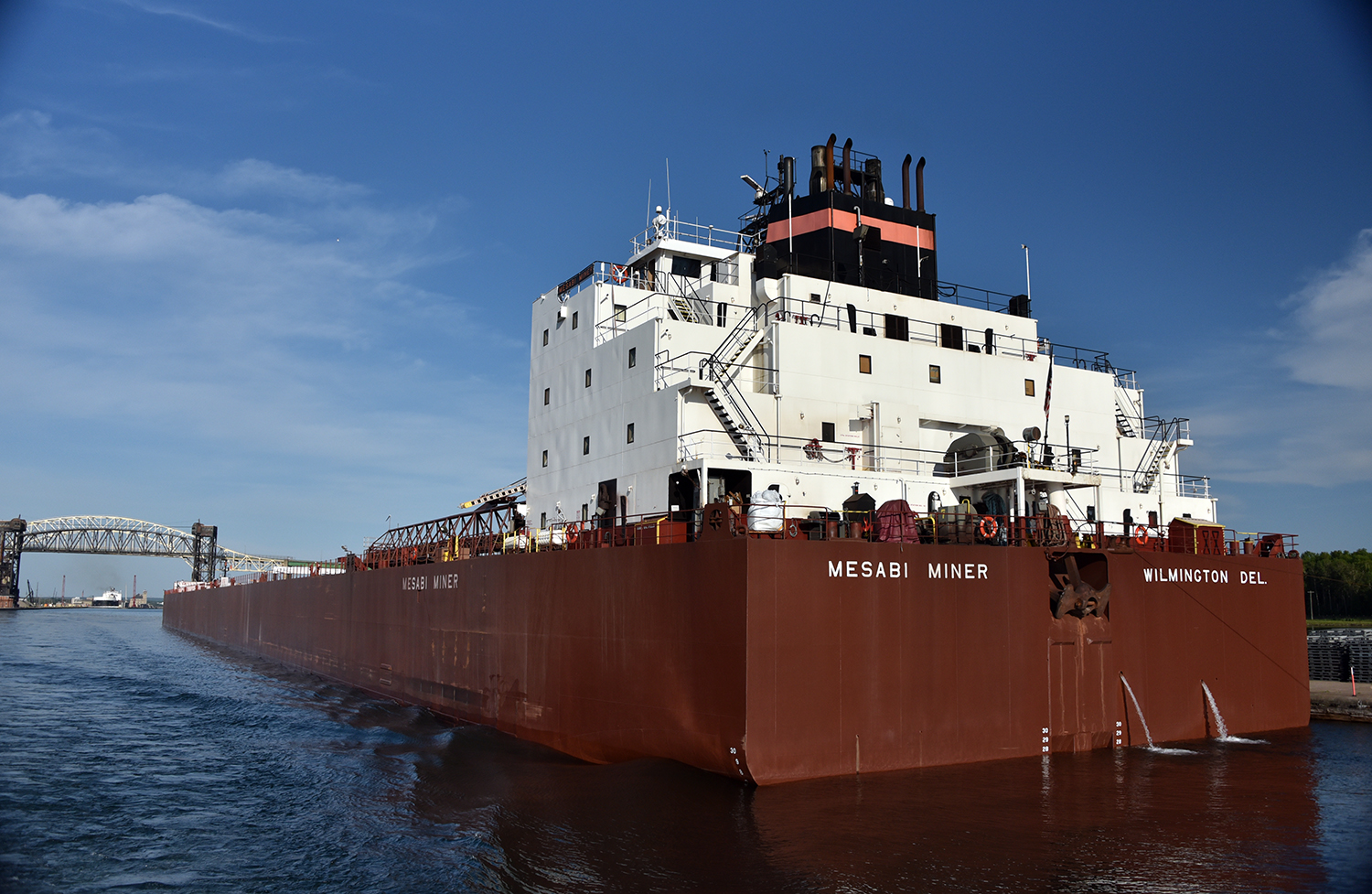
SAULT STE. MARIE, MI – On Sunday morning, Interlake Steamship Co.’s 1,004’ vessel Mesabi Miner unmoored from the West Pier of the Soo Locks and resumed its down bound trip to St. Clair, MI., following engine repairs.
On June 20th, the Mesabi Miner tied up at West Pier. The following day fleet mate James R. Barker tied up alongside the Miner’s port side and delivered engine parts. Seven days later the Miner would finally reach St. Clair.
‘A key part of our economic opportunity’: Great Lakes mayors united in call for a provincial marine strategy
They were there for a purpose, and it wasn’t to look at the ships passing by in the Welland Canal.
Walter Sendzik, mayor of St. Catharines and chair of the Great Lakes and St. Lawrence Cities Initiative, was joined by Port Colborne Mayor Bill Steele, Township of Tiny Mayor George Cornell, and marine industry representatives to announce they want to see the Ontario government develop a strategic, well-funded vision for the maritime industry in the province. “We urge the Province of Ontario to move forward on a marine strategy for our province,” said Sendzik. “It really is a key part of our economic opportunity”
The group represents more than 150 Great Lakes and St. Lawrence River mayors.
Steele said a marine strategy is “more than just a transportation initiative. “A strategy focused on supporting our maritime industry is relevant for international trade and community economic development, but it also has important ties to tourism and recreation as well as natural resources and the environment,” Steele said.
J. Wesley Newton, executive vice-president of strategy and business development for Algoma Central, said “we see the Great Lakes and Saint Lawrence Seaway as a jewel in our national infrastructure.” Newton said the lakes and seaway “allows industries and the Great Lakes region to compete internationally and export their goods to the world.”
He said the use of marine shipping “is more environmentally friendly than transport trucks”. “I would ask you to consider, with all the focus on carbon reductions in our world today and need to find immediate solutions, there’s a solution staring us in the face available today — it’s moving goods from other modes to the marine mode,” he said. According to Newton, for every ton you remove from a transport truck and ship on an Algoma Seaway Max Laker “we reduce carbon by 85 per cent”. “That’s nearly net-zero impact,” said Newton.
“We are extremely grateful for the Ontario government’s commitment to developing an Ontario marine strategy and we look forward to working with our industry and government colleagues on the details. Federal shipbuilding contracts represent a multi-billion-dollar opportunity for Ontario shipyards. An Ontario marine strategy will ensure Ontario is competitively positioned to capture this work and bring shipbuilding back to the province,” said.
Ted Kirkpatrick, director of business development and government relations, Heddle Shipyards, said Ontario “was a shipbuilding mecca in this country.”
He said, “in its heyday, the shipbuilding industry employed thousands of people across the province and supported hundreds of businesses in Ontario from communities like Port Colborne to Thunder Bay.”
Kirkpatrick said the federal government is offering a “generational opportunity” with the number of federal shipbuilding contracts available. An estimated 35 Canadian Coast Guard and Royal Canadian Navy vessels will be built over the next two decades, he said. “A marine strategy will ensure Ontario shipyards are positioned to execute on this one,” said Kirkpatrick.
According to the Chamber of Marine Commerce, the Great Lakes-St. Lawrence region is an economic powerhouse and the industrial heartland of both the United States and Canada. The chamber estimated the region has a combined GDP of over $6 trillion, making it the third largest economy in the world if it were a country.
The Great Lakes-St. Lawrence River waterway is the longest inland deep-draft navigation system in the world, connecting more than 110 commercial ports in Canada and the United States. Every year, ships deliver more than 230 million metric tons of cargo, worth over $100 billion on the Great Lakes-St. Lawrence waterway.
The Great Lakes and St. Lawrence Cities Initiative is a bi-national coalition of U.S. and Canadian mayors from more than 150 cities and municipalities working to advance the protection and restoration of the Great Lakes and St. Lawrence River.
The Star
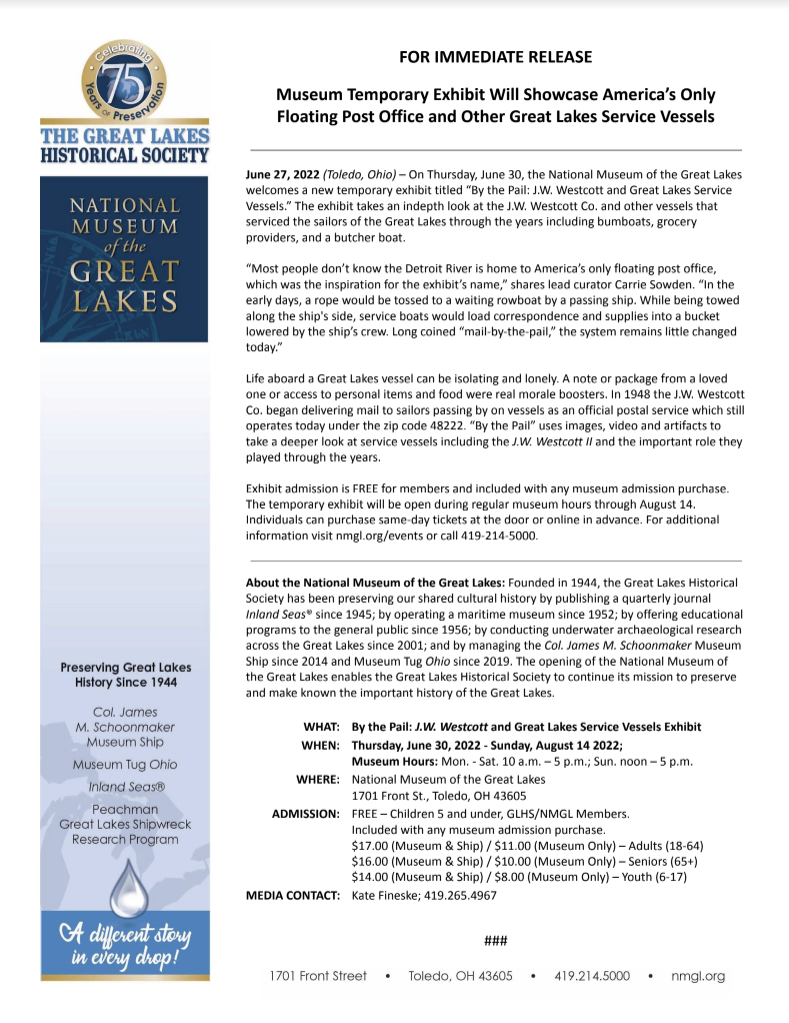
Museum temporary exhibit will showcase America’s only floating post office and other Great Lakes service vessels
TOLEDO, OH – On Thursday, June 30, the National Museum of the Great Lakes
welcomes a new temporary exhibit titled “By the Pail: J.W. Westcott and Great Lakes Service Vessels.” The exhibit takes an indepth look at the J.W. Westcott Co. and other vessels that serviced the sailors of the Great Lakes through the years including bumboats, grocery providers, and a butcher boat.
“Most people don’t know the Detroit River is home to America’s only floating post office, which was the inspiration for the exhibit’s name,” shares lead curator Carrie Sowden. “In the early days, a rope would be tossed to a waiting rowboat by a passing ship. While being towed along the ship’s side, service boats would load correspondence and supplies into a bucket lowered by the ship’s crew. Long coined “mail-by-the-pail,” the system remains little changed today.”
Life aboard a Great Lakes vessel can be isolating and lonely. A note or package from a loved one or access to personal items and food were real morale boosters. In 1948 the J.W. Westcott Co. began delivering mail to sailors passing by on vessels as an official postal service which still operates today under the zip code 48222. “By the Pail” uses images, video and artifacts to take a deeper look at service vessels including the J.W. Westcott II and the important role they played through the years.
Exhibit admission is FREE for members and included with any museum admission purchase. The temporary exhibit will be open during regular museum hours through August 14. Individuals can purchase same-day tickets at the door or online in advance. For additional information visit nmgl.org/events or call 419-214-5000.
National Museum of the Great Lakes