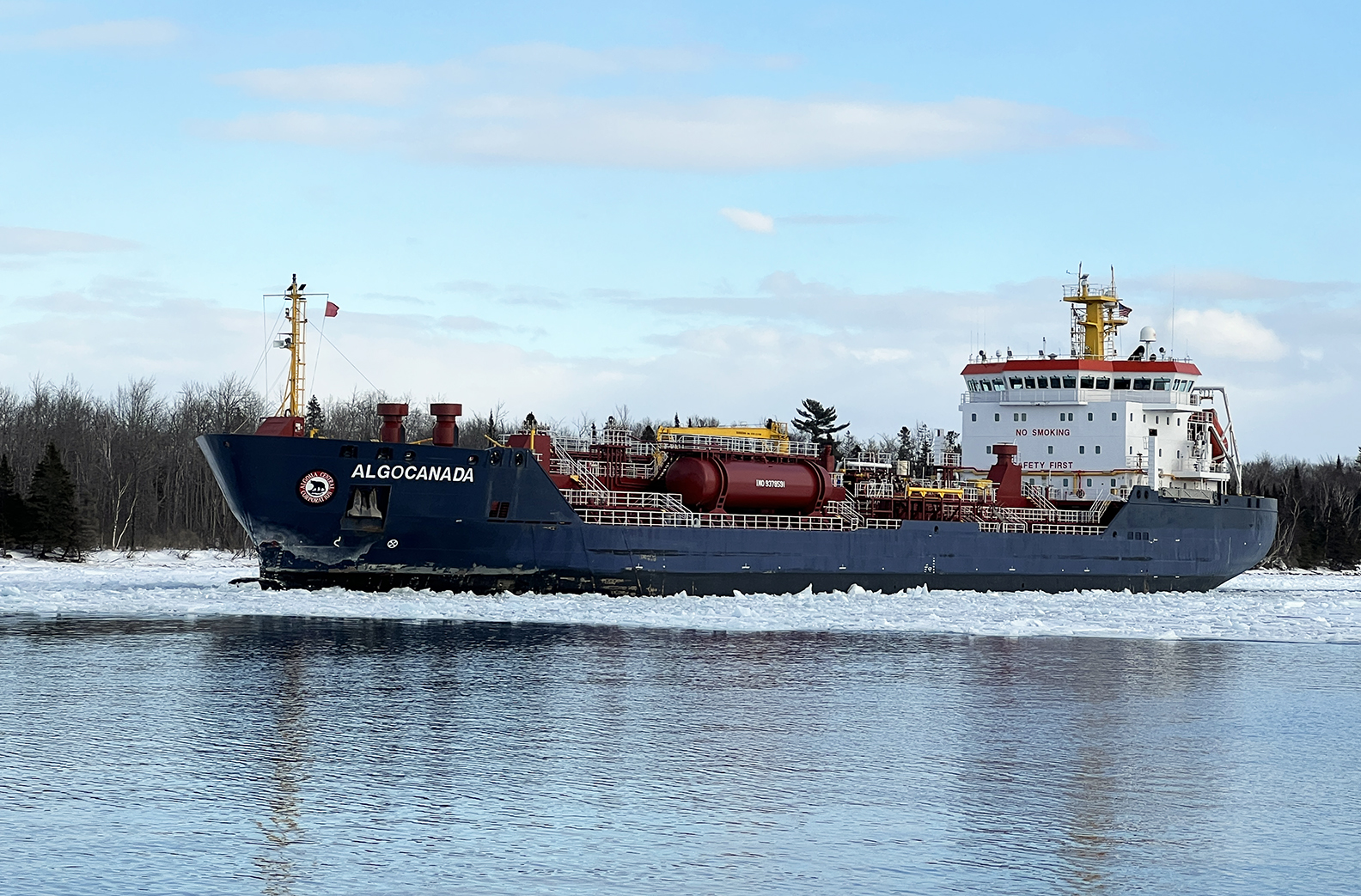
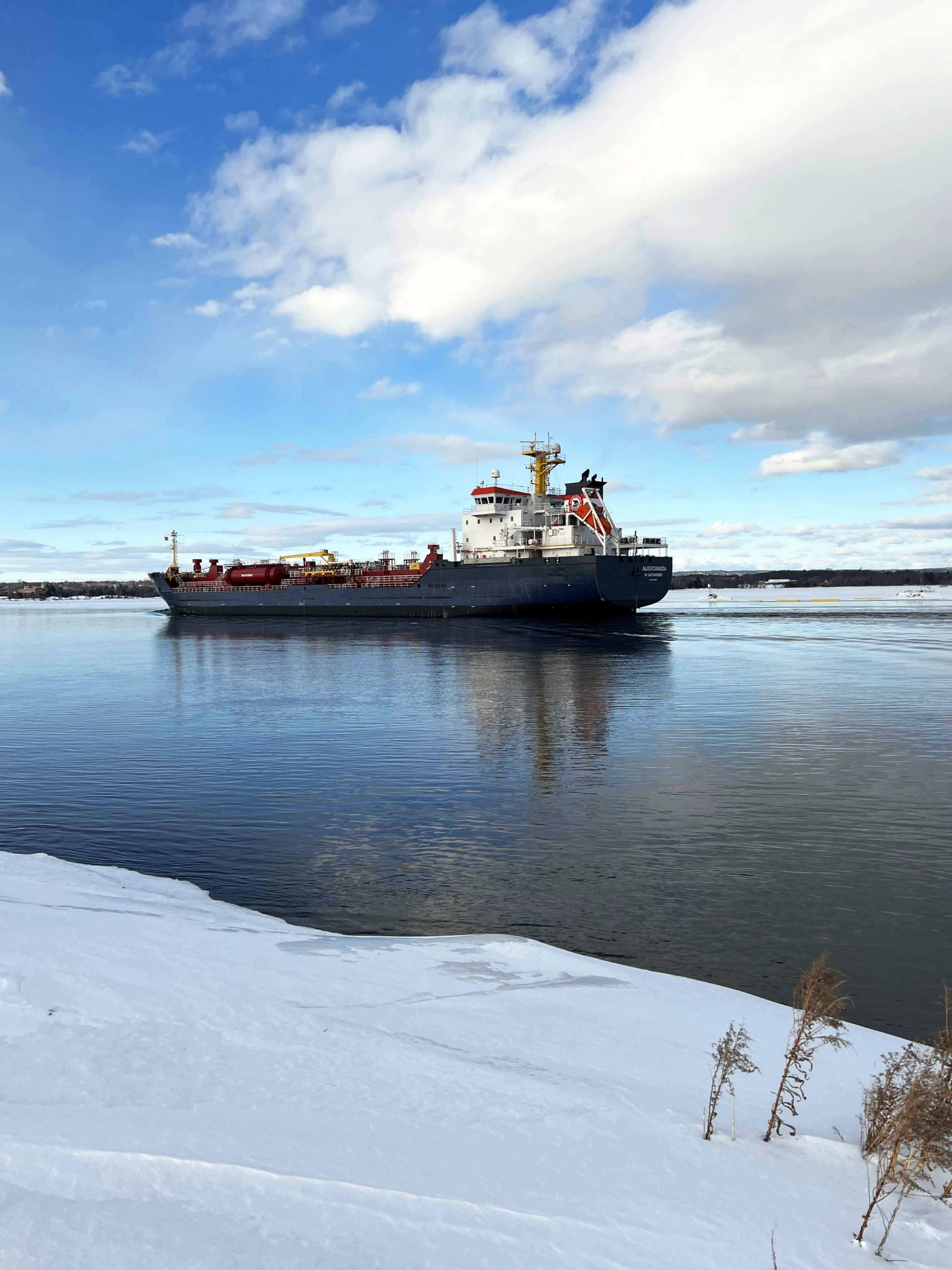
AlgoCanada returns to Soo, expanded icebreaking starts Monday
Sault Ste. Marie, MI – The tanker AlgoCanada made another trip upriver Thursday, docking at the Purvis Dock in the lower harbor, Canadian side, in late afternoon to discharge petroleum products. She was assisted through heavy ice in the vicinity of Johnson and Stribling points by the USCG Katmai Bay. Meanwhile, USCG Neah Bay departed Cleveland Thursday with an AIS destination of St. Marys River.
Monday, March 14, the U.S> Coast Guard is expected to expand icebreaking in the St Marys River’s West Neebish Channel. To date, icebreaking in the West Neebish Channel was limited to Munuscong (Mud) Lake, south of Moon Island. Monday, the Coast Guard will extend icebreaking into the southern half of the West Neebish Channel, working from Mud Lake Junction Light north to the Rock Cut at West Neebish Channel Light 29.
The Coast Guard will not disturb the ice north of the Neebish Island ferry crossing or break ice south of West Neebish Channel Light 45. However the Neebish Island ferry has not run since March 4, and is expected to be shut down for an extended period of time due to ice conditions.
View a video of the AlgoCanada here: https://youtu.be/eUPyGBuXxrs
Multiple cruise ships heading to Keweenaw this summer
Houghton, MI – Houghton and the Keweenaw, Michigan will welcome thousands of people seeing the area for the first time this summer as part of a series of summer cruises.
Between June 1 and Sept. 21, seven cruises from Viking Cruises and two from American Queen Voyages (formerly Victory Cruise Lines) will dock in Houghton.
Viking Cruises will use its new 672-foot expedition ships Viking Octantis and Viking Polaris – smaller than an ocean liner, but the largest such ship that could get through the St. Lawrence Seaway. Because the ships cannot fit under the Portage Lake Lift Bridge, they will have to turn 180 degrees and head back out to Lake Superior.
One of the Viking ships is currently in Antarctica, where it spends half the year. In addition to a cruise ship, it also serves as a research vessel. The cruises are geared more at learning, including scientific equipment and an auditorium for lectures.
The ships will dock somewhere near the Kestner Waterfront park. Visitors will be carried to the shore by tender boats, which Nemetz said would carry about 40 to 70 people at a time. They will disembark near Bridgeview Park. Plans call for the ship to arrive at 8 a.m. and leave at 5:30 p.m.
There will be two sets of excursions during the day, each lasting about two-and-a-half hours. About 90% to 95% of guests will do at least one, Nemetz said. They will eat lunch on the ship.
Among the excursions are visits to the Quincy Mine, a hike at Hungarian falls and a seaplane flight over Copper Harbor and Estivant Pines. One still being developed would bring people to Finlandia for a class on how to play harp. A walking tour of Houghton will be centered around historic bars and breweries.
About 630 people will be getting off the Viking boat, including 300 or so guests, said Brad Barnett, executive director of the Keweenaw Convention and Visitors Bureau. Victory’s total will be smaller, about 240 guests and 70 crew. The Viking visitors will generally be between 60 to 80 years old, Barnett said. With ticket prices starting around $7,000, they will also generally be well-off.
There are also opportunities for volunteers to serve as ambassadors for the area during the visits, Barnett said.
Mining Journal
Algoma Central, Nova Marine add five vessels
St. Catharines, ON – Algoma Central Corporation and Nova Marine announced Thursday an increased investment in their global short sea shipping joint ventures, NovaAlgoma, by acquiring three cement carriers from KGJ Cement in Northern Europe and two handy-size bulk carriers from Swire Bulk Holdings Pte. Ltd. of Singapore. The vessels will be strong additions to NovaAlgoma’s already diversified vessel portfolio, which includes cement carriers, mini-bulkers and handy-size bulk carriers.
“We carefully consider each opportunity for growth and these vessel purchases fit perfectly into our long-term plan for sustaining a profitable business alongside our partners at Nova Marine,“ said Gregg Ruhl, President and CEO of Algoma Central Corporation. “The three cement carriers will support increasing cement requirements and significant global infrastructure investments. The two handy-size vessels will be part of our active international sales and purchase vessel platform, which has delivered strong returns since 2018,” concluded Mr. Ruhl.
“The cement carriers will supply additional capacity for NovaAlgoma Cement Carriers (“NACC”) and provide tailored and flexible short sea logistics solutions for our customers in this market,” said Vincenzo Romeo, Chief Executive Officer at Nova Marine. “Working together with our partners at Algoma, we continually review market conditions and add incremental investments so we can strategically evolve with fluctuations in industry demand,” added Mr. Romeo.
The first of the three cement vessels, the NACC Providence, previously named the Glory Atlantic, was delivered in early February. At 446 feet in length, 83 feet in width, she will be too large for service west of Montreal. The second vessel will follow in early March and the third is expected to be delivered in late June. All three vessels will join the NACC fleet serving a growing list of clients around the world.
The two handy-size bulk carriers, to be named the Sider Athena and the Sider Bear will join the NovaAlgoma Bulk Holdings fleet in late April and will be commercially managed by Nova Marine.
Algoma Central Corporation
Oil, gas industry groups try to block rules to better protect the Great Lakes
Long after an Enbridge oil pipeline broke, an oil sheen could be seen along the Kalamazoo River. Crews then worked to clean up the oil that sank to the bottom. A new rule went into effect last month, requiring oil and gas companies to better monitor their pipelines if they are in sensitive coastal areas such as the Great Lakes.
Two industry groups, the American Petroleum Institute and GPA Midstream have petitioned the U.S. Court of Appeals to review the rule and, until that’s done, stop the rule from being enforced.
Congress passed laws in 2016 and 2020 requiring the Pipeline and Hazardous Materials Safety Administration to amend its rules to help prevent catastrophic oil spills that damage shorelines and beaches, and lawmakers specifically named the Great Lakes as an area to be protected.
The “Pipeline Safety: Unusually Sensitive Areas for the Great Lakes, Coastal Beaches, and Certain Coastal Waters” interim final rule went into effect in late February.
“Unusually Sensitive Areas fall under stricter regulations as to how an operator has to maintain the integrity of the pipe, which would lower the possibility of a failure,” explained Bill Caram, executive director of the watchdog group Pipeline Safety Trust.
Caram said the filing by the industry groups came as a surprise for many because it was clear that the Great Lakes should have been better protected all along.
“I certainly didn’t expect it. This [the previous rule] was an obvious shortfall of the definition. Senator [Gary] Peters and other lawmakers mandated the federal agency that that this loophole be fixed. PHMSA, the regulator, did that in a relatively straightforward manner, and so this definitely took us by surprise.”
The rule specifically cited events involving Enbridge pipelines in its introduction of the rule.
It stated the rule “will provide enhanced protections for hazardous liquid pipeline accidents similar to the 2010 Marshall, MI and the 2015 Refugio Beach, CA oil spills and ensure that events like the anchor strict that damaged Enbridge’s Line
The two industry groups requesting a stay and review of the rule argued that they had not been given adequate opportunity to comment. The petition to the court said the agency issued the rule without first publishing the proposal, providing the public a chance to comment and the agency a chance to amend the Unusually Sensitive Areas definition.
This could delay implementation of the rule for months or longer, because if the petition is denied, then the two industry groups can file suit.
“We certainly hope this is just a matter of months and the agency can sort it out. We certainly hope that the agency denies this request, and the rule stays in place,” said Caram.
Attempts to reach GPA Midstream were unsuccessful. In an email, the American Petroleum Institute responded, “Unfortunately, our subject matter expert on this is out of the office today,” and no one could offer comment for this story.
Michigan Radio
U.S. Coast Guard rescues person on ice floe
Sault Ste. Marie, MI – Members of U.S. Coast Guard Station Sault Sainte Marie and Air Station Traverse City rescued a man stranded on an ice floe on Lake Superior March 8. A 55-year-old man called the Coast Guard to report that he was stranded on an ice floe approximately threemiles east of Point Abbaye off the Keweenaw Peninsula.U.S. Coast Guard Sector Sault Sainte Marie coordinated with Negaunee Dispatch to locate the GPS position produced from the man’s 911 call. The Coast Guard Ninth District launched an MH-60 helicopter from Air Station Traverse City. The crew of the MH-60 immediately located the man and hoisted him safely into the helicopter where the rescue swimmer conducted a health assessment. The man was taken to Houghton County Memorial Airport for evaluation by awaiting Emergency Medical Service personnel. No injuries were reported.
USCG