Steel production jumps by 14,000 tons in the Great Lakes Region
Steel production rose by 14,000 tons in the Great Lakes region last week, after rising by 13,000 tons a week earlier, according to the American Iron and Steel Institute.
Locally, steel mills in the Great Lakes region, clustered mainly along the south shore of Lake Michigan in Northwest Indiana, made 547,000 tons of metal in the week that ended March 11, up from 533,000 tons the previous week.
Steel mills remained well below 80% capacity, a key threshold for financial success for the steel sector. After years of record profitability, the industry has been dealing with falling prices, increased economic uncertainty and rising import levels after tariffs were rolled back in favor of quota systems with some trading partners. The United Steelworkers union and Cleveland-Cliffs pursued new trade protections for the first time in years after a collapse in the tin market that led to the idling of tin mills, including in Gary.
Overall, domestic steel mills made 1.677 million tons of steel last week, up 0.8% from 1.664 million tons the previous week and down 1.9% compared to 1.71 million tons the same time a year prior.
Nationally, steel production in 2023 totals 16.51 million tons, a 5.1% decrease from the 17.39 million tons manufactured through the same period last year.
U.S. steel mills have run at a capacity utilization rate of 73.9% through Saturday, down from 79.7% at the same point in 2022, according to the American Iron and Steel Institute.
Steel capacity utilization was 75% last week, down from 78.7% a year earlier and up from 74.4% the week prior.
Steel production in the southern region, which encompasses many mini-mills and rivals the Great Lakes region in output, totaled 704,000 tons last week, down from 717,000 tons the week before, according to the American Iron and Steel Institute.
Volume in the rest of the Midwest rose to 210,000 tons, up from 206,000 tons the week prior.
NWI Times
Southeast Side Residents Suing to Keep Army Corps ‘Mountain of Dredge’ From Rising Up on Lake Michigan
Opponents of a toxic sludge landfill on Lake Michigan have filed a lawsuit to stop a plan by the U.S. Army Corps of Engineers to expand the dump, which has already operated for nearly three decades longer than initially intended.
The Environmental Law and Policy Center filed the suit Monday in U.S. District Court on behalf of the Alliance of the Southeast and Friends of the Parks.
At issue is a 45-acre site on Lake Michigan, at the mouth of the Calumet River, adjacent to Calumet Park. Since 1984, after the Army Corps dredges Chicago-area waterways for navigation purposes, the sediment is stored in what’s known as a Confined Disposal Facility.
Now the facility — initially only authorized by the Illinois legislature for a 10-year period — has reached capacity. The Corps had said it would turn the property over to the Chicago Park District when the dump maxed out, but instead, the Corps wants to extend the life of the facility by building a 25-foot-tall vertical expansion.
The lawsuit alleges the Corps does not have authority to build the new dumpsite and has violated federal environmental and dredge-management laws by failing to adequately consider the project’s environmental impacts and less harmful alternatives.
The Corps only explored options for new facilities within the 10th Ward, home to the current dump. Residents balked at having a second waste site built in their community, but that left the Corps’ expansion plan as the only viable alternative.
“We are tired of being the dumping ground for toxic materials in the city,” said Amalia NietoGomez, executive director of Alliance of the Southeast, in a statement. “Chicago’s Southeast Side is already overburdened, and we don’t need an expansion to add more toxic dredgings from the river right next to Calumet Park, where families gather, do sports, have picnics and play in the water.”
Neighbors are concerned about pollutants from the facility and possible impacts on people’s health and their drinking water, she said.
Contaminants in the dredged materials include mercury, PCBs, arsenic, barium, cadmium, manganese, chromium, copper, lead and more. Friends of the Parks has long been concerned with the potential for these chemicals to leach into Lake Michigan.
“Chicago’s lakefront is one of our city’s most precious gems,” said Juanita Irizarry, executive director of Friends of the Parks, in a statement. “The (facility) lingers on our lakefront as a remnant of previous eras’ zoning and environmental policies. It is a travesty to continue to designate prime lakefront park land, that is next to other parks and beaches, for a toxic dump.”
The Army Corps did not immediately respond to a request for comment. According to a status update on the Corps’ project website, “Vertical expansion of the CDF is underway and scheduled for completion in (fiscal year) 2025.”
No river dredging has occurred since 2020, and harbor dredging last took place in 2022, according to the Corps.
A spokesperson for the Illinois Environmental Protection Agency said the Corps construction permit application “remains under review.”
WWTW
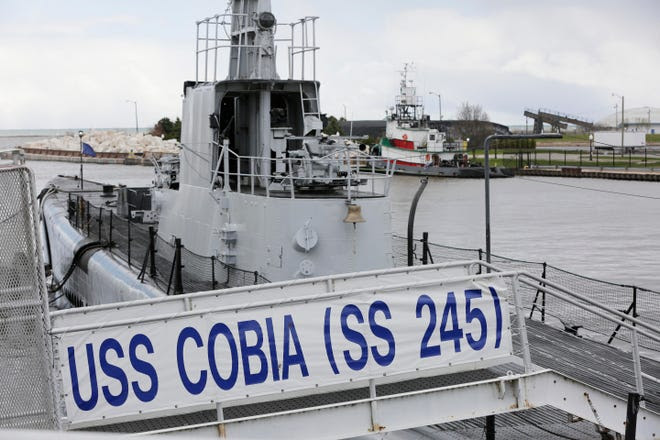
Manitowoc’s Cobia submarine is turning 80
MANITOWOC – On March 17, 1943, World War II submarine USS Cobia’s keel was laid by the Electric Boat Company in Groton, Connecticut.
This was the beginning of her journey to service during World War II, ultimately serving six war patrols in the Pacific Theater from 1944 to 1945.
March 17 will mark the 80th anniversary of her keel-laying “birthday,” and on March 18, the Wisconsin Maritime Museum will hold a celebration of Cobia’s 80th “birthday.” The museum will be open 10 a.m.-4 p.m. that day, offering $8 discounted admission, which includes access to the submarine. The museum is at 75 Maritime Drive in downtown Manitowoc.
Help wanted: Lake Michigan Carferry seeking 2nd Mate, 3rd Mate, 3rd Assistant Engineer
Third Assistant Engineers supervise a watch with the assistance and direction from the Chief Engineer. Responsible for the safety of the personnel assigned to the watch and their task performance in the operation of the vessel. Assists with the operation and maintenance of all vessels operating equipment and systems. Maintains the engine room records as required by various agencies. Conducts periodic safety inspections of departmental tools and safety equipment as directed. Required to make descriptive entries of all work performed in the Engineer log. Be prepared to live and work aboard the vessel the duration of the sailing season, from mid-May to mid-Oct. (room and board provided). Employee will stand a 4-hour watch, twice daily, 7 days per week. Eligible for AMO medical, dental, vision and 401K after completing 60-day probationary period. APPLICANTS FOR LICENSED ENGINEER POSITIONS MUST BE QUALIFIED AND POSSESS THE 3RD ENGINEER OF STEAM VESSELS OF UNLIMITED ENDORSEMENT OF 4000 HP OR HIGHER. Qualifications/Certifications Required: Valid Transportation Worker Identification Credential (TWIC), Valid Merchant Mariners Credential issued by the U.S. Coast Guard with proper endorsements, including at least Third Assistant Engineer of steam vessels of unlimited horsepower, current US Coast Guard Medical Certificate and be legally eligible to be employed in the United States (proof of identity will be required upon employment).
Licensed Deck Officer responsible to manage, oversee and direct the Deck Department for the daily operations of the vessel. Knowledge of the fire and lifeboat stations along with signals and procedures associated with an emergency in order to properly carry out a fire and lifeboat drill to US Coast Guard standards. On-scene commander in emergency situations and drills. Supervises the Deck Department assuring that work is accomplished in a safe and efficient manner. Supervises the general management of loading and off-loading passengers and cargo.. Maintenance of all cargo gear, deck gear, hold, decks, hatches and hull. Management of all emergency station bill assignments, posting of lists, and search parties. Manages the cleanliness of exterior, car deck and holds of the vessel. Be prepared to live and work aboard the vessel the duration of the sailing season, from mid-May to mid-Oct. Room and board provided. Employee will stand a 4-hour watch, twice a day, 7 days per week. Eligible for AMO medical, LMC dental, vision and 401K after completing 60-day probationary period. Applicants must possess unlimited tonnage endorsement. Qualifications/Certifications Required: Valid Transportation Worker Identification Credential (TWIC), Valid Merchant Mariners Credential issued by the U.S. Coast Guard, Current US Coast Guard Medical Certificate and be legally eligible to be employed in the United States (Proof of identity and eligibility will be required upon employment.
For particulars, contact Shari Vandervest at svandervest@ssbadger.com
Know Your Ships survey
Know Your Ships is asking readers to take a short survey to help chart their future course. You can take the quick survey by clicking this link: https://docs.google.com/forms/d/e/1FAIpQLSfYyWupfE5-AE8Bjss9g2YWVnsZIjlnOFW9LujpoAvFW-KK3Q/viewform?vc=0&c=0&w=1&flr=0&fbclid=IwAR1sXSvH6h0iiVBuq4rQHYgX25uWzInthKQdqiRXIPuBTjfiDRY7eEeR9Jo