Soon-to-be-scrapped Cuyahoga takes on water at Ashtabula
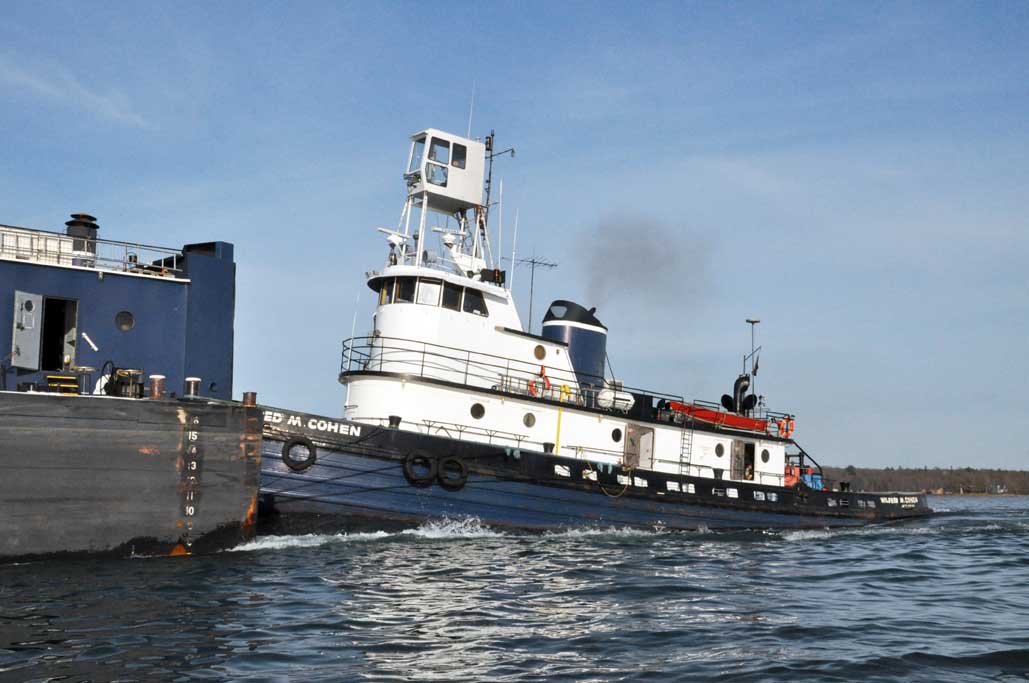
ASHTABULA, OH – Reliable waterfront reports indicate the laid-up Canadian-flagged laker Cuyahoga took on water in the engine room over the weekend. On Saturday she was down by the stern and showing a noticeable port list, although some of that had been evened out by Sunday. A containment boom was placed around the vessel as a precaution. Cuyahoga, seriously damaged in a fire nearly a year ago, is expected to be towed away for scrap in the spring.
REPORT: New Wolfe Islander IV ferry was
off course when it struck bottom last December
KINGSTON, ON – The Wolfe Islander IV (WI4) was off its regular course when it’s believed to have struck bottom, tearing a roughly 30-centimetre gash in its hull and causing the ferry to take on water, according to documents obtained by CBC.
The collision happened just before noon on Dec. 4, when the long-awaited boat had only been carrying passengers for about three months.
After limping to dry dock in Hamilton with the help of tugboats, the ferry has been out of commission for the same length of time. Ontario’s Ministry of Transportation (MTO) has yet to provide any information about what caused the vessel to leave its standard route, or what’s being done to prevent a repeat.
MTO describes a 30-centimetre by two-centimetre tear in the hull, a large scrape on the port side below the waterline and dents in the hull, along with damage to two propellers (thrusters) on the port side, with an estimate of $1 million to $2 million for the repairs.
The document also warns staff to “anticipate delays” when it comes to securing materials, noting the metal needed is unavailable in the required thickness in Canada having been built in Romania.
It is not clear why the ferry was off course. A map of the regular routes the ferry follows was attached to the note. It shows the course the vessel took on Dec. 4 swings outside of the typical path after leaving Wolfe Island, highlighting the suspected area of impact in red and an area where the ferry slowed down in purple.
Weather data from Environment Canada shows winds of 40-45 km/h in Kingston at 11 a.m. on Dec. 4 and noon, but it’s not clear from the documents CBC viewed if the weather was a factor in the collision.
As part of the new ferry project, significant dredging was completed to deepen and widen the channel between the two docks. The notes mention working with an engineering firm to carry out a new marine survey of the channel as soon as possible.
The other two documents obtained by CBC cover much of the same material, but include one significant piece of new information. They describe the need to develop “training enhancements” to avoid similar incidents, before offering the following instruction for ferry crews in the meantime: “Marine Services managers have also advised captains to ensure diligence in staying within the dredged channel while operating Wolfe Islander III.”
Crews would have steered the ferry along that same route dozens of times a day, but familiarity alone doesn’t prevent problems, according to John Dalziel, a ship designer by training and an adjunct professor of industrial engineering at Dalhousie University.
Based on his review of the MTO notes, Dalziel said it’s possible more training could have made a difference.
“Maybe there was some lack of familiarity with how that vessel handled, and perhaps a gust of wind took them quickly across to the side,” he said.
CBC
Maritime industry opposition continues unabated
against Trump-proposed fees on Chinese-built vessels
Prominent maritime industry stakeholders are flooding the office of the U.S. Trade Representative (USTR) with comments opposing the proposed measures targeting Chinese-built and operated vessels, warning of potentially disastrous effects on U.S. trade and consumer prices.
The measures seek to counter China’s dominance in maritime sectors by imposing port fees of up to $1.5 million on Chinese-built ships and operators, while promoting U.S. vessel usage and the U.S. shipbuilding industry. A public comment period ends on March 24 when a public hearing is scheduled at the International Trade Commission.
The International Chamber of Shipping (ICS), which represents over 80% of the global
merchant fleet, states that the proposed fees could severely disrupt U.S. trade and
increase consumer prices. The fees could potentially affect 98% of container ships
calling at U.S. ports.
“The proposed remedies could have an overall net negative impact on the U.S. economy, and result in a decline in U.S. exports,” asserts ICS in its written submission to the USTR.
Leading ro-ro carrier Atlantic Container Line (ACL) projects dramatic cost increases. Export container rates could soar from $500 to $2,500, while import rates could climb from $2,500 to $4,500. ACL warns it would be forced to “terminate its US service, close its American offices, lay off its American staff and redeploy its ships to non-US trades.”
The Chamber of Shipping of America (CSA) cites data showing U.S.-built ships cost four times more than foreign-built vessels, with delivery times exceeding 10 years for specialized vessels.
“Due to decades of neglect, the US maritime industry has seen a steady decline…we necessarily must rely on vessels registered in other nations,” CSA states. It stresses that imposing port fees alone won’t revitalize U.S. shipbuilding or the U.S.-flagged fleet. Instead, proactive legislation like the SHIPS for America Act is required. Among other submissions, the East Coast Stevedore Company warns that implementing the fees as written would “destroy trade across the entire United States.” This sentiment is echoed across the industry, with particular concerns about impacts on agricultural exports, energy trade, and regional shipping services.
The Louisiana Maritime Association (LaMA) warned that American maritime workers could lose out in the near term, even if the fees eventually succeed in boosting future U.S. shipyard activity. “The fallout will affect railroads, pilots, towage (tug) companies, barge companies and many small, independent businesses such as line handling companies, dock, terminal and facility workers. The myriad of United States companies dependent on the shipping industry could (and reportedly already are) lose business based on the anticipation of the implementation of this USTR action.”
Master Mariners of Canada
2025 “Know Your Ships” launches
The new shipping season is at hand, and so is the release of the 2025 edition of Know Your Ships, the popular annual field guide to boats and boatwatching on the Great Lakes & St. Lawrence Seaway, now in its 66th year.
Preorders are now being taken. As usual, standard and spiral bindings are available. Preorders will be the first to mail out when the book arrives from the printer around March 23.
New this year is the ability to preorder the midsummer EXTRA magazine, which will feature a 50th anniversary tribute to the Edmund Fitzgerald and her crew, when you preorder the book.
To mark the opening of the Soo Locks, Editor & Publisher Roger LeLievre will be at the Soo Locks Visitor Center Saturday, March 26, from 11 a.m.-3 p.m., to sign copies of the new edition. Buy them right from him, or from Das Gift Haus and Island Books and Crafts in the Soo, bring them to the Visitor Center and he will sign them.
Preorder at this link: www.knowyourships.com