Michigan’s Mackinac Bridge among 68 in US
NTSB recommends be evaluated for risk of collapse
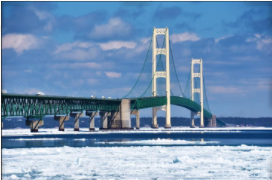
Michigan’s Mackinac Bridge is among the 68 bridges across 19 states that the National Transportation Safety Board recommended be assessed to determine “the risk of collapse from a vessel collision.”
This comes as part of the ongoing investigation into last year’s Francis Scott Key Bridge collapse in Baltimore. The bridge collapsed after the Dali, a containership, struck one of its supports. Six construction workers were killed.
Over the last year, the NTSB identified 68 bridges that don’t have a current vulnerability assessment.
Each bridge on the list is classified as “critical/essential” or “typical.”
Bridges that “serve as important links” are categorized as “critical/essential.” The Key Bridge had this classification, and so does the Mackinac Bridge.
This list doesn’t mean that these bridges are “certain to collapse,” but the board is recommending that the 30 bridge owners evaluate if the bridges are above the American Association of State Highway and Transportation Officials’ acceptable level of risk.
“The NTSB found that had the Maryland Transportation Authority, or MDTA, conducted a vulnerability assessment on the Key Bridge based on recent vessel traffic, MDTA would have been aware that the Key Bridge was above the acceptable risk and would have had information to proactively reduce the bridge’s risk of a collapse and loss of lives associated with a vessel collision with the bridge,” the according to a release from the NTSB.
The Mackinac Bridge opened in 1957 and is owned by the Mackinac Bridge Authority.
The bridge connects the state’s upper and lower peninsulas and spans the Straits of Mackinac, which connects Lake Michigan and Lake Huron.
WDIV
Port Colborne top hat ceremony starts shipping season
Port Colborne officially welcomed the start of the 2025 shipping season on the Welland Canal Monday with its annual top hat ceremony at Lock 8 Gateway Park. The outdoor ceremony, originally scheduled for opening day of the canal Saturday, was postponed due to poor weather.
The St. Catharines top hat ceremony at Lock 3, presented by St. Lawrence Seaway Management Corp, is being held Tuesday starting at 10 a.m. While no vessel passed through the canal during Monday’s celebration, the City of Port Colborne pressed ahead with the public festivities.
Mayor Bill Steele, who presented a ceremonial top hat to Algoma Sault Capt. Nathan Mayo on Saturday as he captained the first downbound vessel of the season, said the event reflects the city’s close ties to the marine industry.
“This event marks our commitment to our marine industry and its contribution to our local, provincial and national economies,” Steele said.
He described the canal as central to Port Colborne’s identity and future. “It’s no exaggeration to say the canal is the heart of Port Colborne,” he said. “Its bridges and our position on Lake Erie are our defining physical features.”
The Welland Canal has been a key part of Canada’s trade and transportation network since its opening. Over decades, it has evolved to become a critical link between the Great Lakes and international markets.
Addressing attendees, Niagara Centre MP Vance Badawey emphasized the canal’s enduring importance, particularly in maintaining the efficiency of supply chains amid trade instability.
“Since the (fourth) canal opened on Aug. 6, 1932, its operations have only grown in importance,” he said. “Today, in our turbulent and rapidly changing times, the Welland Canal remains a critical part in ensuring that our supply chains remain efficient and intact.”
Badawey also spoke highly of significant new investments in the canal and surrounding infrastructure that are expected to boost the city’s and region’s economy.
“A shining example of the seaway’s commitment is the significant investment being made into managing the federal government’s asset,” Badawey said. “The announcement by the city, the seaway and the federal government of a $44-million investment in a cruise ship dock, that will also accommodate Port-related opportunities.”
Steele echoed Badawey’s excitement for the city’s growing role as a stop for cruise ships, with the hopes to bring increased economic activity and tourism to the area this season.
“We’ll be up to around 80 stops this year in downtown Port Colborne,” Steele said. “We’ve got an overwhelming number of both ships and their passengers taking our tours around the city and other events we’ve put together for this season.”
The federal government has committed $350 million over the next three years for infrastructure upgrades in the marine industry, with $180 million earmarked for improvements specifically for the Welland Canal.
Nathan Infantino, operations supervisor for St. Lawrence Seaway Management Corp., said the investments reflect the canal’s importance to Canadian trade and transport.
“This investment will ensure the seaway’s continued reliability and efficiency while creating jobs and strengthening local communities,” he said. “The upgrades include (the) bridges right here in Port Colborne and preparing Lock 8 for our hands-free mooring system.”
Mike Haines, representing Niagara Centre MPP Jeff Burch, outlined the broader impact the marine industry has on the Canadian economy and its trade partners.
“The marine industry supports 329,000 jobs and $59 billion in economic activity in Canada and the United States,” he said. “Something Donald (Trump) should remember.”
The top hat ceremony reflects the historical and cultural importance of the canal. The event dates back to 1970 when then-mayor John Buscarino established it as a way to honour the first downbound ship of the season.
Tami Nail, assistant curator at the Port Colborne Marine and Historical Museum, said the ceremony is a symbol of the city’s connection to the canal and the broader Great Lakes-St. Lawrence Seaway System.
“The top hat ceremony recognizes the importance of the canal system for Port Colborne and the Niagara region, as well as the St. Lawrence Seaway’s 67th navigation season on the canal,” Nail said.
The ceremony revolves around a preserved turn of the century, beaver felt hat made by Tress & Co. in England, which was donated anonymously to the city.
The hat, after being presented to the captain of the canal’s first downbound, is stored at the Captain John W. Sharpe Heritage Resource Centre in Port Colborne.
Niagara This Week
New Corps Tug Named After Michigan Tech Alumnus Ronald J. Pearce
Michigan Tech University alumnus Ronald Johnston Pearce [1929–2020] had a lifelong connection to the Soo Locks and the St. Marys River in Sault Ste. Marie, Michigan, beginning as a child and encompassing a 35-year career with the U.S. Army Corps of Engineers (USACE).
Now, the USACE is honoring his legacy, expertise, and impact on the region with the deployment of the R.J. Pearce – a 76-foot tugboat with a 28-foot beam – that will be commissioned in Sault Ste. Marie this fall.
Growing up in the Soo, Pearce’s admiration for the St. Marys River ran deep. As a 13-year-old boy, Pearce remembered returning across the frozen river from neighboring Soo, Canada, when he heard the newsboys shouting that the United States entered World War II following the attack on Pearl Harbor.
Barely a teenager, Pearce joined the war effort by working for the Civil Defense where he would ride his bike in the dark of night to deliver messages to the 15,000 troops who were stationed to protect the locks. The following summers of 1942 and 1944, Pearce ran an outboard and inboard cruiser, respectively, for the boundary surveyor along the river. In 1945, he traveled with the survey from northern Minnesota to New York. He was in Erie, Pennsylvania, on V-J Day, the day that marked the end of World War II.
The opportunity to work at an early age, especially at a tumultuous time in the country, instilled Pearce with a strong work ethic that would transcend throughout his entire life. While he had a long and successful career, Pearce was most well known for his humble integrity and dedication to his family.
Pearce’s collegiate career began in 1946 at Fort Brady—what would become the Sault Ste. Marie Residence Center of the Michigan College of Mining & Technology, and ultimately Lake Superior State University. He transferred to Michigan Tech’s Houghton campus during his third year, and graduated with his Bachelor’s Degree in Mechanical Engineering in 1951.
After graduation, Pearce held positions at the Chicago Northwest Railroad and the International Boundary Commission. He was drafted into the Army in February 1953 and served in Korea from May 1954 through February 1955, where he spent his time rebuilding Korean villages with public buildings, dams, and electric power.
In the summer of 1956, Pearce was accepted into the U.S. Army Corps of Engineers as a civil engineer, returning to the Soo with his wife, Margaret, and their children, Ronald and Sharon—later to be joined by David, Barbara, Ruth, Joseph Edwin, Murray, and Marilynn. Pearce spent 35 years at the St. Marys River Branch and was appointed chief in 1967.
Pearce’s career resulted in mastery of the area and its operations. His expertise was provided in countless projects that still have an impact on the region to this day. In 2009, USACE awarded Pearce the Distinguished Civilian Award because of his work building relationships with stakeholders, managing contracts and surveys, and managing the development and implementation of the acoustic hydrographic survey vessel James Bray. He retired from the USACE in October 1990.
In recognition of Pearce’s lifelong service and dedication to his country and the U.S. Army Corps of Engineers, a new vessel will be named in his honor as the tug R.J. Pearce. The tug will have the American Bureau of Shipping classification of Maltese Cross A-1 Towing Vessel, Ice Class C0, Great Lakes Service with Maltese Cross AMS and UWild.
The R.J. Pearce will be used primarily to support marine maintenance activities at the Soo Locks and St. Marys River. The vessel will move crane barges around the lock facilities, supporting material and equipment deliveries for routine and emergency work. Additionally, the boat will move crane, excavator, and material barges up and down the St. Marys River, supporting removal of strikes in the federal navigation channel—a critical function that ensures safe commercial navigation between our Lake Superior ports and the lower Great Lakes, as well as many overseas ports.
The tug captains, engineers, and crews (including members who Pearce previously worked with) traveled to the Lower Atchafalaya River in Morgan City, Louisiana, to witness the first launch, when the TB Ronald J. Pearce was released into the water by sinking the barge and then cutting it loose to float. The vessel will make its maiden voyage to the Soo later this year, traveling around Florida, up the North Atlantic, into the St. Lawrence Seaway, and through the Great Lakes until it reaches Sault Ste. Marie.
2025 “Know Your Ships” launches
The new shipping season is at hand, and so is the release of the 2025 edition of Know Your Ships, the popular annual field guide to boats and boatwatching on the Great Lakes & St. Lawrence Seaway, now in its 66th year.
Preorders are now being taken. As usual, standard and spiral bindings are available. Preorders will be the first to mail out when the book arrives from the printer around March 23.
New this year is the ability to preorder the midsummer EXTRA magazine, which will feature a 50th anniversary tribute to the Edmund Fitzgerald and her crew, when you preorder the book.
Preorder at this link: www.knowyourships.com