CCGS Amundsen working upper Great Lakes ice
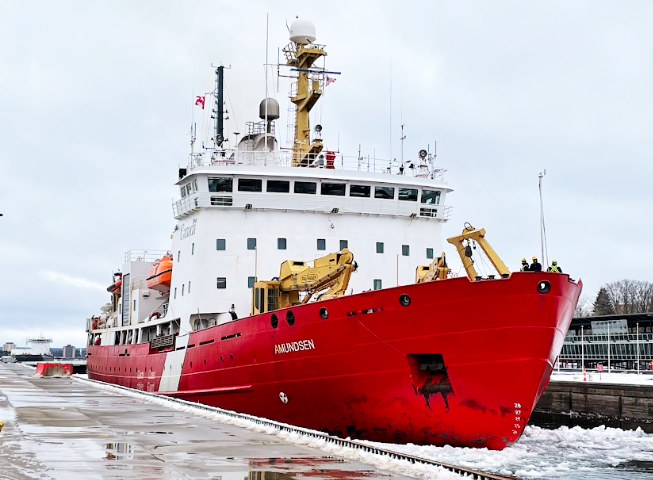
Sault Ste. Marie, MI – The 322-foot-long Canadian Coast Guard icebreaker Amundsen passed upbound through the Poe Lock Friday afternoon on her way to assist with ice operations in Whitefish Bay. Homeported in Quebec City, this is her first visit to the upper Great Lakes.
She earlier broke out the harbor at Midland, ON.
Soo Locks Visitor Center Association
Exhibit “Steam and Steel: Propelling the Future
of the Great Lakes” Opens May 23
at Great Lakes Science Center
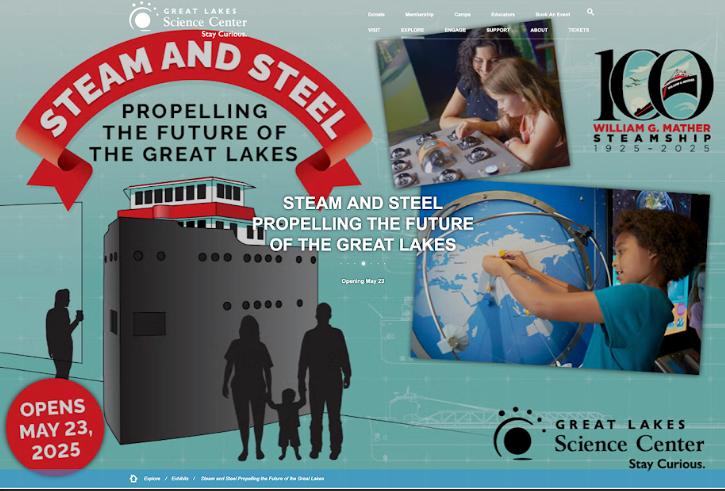
Cleveland, OH – Explore the history of Great Lakes shipping as Great Lakes Science Center celebrates the centennial of the Steamship William G. Mather with a special exhibit, Steam and Steel: Propelling the Future of the Great Lakes, from May 23 through September 1. Once the flagship of the Cleveland Cliffs, Inc., the Mather is now a museum allowing guests to explore the ship and see its huge cargo holds, brass and oak pilot house, elegant guest quarters, and four-story engine room.
Entering the Steam and Steel exhibit inside the museum, guests will first encounter a 14-by-10-foot replica of the front hull of the ship, providing the perfect place to snap a selfie before embarking on your journey into the history of the Mather and the world of Great Lakes shipping. Displays of artifacts from the Mather, and historic photos chronicling Cleveland’s shipping history, will showcase how Lake Erie and access to the other Great Lakes, the St. Lawrence Seaway, and the Atlantic Ocean helped shape the growth of Cleveland as a hub for commerce, industry and innovation.
Interactive exhibits will allow guests to experience what it was like to steer the mighty Mather, load and unload cargo, and raise and lower the drawbridges on a model canal lock. Other exhibits will allow guests to see how technological innovations in shipping, including the addition of radar, dual propeller bow thrusters, and the automated boiler system, contributed to the Mather’s long and successful run as a Great Lakes freighter and helped it become “the ship that built Cleveland.”
Great Lakes Science Center
Shipping, port officials say fees
on Chinese-built ships would cost jobs
DULUTH — Great Lakes shipping officials are pushing back on the Trump administration’s proposed port fee on Chinese-built ships, arguing the move could lead to less cargo moving through U.S. ports and threaten domestic port jobs.
The Office of the United States Trade Representative last month proposed charging stacking fees of up to $3 million every time a Chinese-built ship stops at a U.S. port, regardless of what country’s flag it sails under or where the cargo originated or is destined.
The proposed fees came nearly a year after a coalition of U.S. labor unions filed a petition requesting an investigation into the Chinese shipbuilding industry’s trade practices, alleging that actions like its government’s subsidization of the industry hamper domestic shipbuilding.
Deb DeLuca, executive director of the Duluth Seaway Port Authority, sent a letter Monday to United States Trade Representative Jamieson Greer. While the port supports the Trump administration’s goal of revitalizing domestic shipbuilding, noting Fraser Shipyards in Superior, she said the potential port fees would divert vessels to Canadian Great Lakes ports and pose “significant and irreversible economic damage and job loss” at the Port of Duluth-Superior.
“We are deeply concerned that the proposed fees on Chinese-constructed vessels, ranging from $500,000 to $3 million per vessel per entry, will disproportionately harm U.S. Great Lakes ports and industries, inadvertently creating economic advantages for nearby Canadian port competitors and undermining critical U.S. strategic objectives,” DeLuca wrote.
Last year, 58 oceangoing vessels, or “salties,” arrived at the Port of Duluth-Superior, but the seaway doesn’t track where each ship was built, Jayson Hron, a spokesperson for the Port Authority, said in an email.
The ships carry anything from grain exports to windmill imports and other bulk or containerized cargoes.
An estimated 30% of the vessels operating in the Great Lakes and St. Lawrence Seaway, which connects the lakes to the Atlantic Ocean, are built in China, Bruce Burrows, president and CEO of the Chamber of Marine Commerce, wrote in his organization’s comments filed Monday.
Several lakers — ships that stay on the Great Lakes — have also been built in China.
That was spurred by Canada’s repeal of duties on imported ships in 2010. According to Burrows, Canada now has 17 Chinese-built lakers.
In opposing the proposed fees on Chinese-built ships, Burrows said growing a domestic shipbuilding industry with the capacity to build vessels designed for the St. Lawrence Seaway and Great Lakes will take time.
“A well-planned transition, rather than abrupt regulatory burdens, is essential to ensuring that ship operators can contribute to U.S. shipbuilding efforts while maintaining the efficiency and competitiveness of cross-border trade,” Burrows wrote.
In its public comments, the United States Great Lakes Shipping Association echoed Burrows’ call for a measured transition to domestic shipbuilding. The association wrote that the ships moving through the St. Lawrence Seaway are often smaller bulk and general cargo vessels serving a single customer, making absorbing fees more burdensome; the ship will likely make multiple U.S. port stops in a single voyage; and the ship’s only connection to China may be that it was built there years ago.
“Because of these factors, local maritime commerce is likely to suffer and because of the delay before U.S. shipbuilding and maritime industry could catch up, it might never return,” the association wrote. “This would decimate the marine terminals, ports, towing companies, vessel agencies, ship chandlers, farmers, and the local ancillary services that support these industries.”
The trade office’s proposals do have supporters.
In addition to the unions that filed the petition last year, the steel industry also backs the Trump administration’s recommended measures.
“The proposed actions, such as requiring an escalating percentage of U.S. products to be exported every year on U.S. flagged ships, will not only help curb the use of Chinese built ships, but drive demand for domestically produced ships as well,” wrote Kevin Dempsey, president and CEO of the American Iron and Steel Institute, an industry group that represents steelmakers. “This will directly benefit the American steel industry as one of the primary suppliers of critical raw materials in the American shipbuilding supply chain.”
Duluth News Tribune
2025 “Know Your Ships” available now
The new shipping season is at hand, and so is the release of the 2025 edition of Know Your Ships, the popular annual field guide to boats and boatwatching on the Great Lakes & St. Lawrence Seaway, now in its 66th year.
New this year is the ability to preorder the midsummer EXTRA magazine, which will feature a 50th anniversary tribute to the Edmund Fitzgerald and her crew, when you preorder the book.
Order at this link: www.knowyourships.com