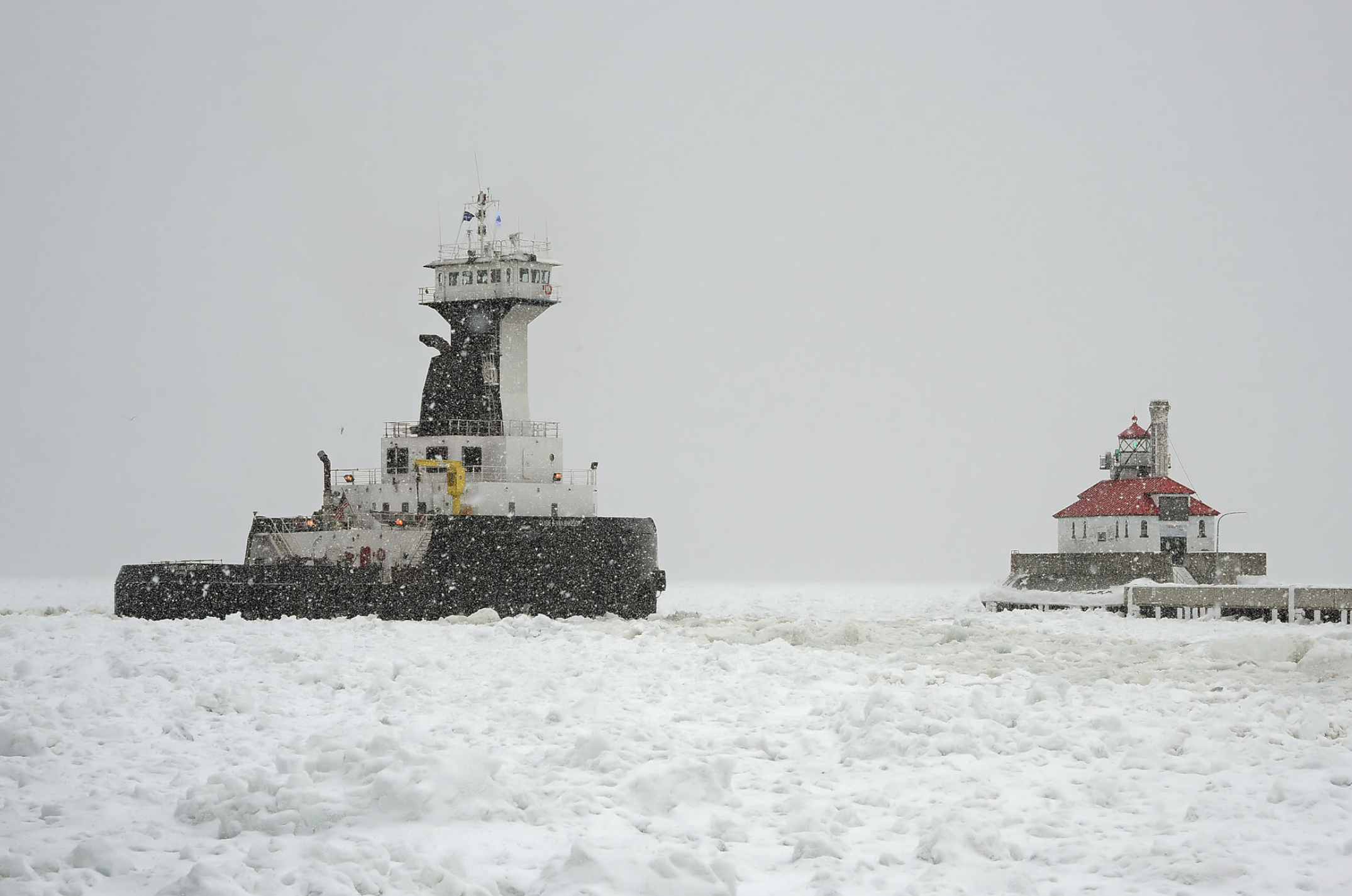
Industry blames ice buildup for sluggish start to shipping season
DULUTH, MN – Last month’s first full month of seasonal shipping totals in the Twin Ports dipped considerably compared to the same month a season ago.
Iron ore through the Great Lakes was down 44.7%, totaling 3 million tons — a figure that was 41% worse than the five-year average. The Port of Duluth-Superior made up 2.43 million short tons of ore in April, after seeing only three ore boats to start the season in the last week of March. That total was 38% below the start of last season, and 27% off five-year averages. Similar dips in output were recorded at ports in Silver Bay and Two Harbors. Limestone shipments totaled 2 million tons, a decrease of 16.6% season over season, but above the five-year average by 5.5%.
Industry leaders blamed a difficult ice-out in March and April, specifically with ice buildup and delays in Whitefish Bay on the eastern end of Lake Superior. The industry used the dip in output to once again advocate for another heavy U.S. icebreaker to join the Mackinaw on the Great Lakes.“Inadequate ice-breaking resources in Lake Superior had a major impact on cargo shipments out of the Port of Duluth-Superior, which underlines how much we need new and improved capacity for the U.S. Coast Guard icebreaking fleet,” said Bruce Burrows, president and CEO of the Chamber of Marine Commerce based in Ottawa. The Port of Duluth-Superior was tended to by a series of smaller Coast Guard cutters as the season started in late March. The U.S. Coast Guard Cutter Spar arrived to its new homeport in Duluth early last month.
On a more positive note, Burrows cited grain exports from U.S. ports being in strong demand along with shipments of salt, steel and containers. “We expect that the demand for different cargo segments will continue to be impacted by fluctuating prices and trade flows related to global supply chain issues and the Russia-Ukraine conflict,” Burrows said. In April, the Twin Ports shipped 95,042 tons of grain, compared to 20,728 tons during the same month last season. Outbound grain shipments comprised of wheat and beet pulp pellets totaled 148,620 short tons through April, nearly doubling the 2021 pace and exceeding the five-season average by 24%. Almost two-thirds of the Duluth-Superior grain float sailed through the Great Lakes-St. Lawrence Seaway System as export commerce.
Inbound salt deliveries to Duluth-Superior topped 81,000 short tons in April, more than doubling the April 2021 total and the five-season average.
“Winter lingered a bit too long this year, which made March and most of April a tough slog for Coast Guard icebreakers and the freighters that depend on them for support to power through those conditions,” said Deb DeLuca, executive director of the Duluth Seaway Port Authority. “We started to see an uptick in vessel traffic later in the month, as the ice situation improved, but it’s still hard to predict the tenor of 2022.” Unusual factors continue to affect the world of cargo transportation, including ongoing global supply chain delays and the war in Ukraine, she added.
“That instability keeps everyone guessing, but there’s still reason for optimism that it’ll be a good season in the Port of Duluth-Superior,” DeLuca said.
Duluth News Tribune
Last coal-powered passenger steamship in U.S. to ditch coal
LUDINGTON, MI – The S.S. Badger, the last coal-fired passenger steamship in the United States – and the largest in the world – won’t always be powered by coal, officials said.
Lake Michigan Carferry, Inc. is in the early phases of looking for ways to ditch the coal that currently propels the 410-foot historic ship across Lake Michigan. “We are just in the early phases at looking at what other options could be viable for the Badger,” said Sara Spore, general manager of Lake Michigan Carferry. “There are not any definite plans, but we know that coal isn’t the long-term solution. We really are starting from scratch and looking at all of our options”. There’s no timeline yet for when a conversion might happen, she said.
The 69-year-old Badger became a National Historic Landmark in 2016. While her coal-fired propulsion system is unique and was part of the historic designation, Spore said the company is not worried about losing the landmark status. “We are looking at how we keep the historic engines in the boat and potentially being able to open that area for people to see,” Spore said.
The Badger’s historical significance goes beyond the engines, according to the National Register of Historic Places. The ship, built in 1952 and 1953, was originally designed to transport railcars across Lake Michigan, serving as a “waterborne link in continent-wide rail and road transportation.” As a car ferry and passenger vessel, the Badger continues to serve in the latter capacity. She is the last Great Lake railcar ferry in operation.
“Badger also possesses a national level of significance in engineering as the final example of Great Lakes rail carferry design, a type which influenced design of such vessels in other regions and around the world,” the federal documents say.
The Badger went to work in 1953 transporting railcars across Lake Michigan for Chesapeake & Ohio Railway Company. But by 1980, that was no longer profitable for C&O, and the ship was sold. It continued to transport railcars until 1990 and seemed destined for the scrapyard at that point. However, she was saved in 1992 by Ludington native Charles Conrad who converted the ship into a car ferry. The Badger has been transporting passengers and vehicles across Lake Michigan ever since.
MLive.com
Tugboat that was sinking in Duluth Harbor is afloat again
DULUTH, MN – The tugboat named “Lake Superior” that partially sunk in the Duluth Harbor back in March is now floating once again.
According to the Coast Guard, contractors are working on what’s called “lightering and dewatering operations,” which will remove any leftover water, fuel, and lube oil from the tugboat, so pollutants don’t leak into the waterway.
The Coast Guard is also looking for any signs of pollution now that the tugboat is floating again, as it had been leaking oil as it sunk. That oil was successfully contained by absorbing materials around the tugboat these past two months.
After this process is done, the tugboat needs to be dealt with by its private owner.
Fox 21 News Duluth
New lakes study predicts Lakes Huron/Michigan will fall by 3.5 feet over record by 2030, then rise 1 foot over record by ’40
MANITOULIN, ON – New research on water levels projects an unprecedented drop of water levels on Lakes Michigan-Huron and Georgian Bay to 1.1 metres (3.5 feet) below the record low by 2030. By 2040, levels may rise to 0.3 metres (one foot) higher than the 1986 record high. The study by W.F. Baird & Associates Coastal Engineers Ltd. was commissioned by the Georgian Bay Great Lakes Foundation (GBGLF) and was shared virtually by GBGLF on May 16/17. The Baird conclusions are essentially the same as those found in a recently completed five-year study by Environment and Climate Change Canada (ECCC), presented during a week-long Great Lakes Coastal Wetlands webinar series from April 4 to 8.
Bill Bialkowski is a director-at-large for GBGLF and a retired professional engineer with experience in the mathematical modeling of hydraulic systems. He spent 15 years analyzing and modeling Upper Great Lakes hydrology and the conveyance capacity of the St. Clair River. He presented his analysis of water levels and the impact of climate change as was presented by ECCC’s Dr. Frank Seglenieks, lead author for ECCC.
The ECCC study predicts that all Great Lake levels will generally trend upwards, with increasing variability. Lake Michigan-Huron currently has, by far, the widest range between high water and low water levels of all Great Lakes, at 6.3 feet. The study suggests that this may go to 13 feet. By 2040, Lake Michigan-Huron is likely to face water levels as high as 177.8 (one foot higher than the 1986 record high). Worst of all, Mr. Bialkowski said, by 2030, which is only eight years away, Lake Michigan-Huron is projected to drop to 174.5 (3.5 feet lower than 2000 lows). “It may become possible to walk to many islands,” he said.
Read the rest of this article at this link: https://www.manitoulin.com/new-lakes-study-predicts-lakes-huron-michigan-will-fall-by-3-5-feet-over-record-by-2030-then-rise-1-foot-over-record-by-40/
The Manitoulin Expositor
Know Your Ships book signing is Saturday at Port Huron
PORT HURON, MI – On Saturday May 28, the Great Lakes Maritime Center in Port Huron will host its 2022 “Know Your Ships” Book Signing with editor and publisher Roger LeLievre from 10 a.m.-3 p.m. Along with the book, Roger will have Great Lakes caps and Stack & Flag charts for sale.
Great Lakes cartoonist / illustrator artist Don Lee, whose freighter cartoons have often appeared on Facebook, will have his easel and will sketch your likeness, with or without freighter (tips appreciated).
Also on hand will be Roger Hulett, author of “A Lot More To Do – Frank Mays Survival of the Tragic Carl D Bradley Sinking.” Ken Niemi, a Great Lakes historian, will have used maritime books, art and some artifacts for sale.
If you can’t make Saturday’s Know Your Ships signing, Roger will also be set up Sunday, May 29, at the Mariner Theater, 430 S. Water St., Marine City, between noon and 3 p.m.
Great Lakes Maritime Center
Help wanted: Lake Michigan Carferry
Lake Michigan Carferry is accepting applications for placement in the engine department aboard the historic S.S. Badger. Candidates must possess a Merchant Mariner’s Credential with QMED (Fireman/Oiler/Watertender) endorsement, a current Medical Certificate and a valid TWIC card. QMED will expect to live aboard and stand a 4 hour watch, twice a day, 7 days a week for the remainder of the 2022 sailing season (as soon as possible to Oct 16th, 2022) QMED wage is $28.91p/hr ($43.37 for OT hours). Visit our web site at http://www.ssbadger.com > Join the Crew to fill out an online application or email lbialochowski@interlakems.com for more information.
Time running out for Boatnerd freighter-chasing cruise early bird rate
After going on pandemic hiatus for the last two years, the Annual Boatnerd Soo Freighter Chasing Cruise is back in business!
•When: Friday – June 24, 6–9 pm, rain or shine
•Where: Soo Locks Boat Tours, Dock #2 (next to the Valley Camp)
•Limit: 100 passengers
•Food: Pizza and salad included with paid passage
•General Admission (US funds): Early Bird rate $30.00 each, $35.00 each from June 1-June 17
•Youth Admission (US funds): Early Bird rate $20.00 each, $25.00 each from June 1-June 17. Youth admission applies to those under 18.
This year’s St. Marys River cruise will be aboard a Famous Soo Locks Boat Tours boat on Friday, June 24. Boarding begins at 5:30 pm, and we cast off at 6pm. The cruise is three hours long. We plan to travel through the U.S. Locks, but that may change in order to chase freighters. (NOTE: At this time, we can approach the Canadian Locks, but not transit through them. We can also approach Algoma Steel, but we cannot enter the slip.)
Pizza and salad are included in paid passage. There will be a cash bar on board. You can bring your own food and beverages (no alcohol).
Reservations are a must, as the group is limited to 100 passengers. Reservations (both online and mail-in) must be received no later than Friday, June 17. Buy tickets here: https://tinyurl.com/2p86wujf
If the cruise is not sold out, Angie Williams will take CASH ONLY reservations through the end of the Boatnerd Picnic on Thursday, June 23, at the Procrastinator Price of $40.00 per General Admission ticket, and $30 per youth ticket.
Contact Angie at griffinclawangie@gmail.com or 734-386-0899 if you have questions or wish to reserve without using EventBrite,.
The Boatnerd Picnic will be Thursday, June 23, from 11 a.m.-3 p.m. at Sherman Park, just west of the locks. Bring a dish to pass. Burgers, hot dogs, buns and condiments will be provided by Boatnerd. Free.) Save the date and think early about your travel plans and lodging. The event will be held rain or shine, but lets hope for sunshine!
Events are in conjunction with the U.S. Army Corps of Engineers annual Engineer’s Day (Friday, June 24) open house at the Soo Locks, Sault Ste. Marie, Michigan.