Nominated Coast Guard commandant voices support for new ice breaker on Great Lakes
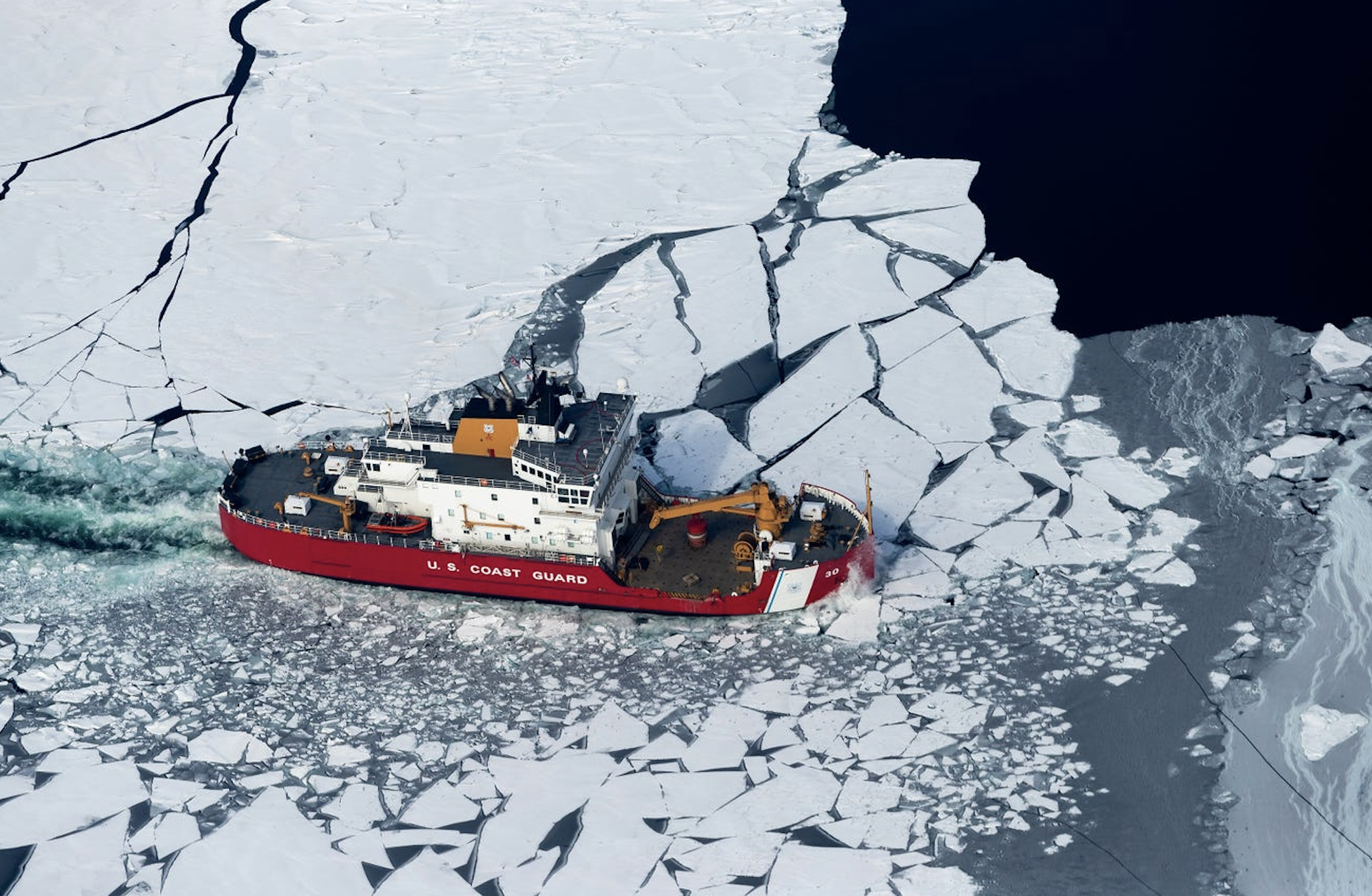
Even though the Great Lakes ice-breaking season has ended, some members of the U.S. Senate Committee on Commerce, Science, and Transportation are continuing to push for funding for a new heavy icebreaker on the Great Lakes to reduce shipping delays during the winter months.
During the first weeks of the shipping season last winter, more than a dozen ships were delayed by ice and gale-force winds. Some were delayed up to 60 hours in Whitefish Bay.
Overall shipping traffic through the Soo Locks during the peak winter season this year was down nearly 50% when compared to last year.
Shipping industry leaders said millions of dollars in losses are at stake for the manufacturing industry, and the Coast Guard must improve its icebreaking capacity. According to the Lake Carriers’ Association, some shipping companies may have held off on sending out ships because of ice in the Great Lakes.
“This was an average or slightly below average ice year, and the Coast Guard didn’t have to do much icebreaking in the southern part of the Great Lakes,” wrote James Weakley, President of the Lake Carriers’ Associations, in an email to WCMU. “They were still unable to keep traffic moving in Lake Superior, the St. Mary’s River and the Straits of Mackinac.”
Coast Guard officials stationed in Sault St. Marie have told WCMU on multiple occasions this season that heavy winds were one of the main reasons for shipping delays this season, and the Coast Guard deployed icebreakers on the Great Lakes since December 2021 to make sure waterways were clear for safe passage.
“There’s obviously a difference of opinion between Congress, the Coast Guard and industry about how to best tackle the challenge of maximizing transit on the Great Lakes during the winter months,” said Senator Todd Young, representing Indiana, during a nomination hearing for Coast Guard Admiral Lisa Fagan, who has been nominated for Commandant of the Coast Guard.
During the hearing, Fagan was asked if she would support the funding and design of a new ice breaker on the Great Lakes.
“I am committed to fielding the icebreaking capacity that we need as a nation, particularly as it pertains to the Great Lakes,” she said. “Our priority is an icebreaker that is at least as capable as the current Mackinaw.”
Fagan added the Coast Guard currently has a fifteen person team working on the design of a new ice breaker. If the ice breaker is approved, it would be included in the 2023 Coast Guard budget.
“This is significant progress and an acknowledgment of need by the USCG,” Lake Carries’ Association Vice President Eric Peace said in an email.
Michigan Radio
Great Lakes cruising season kicks off in Milwaukee with Viking Octantis
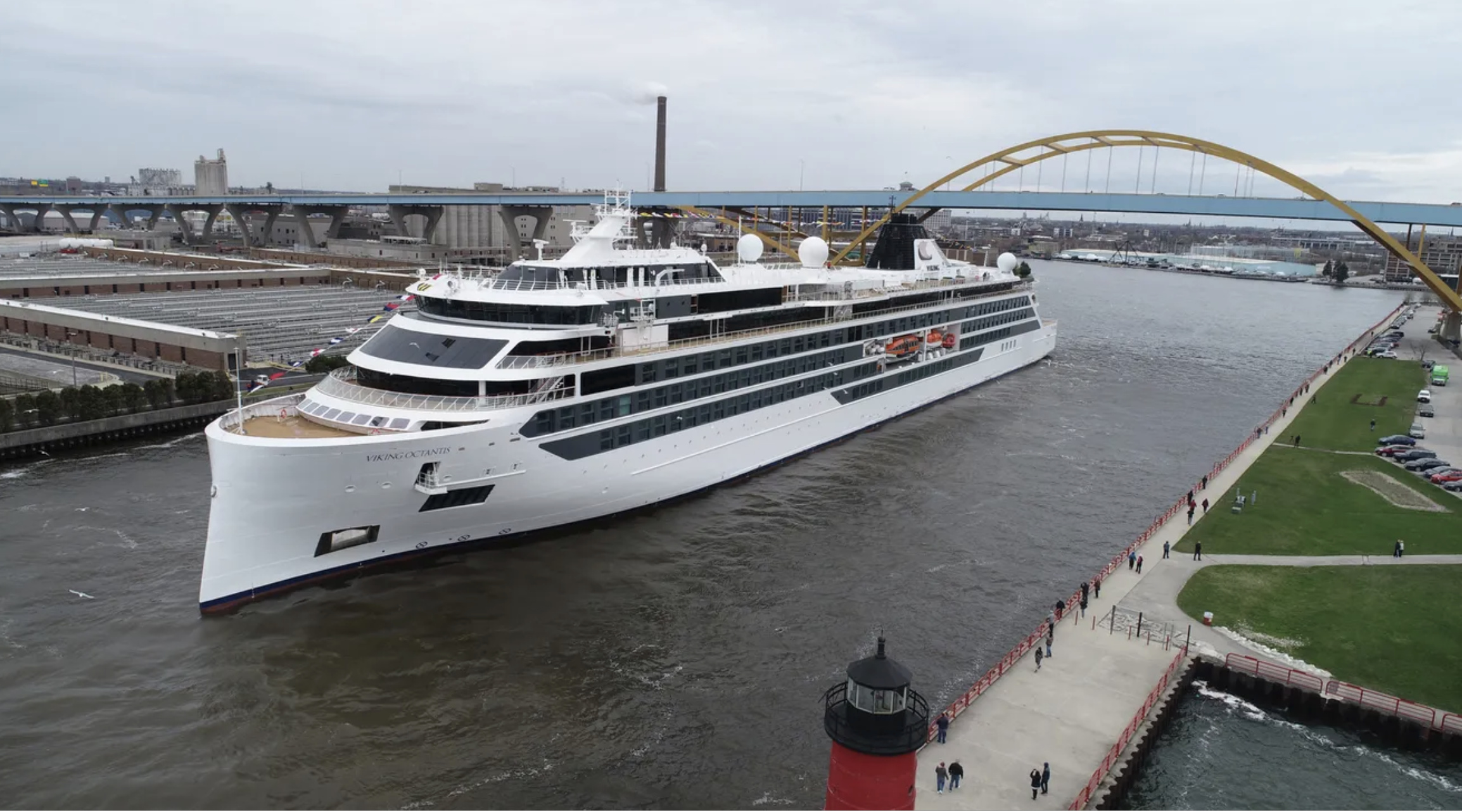
Milwaukee, WI – The Viking Octantis docked at the Port of Milwaukee Friday, marking not only the first cruise ship to visit the city since 2019, but also the first Viking ship to dock here.
The 665-foot, 378-passenger Octantis is the largest cruise ship to sail the Great Lakes and dock in Milwaukee, which is becoming a more popular cruise destination. Fourteen ships were scheduled to dock in the city before the pandemic struck in 2020, up from 10 the previous year. This year, 33 ships are scheduled to bring 10,000 passengers to the city.
Mayor Cavalier Johnson and other politicians and tourism representatives welcomed the ship, praising the efforts of the Port and others to make Milwaukee a cruise destination.
“Today is a wonderful example of just how the city of Milwaukee is creating new partnerships that are exciting and will create much more activity, economic and otherwise, throughout the city,” Johnson said at a press conference after the ship’s arrival. “I’m eager to show off our city to the thousands and thousands of tourists, cruise ship passengers, who will pass through.”
Milwaukee Journal Sentinel
Chuoy the Buoy reports for duty on Lake Michigan, Filling a Chicago-sized gap in monitoring capabilities
Swimmers, boaters, anglers, meteorologists and aquatic researchers now have a new set of eyes continuously monitoring conditions in Lake Michigan.
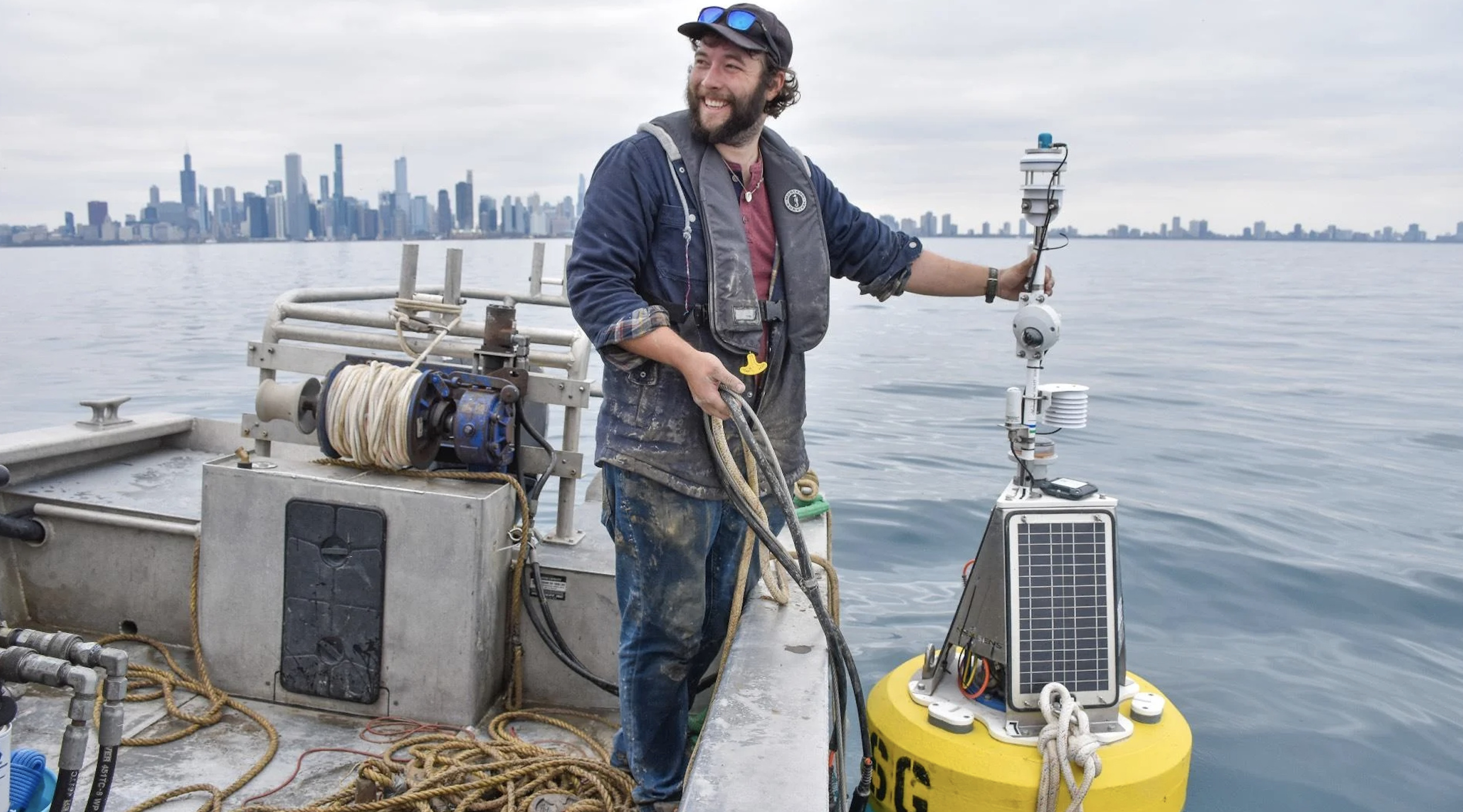
On Monday, a team from Illinois-Indiana Sea Grant deployed their latest data-gathering buoy — Chicago Pier, nicknamed “Chuoy” — a mile and a quarter off Navy Pier, joining Sea Grant’s other buoys in Wilmette and Michigan City, Ind.
Illinois-Indiana Sea Grant, a program co-managed by the University of Illinois and Purdue University, also oversees a pair of buoys for the National Oceanic and Atmospheric Administration; those are positioned in the lake near Waukegan and Winthrop Harbor, respectively.
But weather patterns further north often don’t match what’s occurring on the lake at its southernmost reaches, said Ben Szczygiel, aquatic ecologist and buoy specialist with Sea Grant. Adding Chuoy to the mix will fill a Chicago-sized hole in monitoring capabilities.
Like its fellow buoys, Chuoy will provide a constant stream of real-time information on solar radiation; wind speed and direction; water temperature through the entire water column, from surface to bottom; as well as wave height, direction and period. “Period” refers to the amount of time between waves, Szczygiel explained.
A camera will also capture photos and video from the solar-powered buoy at roughly the top of every hour, he said.
“These are great tools,” Szczygiel said of the buoys. “It would be nice to have one in every harbor,” though at $12,000-$15,000 a piece, the buoys don’t come cheap.
Nonprofit Sea Grant crowdsources funding for the buoys on its own initiative, he said, in order for the data to be freely available to anyone and everyone. The expense is one reason the organization asks boaters to take special care when motoring near the buoys. The Michigan City buoy once took a direct hit, requiring a costly replacement.
The buoys’ publicly accessible data can be found on Sea Grant’s website or a Great Lakes-wide monitoring site maintained by the Great Lakes Observing System.
Getting this information into people’s hands, particularly swimmers and boaters, is a key component of Sea Grant’s mission, which promotes Great Lakes science literacy by combining research, education and outreach. To that end, Chuoy will help people make better informed decisions about whether it’s a safe day to hit the water off Chicago, Szczygiel said.
Up until a decade ago, there was only a single buoy collecting data on Lake Michigan, anchored in the middle of the lake in the 1980s by the National Oceanic and Atmospheric Administration, said Mike Bardou, warning coordination meteorologist in the Chicago office of the National Weather Service.
Crews on board lake-going freighters were another source of weather information, he said, but that was ad hoc, not systematic, and reporting of near-shore conditions was nonexistent, leading to dangerous situations.
Now, when the weather service issues a beach warning or small craft advisory for Chicago, images from Chuoy can help drive the point home.
“We can talk about big waves but that ‘water truth’ will help paint a picture,” said Bardou.
But what makes Lake Michigan waves so deadly isn’t so much the height as it is the period, or timing, with swells coming one after the other in rapid, pummeling succession. That’s a unique aspect of the lake people aren’t as aware of, and it’s what winds up overwhelming swimmers, Castro said.
As it monitors current conditions, Chuoy is also establishing a historic record of Chicago’s near-shore waters.
Bardou said this could be helpful in predicting things like the point at which lake waves will crash over barriers onto DuSable Lake Shore Drive or shoreline homes. “If nothing else, it gives us a threshold going forward of what conditions, like the wind speeds or wind direction, led to this outcome,” he said.
The buoy’s data will have applications outside of meteorology.
Austin Happel, a biologist at the Shedd Aquarium, popped over to Burnham Harbor for Chuoy’s launch and is already dreaming up ways in which the buoy can contribute to his research on urban waterways.
“The buoys collect temperature data, which is a driving factor of how fish behave — when fish spawn, how much they eat,” Happel said. “In the future, I’m hoping to link into this data more to track fish, where they go and how that changes over seasons. At what temperatures do they show up? How do they act when storms come through?”
Chuoy will be in place, weather depending, through late October or early November.
WWTW Chicago
Boatnerd seeking help from volunteers familiar with WordPress
We are in need of someone who has experience with website design and maintenance of our WordPress-based website. Our present volunteer staff does not have the expertise to keep up with it. If you are interested, please email Boatnerd board president Nathan Leindecker to talk about the opportunities.
Nathan Leindecker
nleindecker@gmail.com