64 years ago, Lake Michigan claimed the Carl D. Bradley
ROGERS CITY, MI – Less than 45 miles northwest of Northport and 16 miles southwest of Lake Michigan’s Gull Island lies the remains of the Great Lakes freighter the Carl D. Bradley.
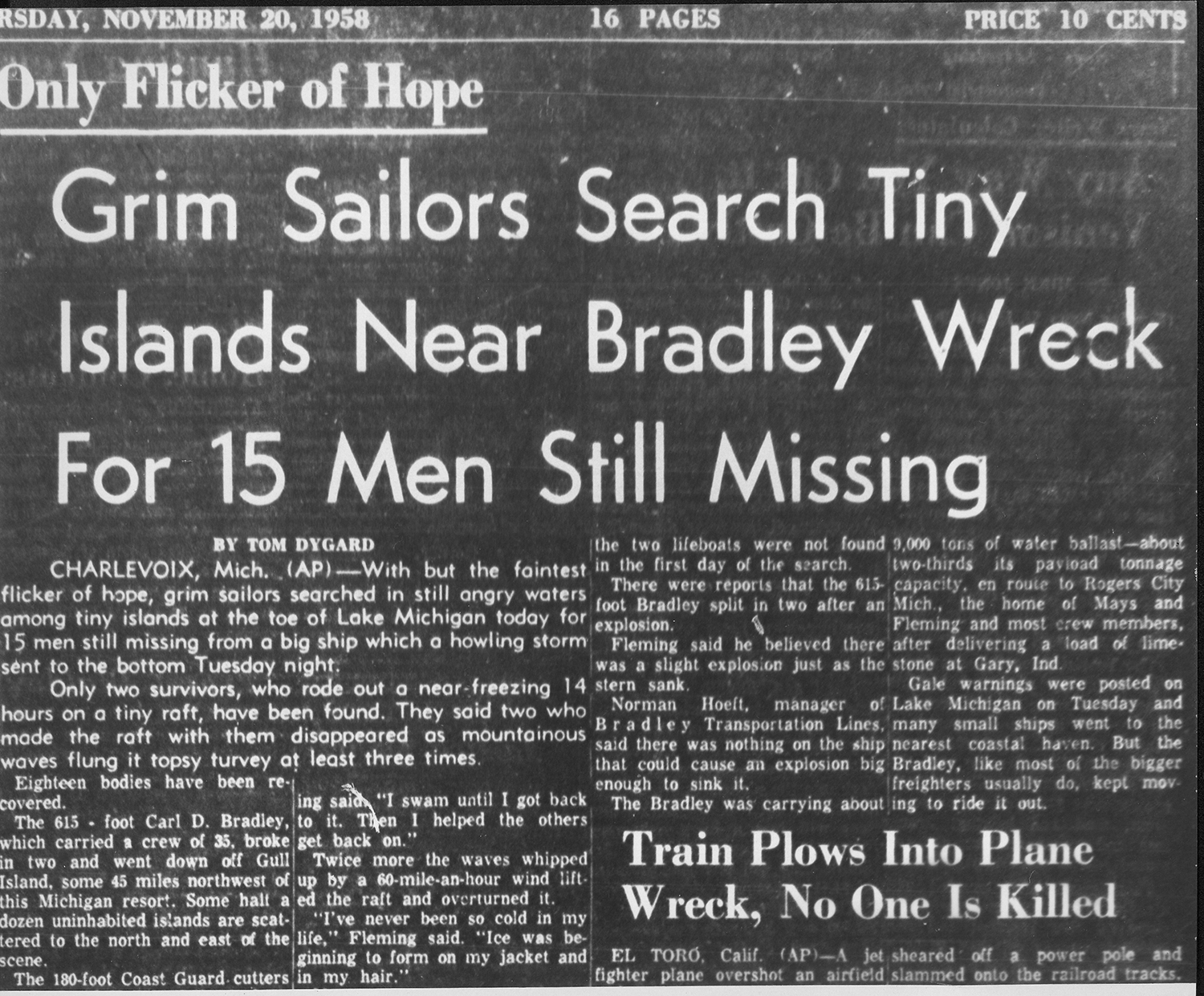
The freighter broke apart in 40-foot waves 64 years ago Friday.
The Bradley’s sinking claimed the most significant Great Lakes crew loss in 70 years, with 33 lives. The 1975 sinking of the Edmund Fitzgerald claimed 29 lives.
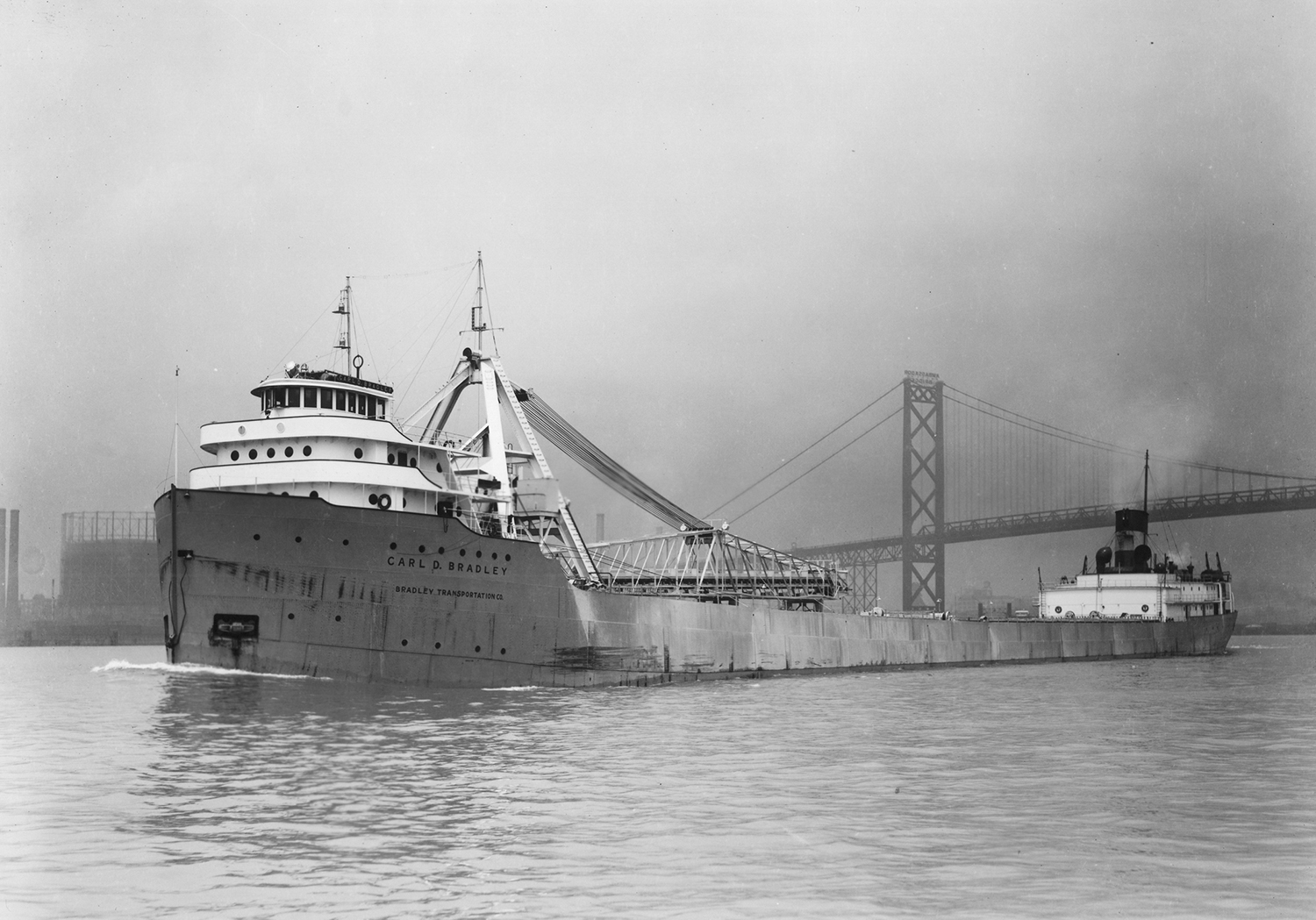
Launched in 1927, the 638-foot Bradley was then the largest and most sophisticated freighter on the lakes. The ship’s frequent homeport was Rogers City and owner was Michigan Limestone and Chemical Co.
On Nov. 17, 1958, after depositing a limestone load, the Bradley departed Gary, Indiana en route to Manitowoc, Wisconsin. There, the freighter was to undergo winter season upgrades and repairs. Mid-route, the captain was directed to return to Rogers City for one last load.
A sudden, every-100-years storm blew in over Lake Michigan causing the empty Bradley to twist and heave between the massive waves. The two survivors, Frank Mays and Elmer Fleming, revealed crewmen could literally hear the rivets popping from the hull.
As it neared 5:30 p.m., Mays recalled he heard a loud thud and then a second thud. From the pilot house, an urgent rescue call was given, “This is the Carl D. Bradley. Mayday! We are going down.”
The Bradley’s final voyage was coming to an end. With a separated bow and stern, the ship plunged 375 feet to Lake Michigan’s bottom. The sinking is estimated to have occurred in less than 15 minutes.
Crewmembers in the pilot house, on deck, and below deck scrambled for their lives. Mays and Fleming were able to make it to an 8-by-10-foot liferaft. Two other crew members joined them, but, through the night, the massive waves and 36-degree water claimed those other crew members.
Mays and Fleming literally held onto the raft’s wooden floor with fingers in between each slat.
With radio and television stations broadcasting the Bradley news, during the night, dozens of emotional Rogers City residents drove their vehicles from their Lake Huron coast to the Lake Michigan shoreline. There, with their vehicle headlights shining on the roaring lake, they looked for Bradley survivors.
The U.S. Coast Guard dispatched an Albatross search-and-rescue plane and the cutter Sundew. As the morning’s sun rays broke, the Sundew’s crew spotted the two survivors on the liferaft. The rescue was very tricky in the 20- to 25-foot waves and frigid winds.
Once Mays and Fleming were rescued, along with retrieving the liferaft, the Sundew headed to Charlevoix, which had the nearest hospital. Eighteen crew member bodies were recovered and 15 were never found.
Read more at this link:
Great Lakes/ St. Lawrence ‘green’ corridor initiative announced at U.N. conference
CLAYTON, NY – Under an initiative announced at a United Nations climate gathering last week, preliminary plans are in the works for a “Great Lakes-St. Lawrence Seaway System Green Shipping Corridor Network.”
The announcement noted that the U.S. Department of Transportation, the U.S. Department of State, and Transport Canada will work with state, provincial, local communities, private-sector and non-governmental leaders, and Indigenous Peoples of Canada and the U.S. to host consultations with ports and other stakeholders. The goal: facilitating the establishment of a Great Lakes Green Shipping Corridor Network.
“It’s a grand initiative if they follow up with it,” said John M. Peach, executive director of the Clayton-based nonprofit environmental advocacy group Save the River. “There’s a lot of initiatives coming out of the COP27. What we have to see is, what’s the follow through?”
“COP27” is the 27th Conference of the Parties to the United Nations Framework Convention on Climate Change, being held in Egypt. The conference began Nov. 6 and concludes on Friday.
“I’d like to see more from them,” Mr. Peach said. “This is a pretty brief announcement of the initiative, and I haven’t seen a lot more.”
A joint statement issued by the American and Canadian embassy and consulates said that the Green Shipping Corridor Network builds on the work launched under the “Joint Statement by the U.S. Department of Transportation and Transport Canada on the Nexus between Transportation and Climate Change,” of February 2021.
The embassies said that green shipping corridors are a key means of spurring the early adoption of zero-emission fuels and technologies to place the shipping sector on a pathway to align with the goal of limiting global temperature rise to 1.5 degrees Celsius.
The 1.5 °C (2.7 degrees Fahrenheit) target is the goal of the 2015 Paris Agreement, which calls for countries to take action to reduce greenhouse gas emissions in order to limit global warming.
“Through the Great Lakes-St. Lawrence Seaway System Green Shipping Corridor Network Initiative, Canada and the United States will work with industry to help facilitate the establishment of green corridors throughout the region, including by convening stakeholders and contributing to assessments and analyses relating to alternative fuels and power options within the system,” according to the joint statement.
Read more at this link: https://www.nny360.com/news/stlawrencecounty/great-lakes-st-lawrence-green-corridor-initiative-announced-at-u-n-conference/article_4f40d19a-39b9-508b-aece-e91dfc3bf28f.html
New Lock at the Soo Phase 3 contractor mobilizes
SAULT STE. MARIE, MI – The U.S. Army Corps of Engineers kicks off Phase 3 construction for the New Lock at the Soo as the contractor mobilizes to the Soo Locks.
Kokosing Alberici Traylor, LLC (KAT), a joint venture headquartered in Westerville, Ohio began moving major equipment to the site via a barge in the Poe Lock on November 3 in between shipping traffic. Mobilization of equipment for Phase 3 marks a big milestone for the project.
The Soo Locks will remain operational during construction of the New Lock at the Soo and without interruptions to shipping traffic.
“KAT started their major mobilization this week with moving project trailers to the site,” Rachel Miller, New Lock at the Soo Supervisory Civil Engineer said. “They previously moved smaller pieces of equipment and have worked over the summer preparing the grounds for upcoming work.”
U.S. Army Corps of Engineers