USCG Cutter Mackinaw will soon make trek as Christmas Tree Ship
CHEBOYGAN COUNTY, Mich. – A special delivery will soon be heading to Chicago.
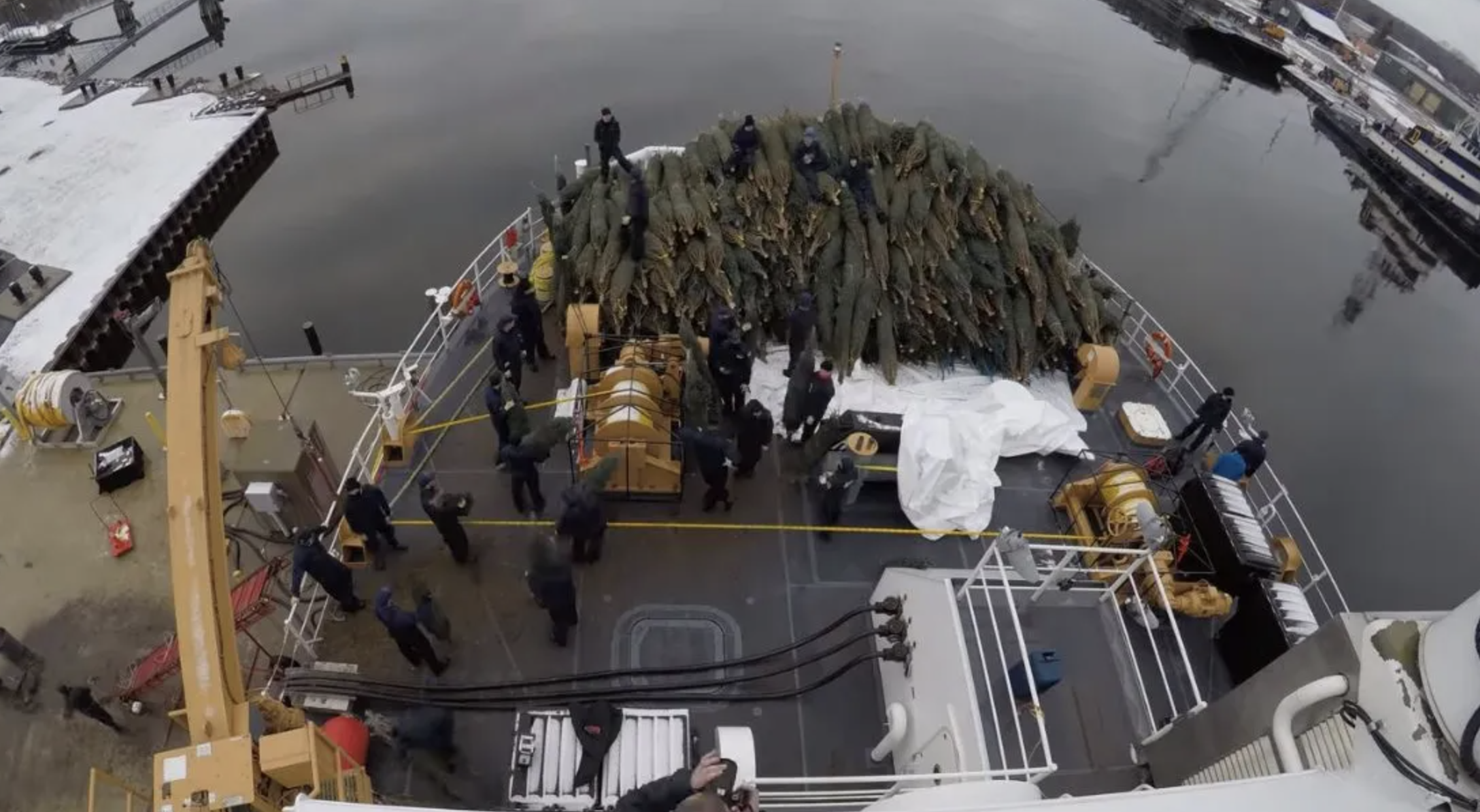
On Tuesday, the U.S. Coast Guard Cutter Mackinaw was loaded with its annual shipment of 1,200 Christmas Trees to deliver holiday cheer to families in need.
This is the 23rd year of carrying on the tradition of the schooner Rouse Simmons, which sank in Lake Michigan in 1912 with a cargo full of Christmas Trees.
More than 30 volunteers helped load the Cutter Mackinaw.Cutter Mackinaw will leave its dock in Cheboygan on November 26.
It’s scheduled to arrive in Chicago around December 1 and will participate in the tree offload and ceremony at Navy Pier, Chicago on Saturday, December 3.
UpNorthLive
Bell from Lake Erie’s deadliest shipwreck goes on display at Toledo museum
While its wreck has been for 172 years the deadliest disaster in Lake Erie’s maritime history, the National Museum of the Great Lakes lacked any reference to the 1850 burning of the passenger steamer G.P. Griffith off the Willoughby, Ohio shore… Until now.
The museum recently added the Griffith’s bell, donated last year by the family of a diver who recovered it back in 1974, to its gallery of Great Lakes shipwreck artifacts.
Several hundred people are believed to have been on board – the exact number and victims’ names are unlikely to ever be known – when the vessel caught fire off the Ohio coast.
“The bell from the Griffith is significant because it represents the worst wreck on Lake Erie in its history,” said Chris Gillcrist, the museum’s executive director. “Also because the wreck occurred near shore, there are no remains left to explore, making the bell one of only a few artifacts from Griffith known to exist.”
A historical marker has long been posted along Lake Erie’s shore in Willowick to commemorate the disaster.
Local diver Louis Key found the bell in 1974 in relatively shallow water and kept it. They were contacted last year by Mr. Key’s relatives after his passing, said Carrie Sowden, the maritime museum’s archaeological director.
“The family was lovely to work with,” she said, and there proved to be just enough space available in the museum’s shipwrecks section to add the bell in a way that blended in.
“It’s exciting to be able to tell this story,” Ms. Sowden said.
The Griffith had left Buffalo on June 16, 1850, and was sailing along Lake Erie’s southern coast toward Toledo when its wheelsman observed sparks coming from around its smokestack that indicated a fire, according to the museum’s historical account.
Charles Roby, its captain, ordered the stricken ship to head toward land in hopes of beaching it, which would allow its passengers to escape. But the Griffith became stranded on a sandbar about a half mile from the shore, and only about 40 of those on board survived.
Any information about who perished was lost with the ship, Ms. Sowden said, and in those days the degree of record-keeping may only have been a log of how many tickets were sold.
Many of the passengers were likely European immigrants traveling by boat to various Great Lakes cities after arriving over land in Buffalo, she said. Most probably did not know how to swim, and they may also have been laden with heavy clothing for the trip even though it was June.
“It’s just this horrific story,” Ms. Sowden said before noting that it was the deadliest disaster on the entire Great Lakes until 1915, when the S.S. Eastland rolled onto its side while docked in Chicago, killing 844 of the more than 2,500 people on board awaiting a brief voyage to northern Indiana.
Ms. Sowden noted that rather than being polished, the Griffith’s bell has a weathered appearance consistent with having been under water for well over a century.
“We chose that deliberately” so that museum-goers could see how the underwater environment affected it, she said.
Toledo Blade