Impending Manitou Islands closure
may put ferry out of business
National Park Service building new Manitou Island docks
By Garret Ellison | gellison@mlive.com
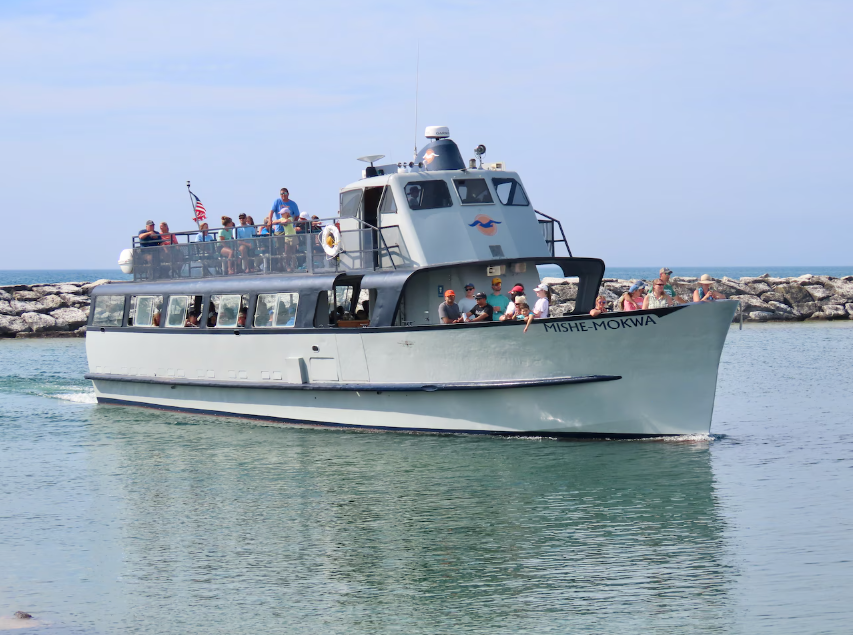
LELAND, MI — The impending closure of North and South Manitou islands during a multi-year infrastructure project at the Sleeping Bear Dunes National Lakeshore may spell the end for a 107-year-old Michigan ferry service.
The owners of Manitou Island Transit, which ferries visitors to the two islands in Lake Michigan, warn the business may close permanently if the National Park Service follows though on plans to close the islands to visitors for two or more years.
North Manitou is scheduled to close for 2025 and possibly longer while a new dock is built, and island village water and electric systems are upgraded. South Manitou is scheduled to close for 2026 and possibly longer for the same reason.
The National Park Service has not yet announced the closures.
The ferry service, which has struggled financially in recent years due to access problems caused by unsafe dockages, will likely be forced to shut down, its owners say.
They are considering filing another lawsuit against the Park Service, which they successfully sued for breach of contract in 2021 over dredging delays.
If the ferry doors close, it’ll be for good.
“If they shut us down — which they’re doing right now — there will never be a ferry boat back there again out of Leland,” said Jimmy Munoz, captain of the Mishe-Mowka ferry.
“They can say all they want to after putting us through this, but it isn’t happening,” he said. “If they go through with this, that part of history is over.”
Related: Manitou docks to be rebuilt after chronic shoaling
Island closure plans for 2025 and beyond
According to the Park Service, island closures are an unfortunate necessity in order to build new docks as part of a $32 million project funded in its fiscal 2024 budget using money appropriated by Congress under the 2020 Great American Outdoors Act.
Those with private boats could still visit the islands, but they couldn’t use the docks or visit the villages while workers dig them up to replace water pipes, septic fields and electrical systems — which are all happening under the same contract.
The Park Service awarded a nearly $28 million contract to Coastal Construction Group of Cheboygan for the project on Sept. 26. Parts of the contract remain in negotiation and the government’s goal is to have a finalized contract in place by January.
Scott Tucker, Sleeping Bear Dunes superintendent, said the plan is to close North Manitou next spring and finish the work before the end of 2025. The work would switch to South Manitou in 2026, which would be closed under a similar timeline.
North Manitou work could extend into 2026 due to delays and weather conditions. South Manitou work could extend into 2027 for the same reasons.
“There’s a lot of unknowns based around the contractor schedule,” said Tucker. “Worst case scenario; each island (is) closed for two years.”
The closure is for safety reasons, said Tucker.
While the work is underway on South Manitou, “there’s going to be six-foot trenches through the entire village,” Tucker said. “There’s going to be no way for visitors to safely get through that large construction zone. Same thing on North.”
But it hasn’t been determined whether the existing docks will stay in place or be removed while the new docks are being built, said Tucker. “We still don’t know yet.”
Dredging dispute has cascading impacts
The focus on visitor safety feels ironic to Manitou Transit owners, who’ve disputed the safety of a temporary dock built on North Manitou to accommodate the ferry, which has struggled to reach the island due to sand shoaling around the existing dock.
The ferry did not service North Manitou for most 2023 and 2024, saying the temporary dock extension is too exposed to the unruly Manitou Passage.
Munoz says the 61-foot ferry rocks hard while berthed at the new temporary dock and tying-up proved unsafe and unworkable — as would be getting passengers on-and-off using a gangplank, which the Park Service suggested as a work-around.
The wave energy reflecting off the dock “creates this crazy motion that a boat can’t sit in,” he said. “Even in a one-foot swell, the boat doesn’t know which way to rock.”
“There’s no way to tie-up correctly in that situation,” Munoz said. “It makes a boat like a pendulum, with the difference being you have lines tied to that dock. But it keeps trying to pull harder and harder, and every time it comes back, it goes that much further, and eventually lines snap.”
“It makes a very dangerous situation.”
Manitou Island docks relocation
Munoz said he took the ferry to North Manitou four times this summer “because I was trying to show them why it wouldn’t work,” he said. “We asked them not to build it.”
In February, Munoz met with the Park Service to discuss options for a new temporary dock. He suggested a floating dock with various placements — but definitely not directly east into unprotected waters off the T-section of the existing dock.
“And that’s exactly where they put it,” he said.
“This is the first time since the park was established that an island has been inaccessible,” Munoz said. “Are they becoming harder to deal with? The answer would be ‘yes.’”
Another lawsuit is brewing, say ferry owners
Operating a ferry has been an increasingly frustrating endeavor for the Munoz family ever since the waters of Lake Michigan began to rise to record levels a few years ago.
The Mishe-Mowka sat idle in 2020 because rising lake levels increased shoaling around the North Manitou dock and lifted the South Manitou dock off its pilings, making both landings unsafe.
North wasn’t dredged until August 2020 and South’s dock wasn’t fixed until 2021, rendering 2020 a total wash during a year of record park attendance.
The company sued for breach of contract, arguing that the park knew about the problem and dropped the ball on dredging. The business was pushed into near-insolvency and force to seek a loan to stay afloat. A federal Court of Claims judge sided with them last fall, but granted a concession to the park’s argument that pandemic upheaval was a factor in 2020 delays.
The business wants compensation for not being able to service North Manitou this year, but isn’t getting anywhere. Tucker said the government feels the dock was safe and Manitou Transit could have run passengers “but chose not to.”
“Unfortunately, there is no legal way for the National Park Service to buy out a contract, to pay them not to run,” he said.
The ferry owners feel like they’re being forced to sue again.
Jimmy and Megan Munoz, who co-own the business with other family members, say it is financially infeasible to operate the ferry under the construction schedule.
Their existing contract expires in 2029. The contract is exclusive and amounts to a monopoly, but the business is wholly dependent on the federal government — which took property on the islands from the business when the park was established in the 1970s — to provide and maintain a dock.
In an October letter from federal Interior Department attorneys, the business was told “there is no path to continue operations while this work is being performed.”
Unlike most Park Service concessioner contracts, Manitou Transit operates from its own dockside property and must maintain its boat, parking lots, insurance policies and incur other operating and equipment costs associated with ferrying passengers safely.
It isn’t massively profitable. In their 2021 lawsuit, the company claimed only $500,000 in damages from the 2020 season loss. The park takes a 4 percent cut of gross receipts.
The islands don’t draw huge visitor numbers. They account for about 28 percent of the park’s total 71,000 acres but a tiny fraction of its annual attendance. In 2022, the most recent year with normal service to North Manitou, 10,658 people visited both islands — 6,427 to South and 4,231 to North. That’s less than 1 percent of the 1.5 million park visitors that year.
This year, 249 people visited North and 8,251 visited South.
Because they are federal wilderness, the islands tend to draw daytrippers and advanced backpackers. A round-trip ferry ticket is $45 for adults, $23 for kids. The season is generally Memorial Day to Labor Day with some fall service on weekends.
The owners each work other jobs in the off-season to make ends meet, they said. Taking out another loan isn’t an option because they’re still paying back the first one.
Ferry service disruptions hasn’t played well with customers, either. Canceled reservations and schedule changes cause angry phone calls and bad reviews, they said.
“We have to jump through hoops to make sure everything is perfect, but they can just say, ‘Oh, sorry. You’re out of luck for two years,’” said Megan Munoz. “They make it nearly impossible to run a successful business.”
If the ferry service closes, the islands might simply be inaccessible for a while to anyone without their own boat.
Tucker said the Park Service would simply put out a new prospectus in 2028 for the next 10-year ferry contract.
As for where another boat might port, there aren’t many options besides Leland, from which it takes 1.5 hours to go 15 miles.
“It could come out of Frankfort,” Tucker said, which is roughly 30 to 40 miles away from the two islands.
Link to article and many pictures: https://www.mlive.com/environment/2024/11/impending-manitou-islands-closure-may-put-ferry-out-of-business.html?e=62ea06b573d7c671e4e794b4329ab333
Lakes Limestone Trade Down in October
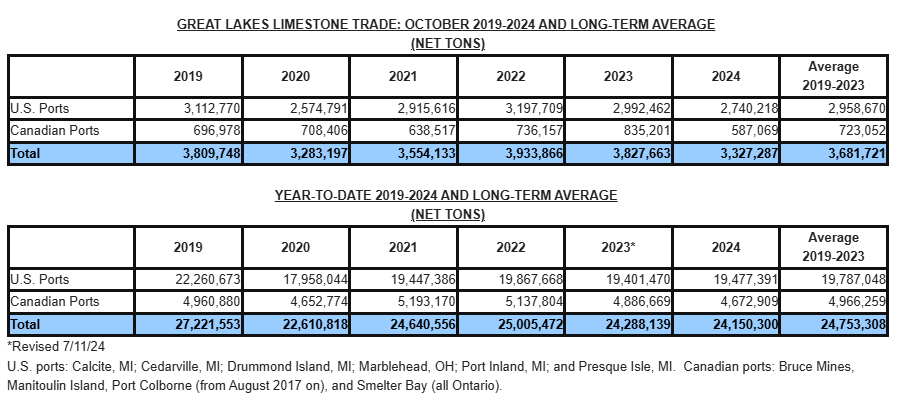
CLEVELAND — Shipments of limestone on the Great Lakes totaled 3.3 million tons in October, a decrease of 13.1 percent compared to a year ago. Limestone cargos were also below the month’s 5-year average by 9.6 percent.
Loadings from U.S. quarries totaled 2.7 million tons, a decrease of 8.4 percent. Shipments from Canadian quarries totaled 587,069 tons, a decrease of 29.7 percent.
Year-to-date the limestone trade stands at 24.2 million tons, a slight decrease compared to 2023. Loadings from Michigan and Ohio quarries total 19.5 million tons, a near match to last year. Shipments from Ontario quarries total 4.7 million tons, a decrease of 4.4 percent.
Refer To Charts in Gallery below
U.S. ports: Calcite, MI; Cedarville, MI; Drummond Island, MI; Marblehead, OH; Port Inland, MI; and Presque Isle, MI. Canadian ports: Bruce Mines, Manitoulin Island, Port Colborne (from August 2017 on), and Smelter Bay (all Ontario).
Lost Mariners Remembrance ceremony being held in Detroit this weekend on Edmund Fitzgerald anniversray
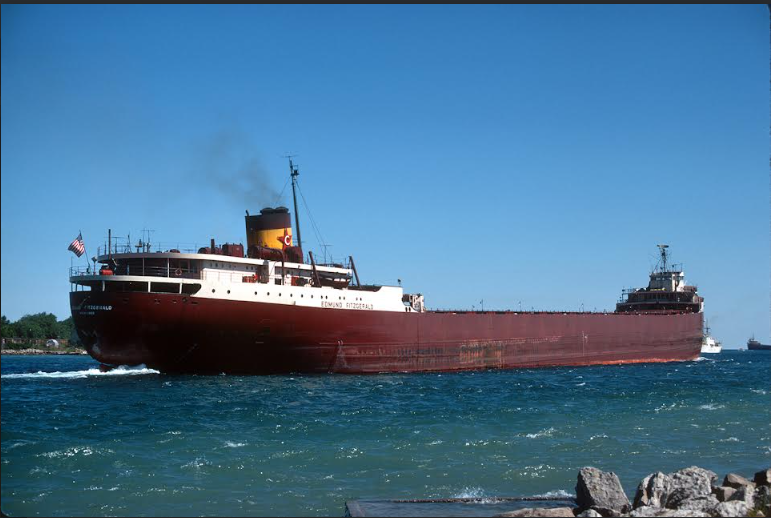
The Edmund Fitzgerald sank on Nov. 10, 1975 in Lake Superior, in a violent storm on the lake. November can be a turbulent month for weather across Michigan, and gales – very strong winds – are common on the Great Lakes. Intense areas of low pressure can sweep across the Great Lakes region bringing arctic air masses. The relatively warm waters of the Great Lakes can help storms intensify and produce life-threatening conditions.
Posted 8:06 AM, Nov 04, 2024 and last updated 8:24 AM, Nov 04, 2024
The Detroit Historical Society is honoring lost mariners during its annual Lost Mariners Remembrance this weekend in Detroit.
It’s the 25th year the society has held the event, which also marks the anniversary of the sinking of the S.S. Edmund Fitzgerald.
This year’s event will take place Sunday, Nov. 10 at the Dossin Great Lakes Museum on Belle Isle.
It will start with a lantern ceremony at the S.S. Edmund Fitzgerald anchor, and then Lee Murdock, a celebrated balladeer of the Great Lakes, will perform at 6:15 p.m.
There will also be a wreath ceremony, a lost vessel tribute, a final blessing and then the playing of the “Wreck of the Edmund Fitzgerald” by Gordon Lightfoot.
Tickets are $10 for members and $15 for the general public.
Shipwreck Society makes 49th Edmund Fitzgerald Memorial Ceremony closed to the public
The Great Lakes Shipwreck Historical Society’s Annual Edmund Fitzgerald Memorial Ceremony is always a solemn event, but again this year, it will be closed to the public. Due to the museum’s small size and inability to accommodate the many people who typically want to attend, the decision has been made to keep the event private. This memorial service has always been primarily intended for the families of those lost on the Fitzgerald when it sank 17 miles northwest of Whitefish Point on November 10th, 1975.
However, recognizing the wider community’s interest, the Shipwreck Society has upgraded its technology to ensure the memorial can still be experienced by many. The event will be live-streamed, with a link to follow, allowing the public to participate virtually while maintaining an intimate atmosphere for the families attending in person. This combination of preserving the event’s personal nature while expanding access is a thoughtful way to honor the memory of those lost and to include those who wish to pay their respects from afar.
This event will be live-streaming from Whitefish Point starting before 7pm on Sunday, 11-10-2024 and ending after 8pm. Please stay tuned for more information.
There will also be an opportunity to see this event at the Michigan Maritime Museum in South Haven, MI where they will host a simulcast of the broadcast of our stream in real time. If you’re in that area call the MMM at (269) 637-8078 for more information. There has been a flood of questions about the 50th anniversary Edmund Fitzgerald Memorial Ceremony. We do have plans for a public event that we will release in 2025. Any questions about the 49th event please reach out to:
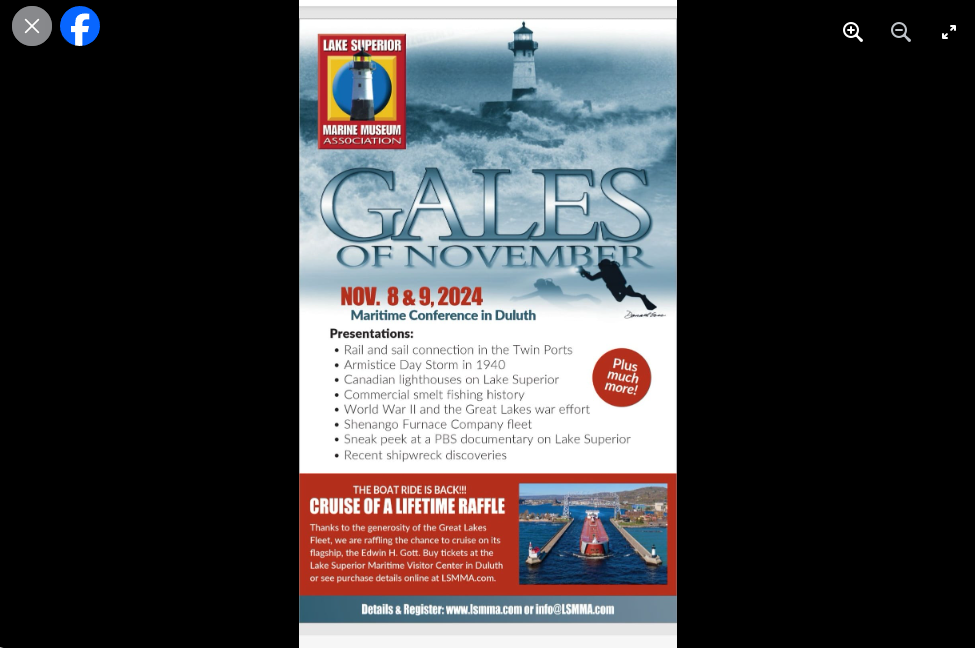
Gales of November 8-9
See flier below. Help support the Lake Superior Maritime Museum Association.
See flyer below.
National Museum offers “Fitzgerald Experience 2024”
Toledo, OH – In honor of the 49th Anniversary of the loss of the S.S. Edmund Fitzgerald on November 10, 1975, the National Museum of the Great Lakes is offering a weekend of special tours. The Fitzgerald Experience is a guided tour of the Col. James M. Schoonmaker Museum Ship, using the lake freighter and its similarities to the Edmund Fitzgerald to discuss the events of November 10, 1975, theories about the sinking and stories about the 29 crew members who were lost. This tour is approximately 75 minutes long.
Tickets are $20 for members and $25 for non-members. Each tour will be limited to 8 people. Guests also receive a museum store discount of 10% (non-members) / 20% (members) off in-store purchases. Tours are offered every half hour from 10 a.m. – 3:30 p.m. on Saturday, November 9 and from noon – 3:30 p.m. on Sunday, November 10.
Your tour purchase includes admission to the National Museum of the Great Lakes.
Due to its historical accuracy, the Col. James M. Schoonmaker Museum Ship is not ADA accessible. Narrow, steep staircases are common throughout the Schoonmaker and may provide difficulties in accessibility for some.
The Schoonmaker is also not heated and much of the tour is on uncovered decks. We encourage you to dress appropriately for the weather. If we determine that the weather has made these tours impossible, we will provide a refund of the ticket price (minus fees). If the program is cancelled, we are not planning a make-up date.
You can process a refund (minus fees) and cancel your ticket up to 7 days before the event. Go here to buy tickets: https://www.eventbrite.com/e/the-fitzgerald-experience-2024-tickets-1043046027747?aff=ebemoffollowpublishemail&ref=eemail&utm_campaign=following_published_event&utm_content=follow_notification&utm_medium=email&utm_source=eventbrite