Iron, steel, petroleum continues to drive tonnage through St. Lawrence Seaway
The St. Lawrence Seaway announced its September performance figures, with 23.6 million mt (metric tons) of cargo shipped since the beginning of the navigation season.
While overall tonnage is slightly down compared to last year, iron, steel, petroleum and potash demonstrate positive trends that underscore the seaway’s role in North American supply chains, with indications of a strong finish for grain this season also expected.
“As we enter the fall, a busy time for grain harvests, we are ready to support our partners with the immediate capacity to accommodate increased traffic,” said Jim Athanasiou, president and CEO of the St. Lawrence Seaway Management Corporation. “The St. Lawrence Seaway is committed to providing a reliable and sustainable link in the supply chain, ensuring the movement of diverse commodities that contribute to the growth of our economies.”
The Great Lakes-St. Lawrence Seaway System serves as a key transportation corridor, facilitating the flow of essential commodities, such as grain and potash, critical for North American and global economies. This robust system supports over 241,000 jobs and numerous industries while prioritizing sustainability and efficiency in marine shipping.
“September’s tonnage report re-affirms that the Great Lakes St. Lawrence Seaway system is a dependable shipping corridor enabling U.S. growers, producers and manufacturers to reach the world economy and keep costs low,” said Adam Tindall-Schlicht, administrator, Great Lakes St. Lawrence Seaway Development Corporation. “With a busy few months remaining in the 2024 season, we’re confident that Great Lakes ports are ready to finish the year strong.”
Cargos that showed increases compared to the same period in 2023 include:
Grain: 6.2 million mt of Canadian and U.S. grain, up by 251,000 mt or 4.2 per cent
Potash: 1.1 million mt up by 200,000 mt or 21 per cent (used primarily as an agricultural fertilizer)
Petroleum products: 2.2 million mt, up by 487,000 mt or 28.8 per cent
Iron and steel: 1.5 million mt up by 313,000 mt or 26 per cent
Inside Logistics
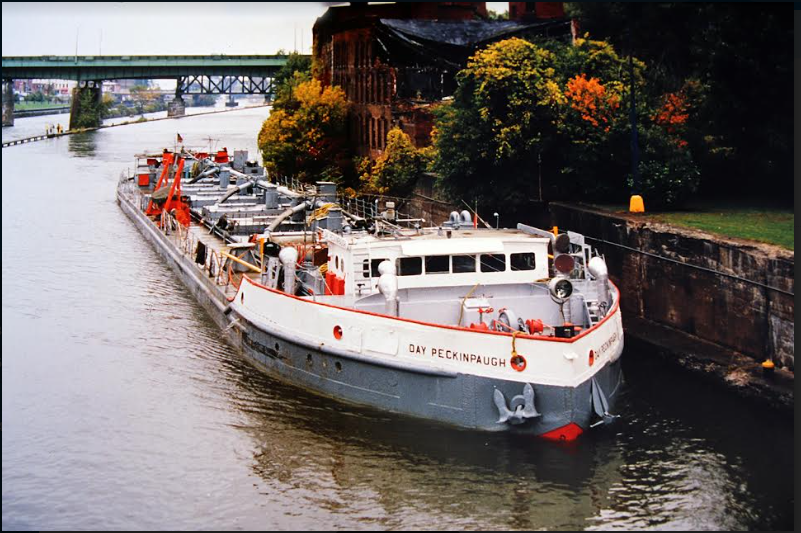
1921 Duluth-built Canal vessel Day Peckinpaugh for sale
Day Peckinpaugh, the last working freighter on the Erie Canal when she was retired in 1994, she has been offered for sale by the State of New York after several years of failed preservation attempts.
Built narrow and low to clear bridges and canal locks, she saw service on the Great Lakes and in World War II before ending her career as q self-unloading dry cement hauler.
The 259-foot-long Day Peckinpaugh was built by the McDougall-Duluth Shipyard in Duluth, MN, the first boat specially designed and built for New York State Barge Canal, the successor to the famed Erie Canal. The ship was originally named ILI 101 after the ship’s first owner, the Interwaterways Lines Inc. of New York City. The ship was the first specifically designed to ply the open waters of the Great Lakes as well as the narrow locks and shallow waterways of the barge canal. Day Peckinpaugh is also the last surviving ship from a fleet of more than 100 of her type that once carried freight from the upper Midwest to the port of New York City.
During World War II, by then named Richard J. Barnes, was drafted into the US Merchant Marine to carry coal and refuel cargo ships along the east coast of the United States. During her Merchant Marine service Richard J. Barnes was attacked by a German U-boat which fired a torpedo at her; the torpedo was thought to have passed under the ship due to her shallow seven-foot draft.
In 1958, the ship was sold to Erie Navigation and retrofitted to carry sand and gravel. The ship was again renamed, becoming Day Peckinpaugh, in honor of the man of the same name, brother of the New York Yankees player and manager, Roger Peckinpaugh.
The ship was converted to a self-unloading dry cement hauler in 1961 and used to carry cement from Oswego to Rome, New York. until her retirement in 1994. Day Peckinpaugh was the last self-propelled regularly scheduled commercial hauler on the barge canal.
In 2005, Day Peckinpaugh was saved from the scrap yard by a partnership of museums and canal preservation societies with a goat to restore and convert her into a floating classroom and museum to highlight the history and heritage of the Erie Canal and the Great Lakes. In late 2011 the New York State Department of Education received a $191,000 grant to outfit the vessel for that purpose with restoration scheduled for completion in 2012.
On March 8, 2010, Guy J. Pucci, a 35-year-old ex-state employee was arrested after almost completely sinking the ship while she was docked at Lock 2 of the Barge Canal undergoing restoration. The ship sustained extensive damage due to the flooding, and repairs were estimated to be in excess of $10,000. As of 2018, it was considered a possible candidate for sinking as a reef due to maintenance costs.
For information on the sale, go here: https://www.govdeals.com/asset/3335/23762
Read more about the vessel here: http://www.tug44.org/canal.corp.boats/day-peckinpaugh/
Marine Mart planned for Oct. 12
The Great Lakes Maritime Institute will host its 43rd annual Marine Mart Oct, 12 in St. Clair Shores, MI. See the flier in the photo gallery for details.
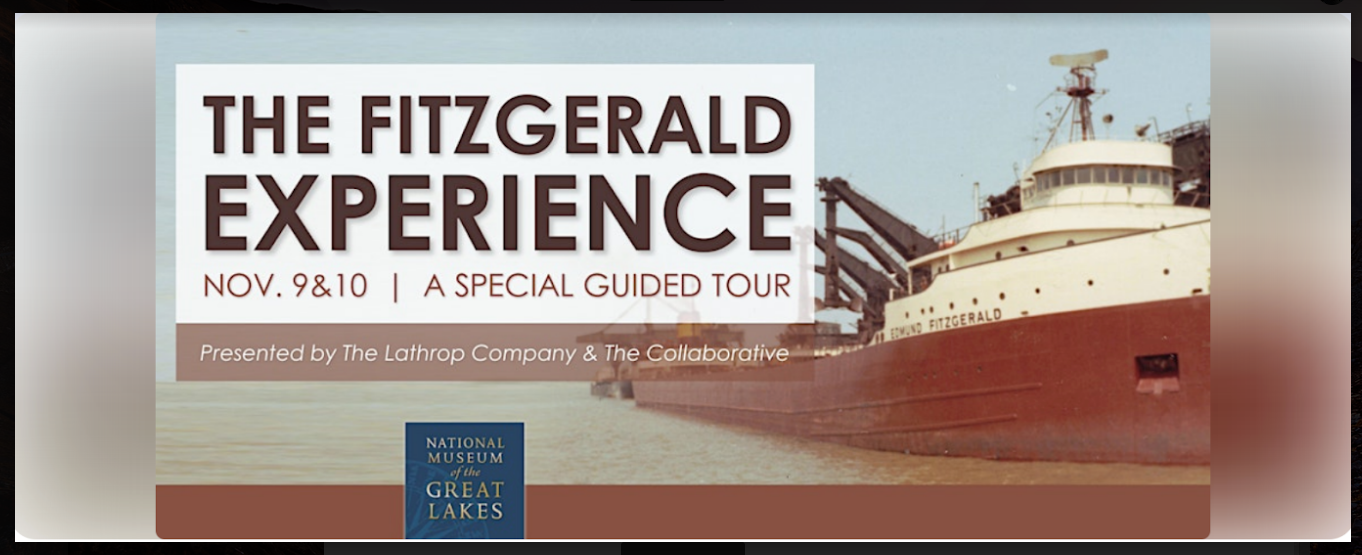
National Museum offers “Fitzgerald Experience 2024”
Toledo, OH – In honor of the 49th Anniversary of the loss of the S.S. Edmund Fitzgerald on November 10, 1975, the National Museum of the Great Lakes is offering a weekend of special tours. The Fitzgerald Experience is a guided tour of the Col. James M. Schoonmaker Museum Ship, using the lake freighter and its similarities to the Edmund Fitzgerald to discuss the events of November 10, 1975, theories about the sinking and stories about the 29 crew members who were lost. This tour is approximately 75 minutes long.
Tickets are $20 for members and $25 for non-members. Each tour will be limited to 8 people. Guests also receive a museum store discount of 10% (non-members) / 20% (members) off in-store purchases. Tours are offered every half hour from 10 a.m. – 3:30 p.m. on Saturday, November 9 and from noon – 3:30 p.m. on Sunday, November 10.
Your tour purchase includes admission to the National Museum of the Great Lakes.
Due to its historical accuracy, the Col. James M. Schoonmaker Museum Ship is not ADA accessible. Narrow, steep staircases are common throughout the Schoonmaker and may provide difficulties in accessibility for some.
The Schoonmaker is also not heated and much of the tour is on uncovered decks. We encourage you to dress appropriately for the weather. If we determine that the weather has made these tours impossible, we will provide a refund of the ticket price (minus fees). If the program is cancelled, we are not planning a make-up date.
You can process a refund (minus fees) and cancel your ticket up to 7 days before the event. Go here to buy tickets: https://www.eventbrite.com/e/the-fitzgerald-experience-2024-tickets-1043046027747?aff=ebemoffollowpublishemail&ref=eemail&utm_campaign=following_published_event&utm_content=follow_notification&utm_medium=email&utm_source=eventbrite