UPDATE: As of 08:00 Friday, Calumet is free and headed up the Saginaw River passing through Bay City.
Calumet grounds in Saginaw River
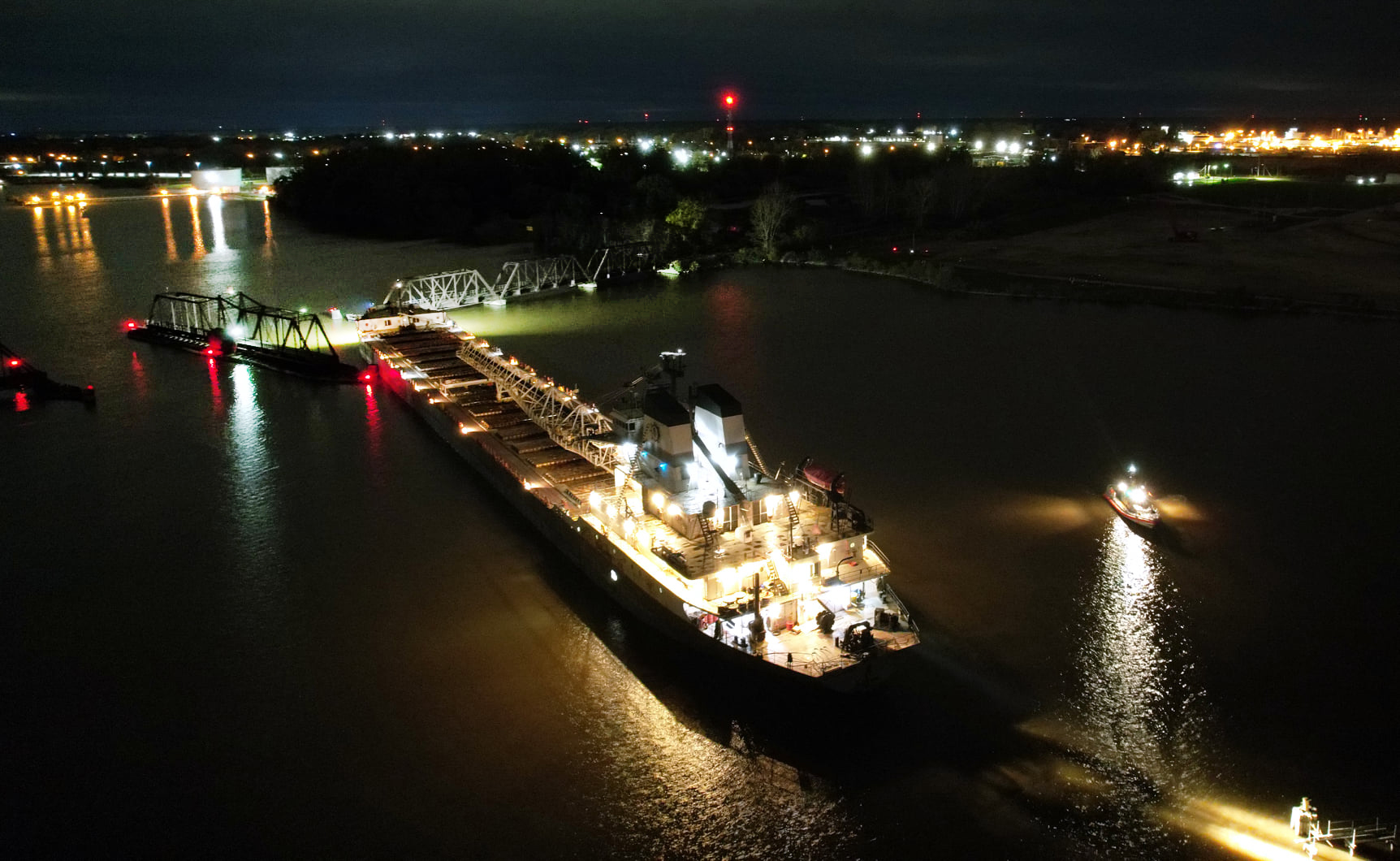
Saginaw, MI – The motor vessel Calumet was aground in the Saginaw River just below the Lake State Railway Bridge in Essexville, MI, Thursday evening, according to a U.S. Coast Guard notice to mariners. Calumet was inbound on the Saginaw River, Thursday evening, headed upriver to unload at a Saginaw Area dock. Approaching the Lake State Railway Bridge in Essexville around 7:30pm, Calumet encountered some difficulty, becoming crossways in the shipping channel, with her port side resting against the Dolphin that protects the downriver side of the center swing span of the bridge and her stern out of the channel, toward the east side of the river. U. S. Coast Guard Sector Detroit put out a Notice to Mariners at 9:45 pm, advising that the M/V Calumet was aground in the Saginaw River shipping channel near the Lake State Railway Bridge. U.S Coast Guard Station Saginaw River had assets on scene. The dock off the stern of Calumet is the old Blue Knight Energy Partners fuel dock.
Todd Shorkey
SS Badger to head to drydock next month for inspection, new paint job
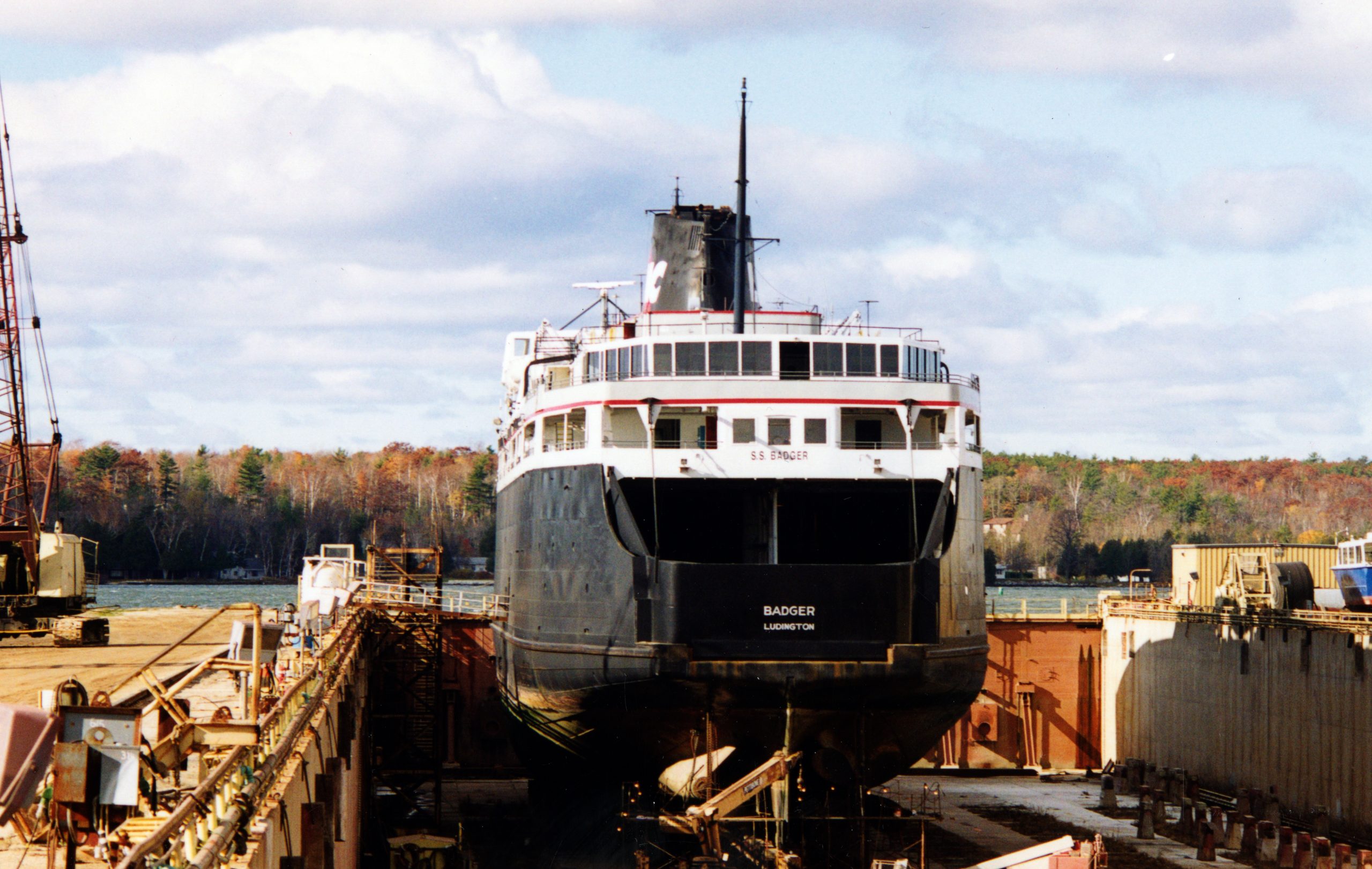
Ludington, MI – The SS Badger will soon be on its way to Sturgeon Bay for its inspections in drydock as well as to receive a fresh coat of paint.
The ship will undergo its required inspection that takes place every five years. Along with the inspection, Lake Michigan Carferry General Manager Sara Spore said the ship will come back with fresh look.
“We’re still working on an exact date,” Spore said Wednesday. “In the beginning of November, it will be towed over to drydock for its five-year inspection. The most notable work with will be sand-blasting and repainting it this year. I don’t think it’s happened since it was owned by the railroad.”
Spore said during the repainting will retain the ship’s traditional black and white with red and white stripes. Should something strike the paint, Spore said the operators will be able to determine where it occurred with a different color showing. The paint on it was done in spots, but not the entire ship.
“It’s been quite a while (since it was repainted). There’s spots where this paint doesn’t match that paint. It’ll look nice when it comes out,” Spore said.
Another upgrade coming to the ship is the replacement of the lifeboats with rescue boats. Spore said the company will need to change the davits — or small cranes on board the ship that allow for the boats to be lowered into the water, should the need arise.
She wasn’t sure what would happen with the lifeboats currently on board the SS Badger. In the past, locals have acquired a previously used lifeboat. Spore said one might be converted into a parade float.
The primary work ahead, though, is the inspection of the ship as it’s pulled by a tug from Ludington to Sturgeon Bay, Wisconsin. Spore said Interlake Steamship, the parent company to LMC, has a new ship being constructed at Fincantieri Bay Shipbuilding. The 639-foot ship, called the Mark W. Barker, was expected to launch this month.
“A lot of the inspection that happens, people don’t see it,” Spore said. “It’s in the engine room (and other areas). Right now, we’re tentatively scheduled to be there on Nov. 15, but it all depends on where the other boats are. It’ll leave in early November. We’re looking at a date, and we’re working with a towing company.”
The inspection itself is expected to last 10 days, and preparations include removing the ship’s propellers among other items. The repainting of the ship is expected to take a good amount of time, too.
“It’s all going to depend on what they find,” Spore said. “The painting alone is going to depend on how many layers of paint there are. We’re assuming we know, but we don’t really know. There’s a lot of years there.”
The company is looking at upgrading some of the services it provides passengers.
No matter what the company does — whether seen by passengers or not — it has to meet the approval from the U.S. Coast Guard. Away from the ship, LMC plans to do some upgrades to the security of docking areas for the ship — in Ludington and Manitowoc, Wisconsin, Spore said. Overall, Spore said the Badger is likely to be away from Ludington for about a month.
Spore said the SS Spartan was surveyed to see what, if anything, could be done with it. “We’ve had engineers looking at the Spartan still assessing the options on that boat,” she said. “We’re still coming to a decision. It’s sat there a long time and with no maintenance. We’re really evaluating the best use for it.”
The Spartan has been tied up alongside its sister vessel, the Badger, and was idled in 1979. At times, it has been used as a training ground for law enforcement and the National Guard. Various other uses for the Spartan have been proposed. Spore said the ship’s future is undetermined.
“There’s always pie-in-the-sky dreams,” she said, “but operating a carferry is very expensive. I don’t know what the future holds for it. We’re evaluating it.”
Ludington Daily News
Expanded maritime container capability now available at Duluth’s Clure Public Marine Terminal
Duluth, MN – Port officials announced Thursday that Duluth’s Clure Public Marine Terminal now has the ability to handle significantly larger volumes of international shipping containers transported by vessel, in an expansion that will augment existing road- and rail-based intermodal container service under the Duluth Cargo Connect banner.
Through recent investments in infrastructure and capabilities to ensure homeland security compliance, Duluth now becomes only the second United States port on the Great Lakes-St. Lawrence Seaway System capable of handling containers by direct water connection and the only such port west of Cleveland, Ohio.
“Our Clure Terminal is a full-service multimodal logistics hub for the Upper Midwest, so it’s only natural that we offer the advantages of maritime container handling to complement our land-based network,” said Deb DeLuca, executive director of the Duluth Seaway Port Authority. “We’ve been nurturing this potential for a while and we’re excited to see it coming to fruition. Considering the significant congestion and delays occurring at some coastal ports, we provide a fluid alternative for containers to move inland and bypass those coastal bottlenecks.”
As North America’s furthest-inland seaport, Duluth is an attractive, uncongested choice for shippers looking to move containerized cargo to and from America’s heartland. In recent years, that activity included only land-based movement on the region’s highways or four Class I railroads serving the Clure Terminal. This new waterborne container option is available now, exclusively through Duluth Cargo Connect.
“We’re excited about expanding our container services to include a direct maritime connection over our docks, which will give our customers even more opportunity and flexibility in their supply chains,” said Jonathan Lamb, president of Duluth Cargo Connect. “Whether the commodity is raw materials for manufacturing, finished goods, foodstuffs or other retail items, and whether connecting via feeder vessel with steamship-owned containers from a coastal port or direct charter vessel with private shipper-owned containers, we are well equipped to provide shippers with a seamless alternative.”
DeLuca and Lamb cited the many added services Duluth Cargo Connect offers as a significant benefit to shippers. Beyond basic handling and customs clearance, the terminal features Foreign Trade Zone status, capability to stuff/de-stuff containers on-site, heat-treated dunnage certification for export packaging, a truck scale, reefer plugs, robust highway and rail connections and the most environmentally efficient way for containers to connect in and out of the Midwest.
“This idea of containers reaching the Midwest direct by water isn’t new,” said DeLuca. “It’s been part of the Clure Terminal vision since the mid-1960s, but the time is right to bring that vision into a modern focus, and we’re well positioned to do it.”
Duluth Seaway Port Authority
‘The Fitzgerald Experience’ coming to National Museum of the Great Lakes Nov. 6
Toledo, OH – In honor of the 46th anniversary of the loss of the Edmund Fitzgerald, National Museum of the Great Lakes is offering a weekend of special tours. “The Fitzgerald Experience” is a guided tour of the Col. James M. Schoonmaker Museum Ship, using our lake freighter and its similarities to the Edmund Fitzgerald to discuss the events of November 10, 1975, theories surrounding the vessel’s sinking, and stories about the 29 crew members who were lost.
Tickets are $20 for members and $25 for non-members. Each tour will be limited to 8 people. The tour is approximately 75 minutes long. Times are Nov. 6 at 10 AM and Nov. 7 at 5 PM. Tour purchase includes admission to the National Museum of the Great Lakes. Tickets from www.eventbrite.com/e/the-fitzgerald-experience-2021-tickets-192532167897
Mandatory vaccination policy adopted for Seaway vendors, suppliers, visitors and contractors
The St. Lawrence Seaway Management Corporation is adopting a mandatory vaccination policy as mandated for the federally regulated marine transportation sector. All vendors, suppliers, visitors and contractors are expected to be fully vaccinated to have access to all our sites and premises starting November 15.
St. Lawrence Seaway Management Corporation
Help wanted: Great Lakes Pilotage Authority seeks pilot candidates
The Great Lakes Pilotage Authority operates in the interest of safety a marine pilotage service in all Canadian waters in the Provinces of Ontario, Manitoba and in Quebec south of the northern entrance to the St. Lambert Lock. The Great Lakes Pilotage Authority is currently recruiting eligible candidates for the following pilotage districts in order to train them to become licensed marine pilots.
➢ Competition number CO-202101 – Cornwall District (waters of the St. Lawrence River and lakes between St. Lambert Lock, St-Lambert, QC and Snell Lock, Massena, N.Y.).
➢ Competition number D1-202101 – International District no. 1 (waters of the St. Lawrence River between Snell Lock and Cape Vincent, New York, at the entrance to Lake Ontario and includes Kingston, Ontario).
➢ Competition number LO-202101 – Lake Ontario District (waters and the ports of Lake Ontario and the navigable waters within the limits of the Port of Churchill, Manitoba).
➢ Competition number D2-202101 – International District no. 2 (waters of the Welland Canal between Port Weller and Port Colborne, Ontario, Lake Erie and the waters of the connecting channels between Lake Erie and Lake Huron).
➢ Competition number D3-202101 – International District no. 3 (waters of Lake Huron north of latitude 43° 05.5′ N and the waters of Lakes Michigan and Superior, including St. Mary’s River and Georgian Bay).
Apprentices must successfully complete the Great Lakes Pilotage Authority apprentice pilot training program in order to be recommended by the training committee for evaluation by an examination board. An apprentice becomes a licensed pilot following successful evaluation by the Board of examiners.
ESSENTIAL QUALIFICATIONS
1. Be a Canadian citizen or a permanent resident of Canada.
2. Hold at a minimum one of the following Canadian certificates of competency:
➢ Master Mariner;
➢ Master, Near Coastal;
➢ Master 3 000 Gross Tonnage, Near Coastal;
➢ Master 500 Gross Tonnage, Near Coastal;
➢ Chief Mate;
➢ Chief Mate, Near Coastal;
➢ Master 3 000 Gross Tonnage, Domestic.
3. Have served at sea in the last five (5) years:
➢ for at least 12 months as ship’s captain while holding one of the above-mentioned certificates; or
➢ for at least 24 months as officer in charge of a navigational watch while holding one of the abovementioned certificates.
4. Hold a valid Marine Medical Certificate issued by Transport Canada indicating the capacity to carry out pilotage duties.
5. Hold a restricted radio operator’s certificate (ROC-MC) or a valid General radio operator’s certificate (GOC) issued under the Radiocommunication Act.
6. Hold the following training certificates:
➢ Simulated Electronic Navigation, Level II; and
➢Bridge Resource Management.
7. Speak and understand English sufficiently well enough to effectively carry out pilotage duties for District No. 1, Lake Ontario District, District no. 2 and District no. 3.
8. Speak and understand French and English sufficiently well enough to effectively carry out pilotage duties for the Cornwall District.
9. Successfully complete a “Character profile” test.
The Great Lakes Pilotage Authority is committed to building a skilled and diverse workplace reflective of Canadian society. We treat all employees and job applicants fairly and with dignity and respect. The Great Lakes Pilotage Authority uses an individual’s qualifications, skills and achievements as the basis for employment-related decisions, including hiring, promotions, compensation, benefits and conditions of employment. We promote employment equity and encourage applicants to complete the Self-declaration Form if they belong to one of the designated groups (Aboriginal peoples, members of visible minorities, persons with disabilities, women) when they apply. The self-declaration form is available on our website at: http://www.glpa-apgl.com/about/careers/
HOW TO APPLY
Interested individuals should send their application indicating the competition number(s), along with a resume specifying their qualifications and experience, and the supporting documentation for items 1 to 6 above to:
Director of Human Resources
Great Lakes Pilotage Authority
P.O. Box 95
202 Pitt Street
Cornwall, Ontario K6H 5R9
Or by email to: humanresources@glpa-apgl.com
Applications must be received no later than November 12th, 2021. The Great Lakes Pilotage Authority adheres to the Employment Equity Program.