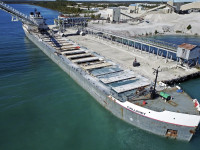
Roger Blough tow leaves Sturgeon Bay
12:50 p.m. UPDATE: Meredith Ashton and Candace Elise towed the Roger Blough from Bayship late Tuesday morning. The destination had not been entered on AIS.
ORIGINAL POST: Two Ashton Marine tugs (Meredith Ashton and Candace Elise) were at Bay Shipbuilding in Sturgeon Bay Tuesday morning waiting to tow the fire-damaged Roger Blough away. Bayship has rigged heavy towing chains to the bow and stern, there is also a portable generator mounted on the deck. Her destination appears to be Conneaut, OH.
Jim Conlon
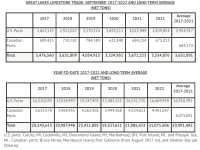
Lakes Limestone Trade Down 3.7 Percent in September
CLEVELAND – Shipments of limestone on the Great Lakes totaled 3.5 million tons in September, a decrease of 3.7 percent compared to a year ago. Limestone cargos were below the month’s 5-year average by 2.7 percent.
Loadings from U.S. quarries totaled 2.9 million tons, a decrease of 5.4 percent from 2021. Shipments from Canadian quarries totaled 675,023 tons, a decrease of 1.3 percent.
Year-to-date the limestone trade stands at 21.1 million tons, a near match compared to a year ago. Loadings from Michigan and Ohio quarries total 16.7 million tons, an increase of less than 1 percent. Shipments from Ontario quarries total 4.4 million tons, a decrease 3.4 percent.
Lake Superior News
Short-sea shipping could increase jobs in Cleveland
CLEVELAND – You may have already heard the warnings to start your holiday shopping early this year.
The effects of the pandemic, supply chain issues and now congestion at coastal ports could leave that “must have” holiday gadget or toy stranded miles away from area store shelves.
Now ports are rethinking how cargo should be transported.
The ship “Huron Spirit” is docked to offload Canadian-made steel in Cleveland. This is an example of short-sea shipping, the movement of cargo between ports, without traveling on the oceans. It is a concept that isn’t new.
“Particularly on our instance here on the Great Lakes and the St. Lawrence Seaway system it is becoming much more popular and prevalent for a lot of cargo owners not only around here but the Midwest in general,” said David Gutheil, the Chief Commercial Officer for the Port of Cleveland.
Coastal port congestion is sparking interest in short-sea shipping on the Great Lakes, here and in Canada. The Great Lakes Commission, an international agency that sets policies for the lakes, encouraged the practice this summer.
“We are basically trying to develop a solution that already exists and increase the knowledge in the supply chain industry that they have an option like this to use,” remarked Gutheil.
Gutheil says increasing shipping between Great Lake ports will speed up transportation time, as goods are off-loaded closer to their final destination.
“Unfortunately, it has taken a pandemic and some congestion that is going on in some coastal ports because of global supply chain issues to make people realize that this is a viable solution,” said Gutheil.
Another change the Port of Cleveland made was to create a container business in 2014. This allows a greater influx of finished goods, to arrive in Cleveland. That’s where the port can see immediate growth using short-sea shipping.
“We have the capacity to handle more than 50 thousand containers annually. Here at the space, we are operating right now at the port,” stated Gutheil.
Gutheil can see “overseas ships” stopping first in Canada, then smaller ships coming to Cleveland. He believes an increase in waterway traffic has potential environmental benefits.
“More maritime shipping means less pollution because it means less truck and less rail movements,” said Gutheil. “The movement of cargo on the water is seven times more fuel efficient than movement by trucks. It reduces fuel emissions, and it is greener in general.”
Over 20,000 jobs and $3.5 billion in economic activity annually are tied to the Port of Cleveland. Short-sea shipping could push those numbers even higher.
“We want to help folks around here not only move their cargo more efficiently but gain higher paying jobs through the movement of cargo and if we can assist in that process, we’re happy to do so,” stated Gutheil.
WKYC
Lake Ontario water levels lower than average this fall
Lake Ontario currently has lower water levels than the past two years, but officials say there is no need to worry.
Lake Ontario’s levels are currently just below the historical average, and just about a foot lower than at this time last year. Bryce Carmichael, a hydraulic engineer with the U.S. Army Corps of Engineers and the International Lake Ontario-St. Lawrence River Board, said that even though the International Joint Commission, which oversees the maintenance of Lake Ontario, there is not much man can do to combat the changes.
“There is no feasible way that manmade structures can control a body of water the size of Lake Ontario,” Carmichael said. “It’s just up to Mother Nature primarily. We have a little bit of influence at certain times of the season that can be used to benefit users, but the primary driver is really natural factors.”
Despite the levels being lower than recent years, they are still above any record lows, Carmichael said that this is normal.
“This is not unprecedented,” Carmichael said. “We would expect these levels to come about seasonally, periodically, definitely not every year. But as we move through the next decade or so, it could happen again. In a year we could have record highs or record lows.”
In a recent attempt to help recreational boaters, water levels in Lake St. Lawrence, near Massena, were temporarily lowered from Oct. 7 to Oct. 10. Carmichael said that while the IJC cannot always prioritize recreational boaters, some interests can work together to create change.
“So, in the consideration of low water impacts, there is a operation that can be made that can increase water levels in specific parts of the system to help navigation, sometimes that does help recreational boating as well,” Carmichael said. “But, they are not always step-by-step in tandem.”
The temporary water level raising will have no significant impact on the surrounding environment. The IJC will continue to monitor water levels along Lake Ontario and the St. Lawrence River.
WRVO
-
- Dan Vaught photo
-

- NMOTGL flyer
-
- NMOTGL flyer
-
- Limestone stats
See media gallery below