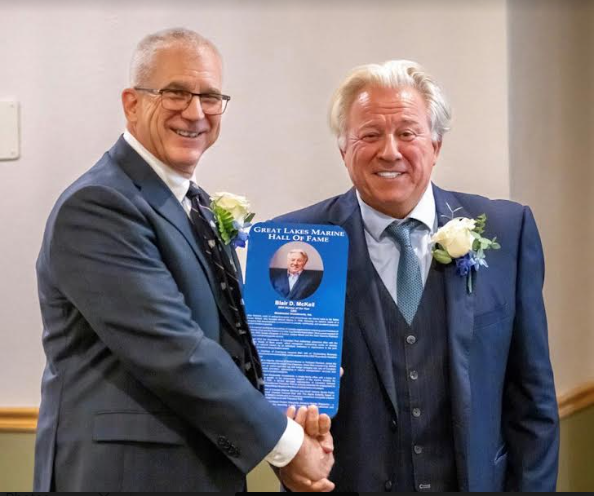
Blair McKeil 2024 Great Lakes Marine Hall of Fame Inductee
SAULT STE MARIE, MI – McKeil Marine’s Blair McKeil was honored recently with the Marine Man of the Year Award and induction into the Captain John P. Wellington Great Lakes Marine Hall of Fame at Sault Ste. Marie.
McKeil most recently served as the Vice Chairman of the Board of Directors for McKeil Marine from 2016 until the sale of the company in late 2023. The award is given every other year alternating between U.S. and Canadian nominees.
McKeil Marine was founded in 1956 by Blair’s father Evans, who saw an opportunity for a Great Lakes marine transportation company while working as a dredge laborer on the St. Lawrence Seaway.
Blair took over in 1992 and transformed the owner-operated tug-and-barge company into one of Canada’s leading marine service providers with customers along the St. Lawrence Seaway, East Coast, and Canadian Arctic.
The Captain John P. Wellington Great Lakes Marine Hall of Fame is housed onboard the Museum Ship Valley Camp at Sault Ste Marie, MI.
View previous awardees here: www.saulthistoricsites.com/museum-ship-valley-camp/hall-of-fame-inductees/
Great Lakes Maritime History group presents annual awards
Four prestigious awards were presented recently at the Association for Great Lakes Maritime History’s annual maritime history conference Sept. 7 in Buffalo, NY.
The awards, and their recipients, were:
Chris Gillcrist, Director Emeritus with the National Museum of the Great Lakes, received the 2024 C. Patrick Labadie Award for Historic Preservation. This award is presented annually to an individual who has significantly contributed to preserving Great Lakes maritime history.
Mark Shumaker received the Henry N. Barkhausen Award for Original Research in Great Lakes Maritime History for his paper “Ford Motor Company’s Canallers.” Since 2001, the association has sponsored the Barkhausen Award to recognize and encourage new research in the field of Great Lakes maritime history. Submissions are encouraged on any topic related to the region’s maritime history, and will be accepted from any person(s) researching that history regardless of formal training. A condensed version the paper was published in the Detroit Marine Historian publication of the Marine Historical Society of Detroit, of which Shumaker is a board member.
Roger LeLievre, editor and publisher of the annual vessel field Guide Know Your Ships and long-time president of the Marine Historical Society of Detroit, was presented with the Joyce C. Hayward Award for Historic Interpretation. This award is given to an individual who has made a major contribution to the interpretation of Great Lakes maritime history, in furtherance of the goals of the association.
Nathan Wietrzykowski was recipient of the Dr. Charles E. Feltner and Jeri Baron Feltner AGLMH Conference Scholarship Award of $250 to facilitate participation in the Annual AGLMH Conference and Awards Dinner each September. Applicants must be students currently enrolled in a graduate or undergraduate program with a professional interest in Great Lakes maritime history.
The Association for Great Lakes Maritime History is a professional association of institutions and individuals from throughout Canada and the U.S. involved in preserving and interpreting the unique maritime history of the Great Lakes region. The Association sponsors an annual maritime history conference, encourages new research by both professional and avocational historians, financially supports the publishing of new research, and promotes the regular exchange of news and information among its members.
Find out more at aglmh.net
Cleveland maritime manufacturer Samsel Supply
to close after 66 years
CLEVELAND (WJW) — A Cleveland manufacturer supporting the marine industry has decided to close after 66 years in business.
Operators of Samsel Supply, a multigenerational, family-owned business located along Old River Road on the east bank of The Flats, called it a “difficult decision,” reads a news release on the closure.
The company is a “fabricator and distributor for contractors, industrial firms, municipalities and the commercial marine market,” reads the release. The company plans to fulfill its outstanding orders and take new orders for its stock until Oct. 5, according to the release. The company plans to retain its employees another 30 days after that and help them find new jobs.
“We are very proud of all that we have accomplished over the years, thanks to the tremendous support of our customers and hard work of our loyal employees,” said Vice President Mike Samsel is quoted in a news release. “It has been an honor to serve this community, and we take great pride in the legacy my father began and we’ve all built together.”
The company was founded in 1958 by Frank Samsel. It initially specialized in making wire rope, chain, blocks, load binders and manila rope. It grew into a major distributor and fabricator of supplies throughout the Great Lakes region, according to the release.
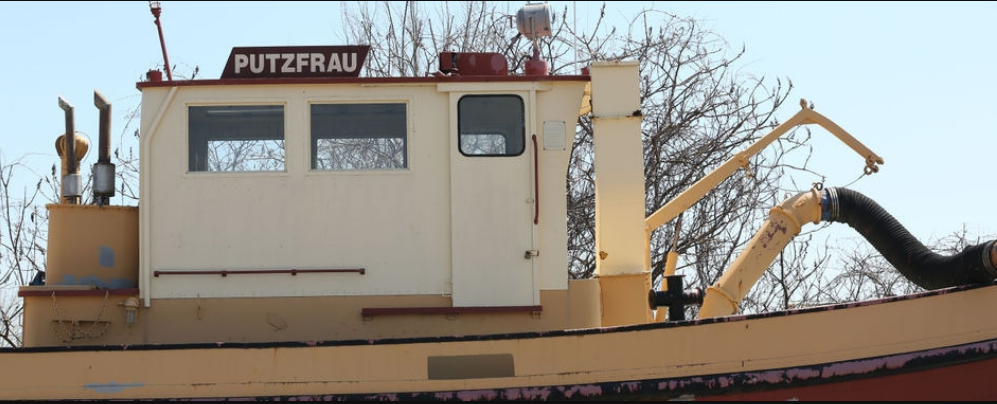
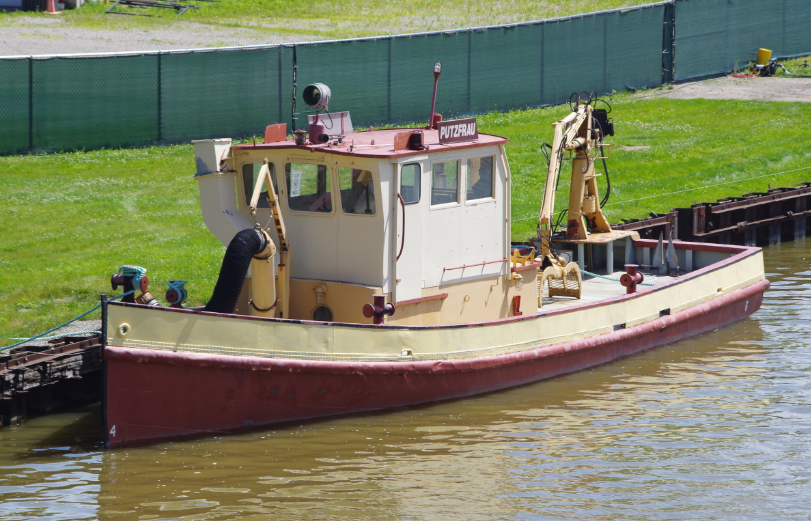
One of the company’s boats, a fish tug named The Putzfrau, “played a key role” in the cleanup of the Cuyahoga River in the late 1960s to early 1980s, “pioneering efforts in environmental sustainability,” reads the release. The company also worked with Greenspace Initiative Program on restoring local fish habitat.
“As we close this final chapter, we are thankful to everyone who has been part of the Samsel Family,” Samsel is quoted in the release. “We are grateful for the opportunity to serve many people and companies over the past 66 years.”
Restoring The Putzfrau: The boat that
cleaned up the Cuyahoga River
by West Creek Conservancy | May 22, 2019 | West Creek Conservancy News, West Creek in Action
This story originally appeared on Cleveland.com
The Putzfrau cleaned up the Cuyahoga.
Frank Samsel outfitted the 56-foot fish tug – whose name means “cleaning lady” in German – in the 1970s with a vacuum, a crane and a winch. His company, Samsel Supply Co., was hired by industries along the river.
The river was an open sewer, where sewage mixed with butcher waste and chemicals leaked from factories.
In a 16-hour day, the Putzfrau could pick up 100 cubic yards of debris and 15,000 gallons of oil.
Now, two decades after the boat was drydocked, Cuyahoga River advocates hope to raise $50,000 to restore the Putzfrau.
“If we restored it to its full capacity, it would be a nice functioning museum, an opportunity to tell the history of the river,” said Drew Ferguson of Phastar, an education and safety services nonprofit that plans to take on the project.
Cuyahoga River advocates want to create a Putzfrau curriculum for students, to learn about the river and its environmental comeback.
“We want to highlight it, make it a centerpiece,” said Peter Bode of West Creek Conservation.
That includes the Putzfrau leading a parade of boats as part of the Cuyahoga50 celebration June 22, the 50th anniversary of the 1969 river fire.
Frank Samsel, 89, of Avon is serving as the final torchbearer in the Xtinguish Torch Fest, representing the individual efforts that launched regional environmental activism.
Here’s Samsel’s take on the Putzfrau’s work on the dirty river. Answers have been edited for length and clarity.
How did you come up with the idea?
When the new Clean Water law came out in 1972, we were on the river regularly because we served commercial marine trade. We made all our deliveries by launch.
Nobody knew anything about cleaning up spills. But it looked like the attempts were made by people who didn’t know the surroundings. We thought we could do at least that good or better.
I designed the boat. We had a systems patent on it, a combination of boat and truck. We had about a 2,000-gallon capacity of liquid up front. Then we made other containers to suit the job we needed.
Council defers decision on the future of the James Whalen tug
THUNDER BAY – City council has deferred a decision on what to do with the historic James Whalen tugboat.
On Monday night, city staff was set to present four options that could see the tugboat recycled or displayed on dry land at a significant cost.
According to the Manager of Parks and Open Spaces Corey Halverson, the report was taken off the agenda to gather further information and feedback from stakeholders.
“When the report went public, we did get some input and feedback from a few stakeholders in the community in relation to the proposed option and recommendation.
“We wanted to take some time as the information they gave us requires a little bit of review,” Halverson told TBnewswatch.
“We want to take a look at exactly what’s being brought forward.
“[We want to] Make sure we understand the context and how it relates to the proposed recommendation that we were bringing forward so that we can put the clearest option possible forward to council the first time they consider it.”
Halverson explained that he would look at additional options that were presented by stakeholders for more ways to preserve as much of the tugboat as possible, while still meeting the intended recommendation.
Moored for years at the Kam River Heritage Park near Syndicate Avenue, in May 2022, the tug sprung a devastating leak, submerging the vessel for several months.
It was lifted and relocated near the James Street Swing Bridge.
The city paid a contractor nearly $800,000 to move the boat and store it securely for the next two years while longer-term options were explored.
The report recommended recycling the boat into parts preserving the bridge, stack, and some railings for a future display.
Halverson said, “Our original recommendation was for the bridge – sort of the wheelhouse area – and the stack, which is some of the key components that you would typically see preserved. And then, we were considering some of the sections of the railing.”
“That was our recommendation. So, to go beyond that, to go into trying to preserve larger portions of the deck, things like that, that’s what we need to take a little bit more time to evaluate what kind of impact that might have on the recycling component and the overall cost of that.”
The report stated that the total cost to the city would be $540,000; however, that can change as he re-evaluates the project.
“I think our original recommendation was based on a typical situation for that type of asset and the type of display you would see in other locations.
“Now we’re just looking at maybe some of the specific context in relation to the heritage value of this type,” Halverson pointed out.
Another option on the table was returning the James Whalen to Kam River Heritage Park, displaying it on the shoreline.
Both options included additional expenses, such as the revitalization of the park itself.
City staff acknowledged the Kam River Heritage Park has been hard to maintain for years, with amounts of discarded needles and garbage strewn about the green space, while vandalism to both the tug and the VIA Train has made it difficult for the city to protect the assets.
Installation of the tug on the shoreline would involve dredging the existing shoreline to create a docking area or constructing a new shoreline as an infill area that could cost up to $1.8 million.
Halverson noted, “The big challenge with moving the tug anywhere is how much it weighs.
“It weighs approximately 300 tons. So, in order to lift it intact it’s a big exercise. It requires specialized heavy-lifting industrial barges.
“That is the challenge that’s linked to every other option other than disassembling it in some shape or form on site.”
However, Kam River Park is one of several locations council could consider as an alternative including the northeast corner of the Pool 6 lands, or at Fisherman’s Park West.
Halverson stated he recommends Fisherman’s Park West as a preferred location for the James Whalen to rest.
A third option council could consider was to sink the boat in Lake Superior as a diving attraction.
“That was an idea that was thrown out early on when we started talking about working on options.
“It is something that is done in other locations. But again, because it included that initial well, even additional repairs and planning for sinking. It has to be a planned operation,” said Halverson.
He explained this option would also involve additional approvals and environmental processes to contend with the overall cost scope.
The total cost for option four would be $1.4 million.
Halverson expects to have the report put back on council agenda for the next meeting on Sept. 16.
National Museum of the Great Lakes Second
Wave Capital Campaign Nears Completion
Toledo, OH – The National Museum of the Great Lakes is entering a new chapter as its Second Wave expansion project progresses. With the foundation set and structural build underway, the museum is reaching out to the community for a final push of support. Now is your chance to contribute to the future legacy of this historic institution.
The Second Wave expansion will add 5,000 square feet of new space, allowing the museum to showcase traveling Smithsonian exhibits, introduce new permanent exhibits, and create dedicated spaces for community education.
“By supporting this campaign, donors are actively preserving Great Lakes history, fueling ongoing education, revitalizing our neighborhood, and boosting the economic vitality of our region,” said Kate Fineske, Executive Director of the National Museum of the Great Lakes.
Donations can be made online at nmgl.org/thesecondwave or by calling the museum at 419-214-5000. Contributions of all sizes are welcome, and donors will receive exclusive Second Wave thank you gifts as a token of appreciation. Donors contributing more than $500 will also be recognized on our donor wall.
“This is the moment to make a lasting impact on our museum and the communities we serve,” said Sara Smith, the Museum’s Director of Institutional Advancement. As we conclude our public campaign, join in this effort and ensure the National Museum of the Great Lakes remains a beacon of pride and inspiration for generations to come. For more information or to make a donation,
The National Museum of the Great Lakes