Lock 8 mechanical issue delays Welland Canal traffic
A mechanical issue at Port Colborne’s Lock 8 brought shipping traffic to a halt on the Welland Canal Tuesday, stranding six vessels on the 43-kilometre-long waterway for six hours.
Nicole Giroux-Laplante, St. Lawrence Seaway Management Corp.’s manager of communications, said traffic was suspended at 3:30 p.m.
There were no safety concerns, she said in an email to The Tribune. In a followup email, Giroux-Laplante said the mechanical issue — she did not say what it was — was resolved and seaway traffic resumed at 9:30 p.m.
When the seaway shut down the canal, Hapag-Lloyd Cruises’ Hanseatic Inspiration, built in 2019 and designed for luxury expedition travel, was in Lock 8.
According to the Cruise Mapper website, the 138-metre-long vessel, which holds 199 to 230 passengers and 170 crew members, is on a 13-day cruise from Toronto to Milwaukee, Wisc.
On the Marine Traffic website, the cruise ship’s Automatic Identification System (AIS) showed its destination as Windsor.
Above Lock 8, on the Lake Erie side of the canal, the Polsteam vessel Miedwie, was listed as headed to Gibraltar. Behind Hanseatic Inspiration were Algoma Discovery, the tug-barge combination Wilf Seymour-Alouette Spirit, in Port Colborne.
Other vessels delayed by the issue at Lock 8 included tug-barge combination Everlast-Norman McLeod, and the tanker Algotitan in the Thorold area.
Welland Tribune – David Johnson
McAsphalt Advantage heads for Canada on maiden voyage
McAsphalt Industries Ltd. has officially taken ownership of the McAsphalt Advantage. This custom-designed vessel is specifically built for trading on the Great Lakes, St. Lawrence, and Eastern seaboard. She has set off on her maiden voyage across the Pacific, heading home to Canada.
This marks a significant milestone in McAsphalt’s journey, opening a new chapter in our tradition of innovation and leadership. The McAsphalt Advantage is not just a ship; she symbolizes our dedication to safety, sustainability, operational excellence, and growth in the asphalt industry.
McAsphalt Industries Ltd.
Autonomous vessel visits Traverse City to explore Great Lakes’ depths
by Kody BairWed, September 18th 2024 at 6:15 AM
Updated Wed, September 18th 2024 at 11:36 AM
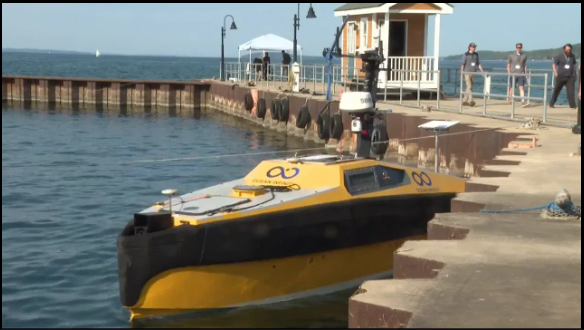
GRAND TRAVERSE COUNTY, Mich., (WPBN/WGTU) — An autonomous surface vessel that will be used to find out more about the Great Lakes made a stop in Traverse City on Tuesday.
The boat was put on display at the Lakebed 2030 Conference at the Northwestern Michigan College Great Lakes campus.
It’s a small boat with a big goal.
“How many square miles our Great Lakes have and how unmapped they are, we’re going to need this technology to basically cover that entire expanse,” Michigan Technological University Research Engineer Travis White said.
Ocean Infinity has partnered with Michigan Tech to send this search vessel on the water in hopes of mapping the entirety of the Great Lakes by 2030.
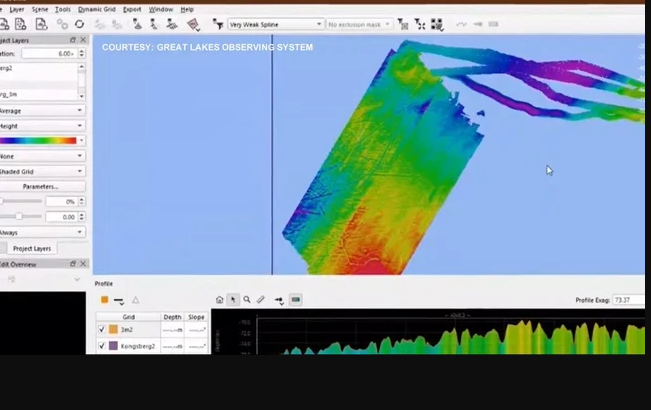
“Less than 15% of our lakes are mapped at high resolution, and that means we know and understand more about the moon than we do about what’s at the bottom of our own lakes, which are our own backyard,” White said.
Michigan Tech said understanding more about the Great Lakes is crucial to keeping them preserved.
“The Great Lakes are a huge resource and understanding what is at the bottom of these lakes can help us better manage those water resources and be able to protect them,” White said.
There’s one more unique thing about this watercraft: the boat’s captains aren’t on board.
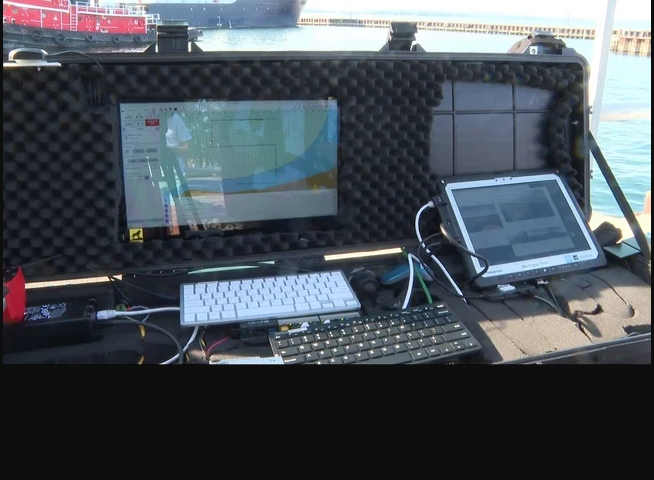
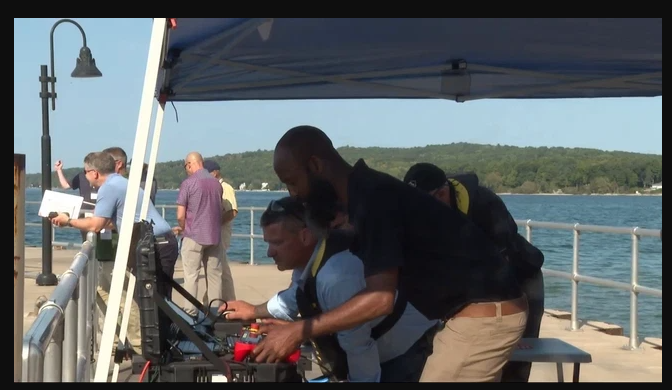
They’re right here. This is their deck. And this is their helm:
The boat is an autonomous surface vessel, it controls itself entirely, only having a remote crew for emergencies.
Ocean Infinity said it will make them work faster in putting eyes on the lakebed.
“It’s something that we can program through a computer, set it on a mission and keep an eye on it, but for the most part, forget that it’s even over there working,” White said.
The first mission of this vessel was to find the wreckage of a 1968 plane crash in Lake Superior.
That mission was conducted last week, where the crew searched about 46 square miles of lakebed in a little more than three days.
As they continue to analyze the data gathered from the expedition, they use it as a learning opportunity for the next year to come.
“After this, we’ll winterize the boat, then we’ll be coming back in the spring to get it ready again,” White said.