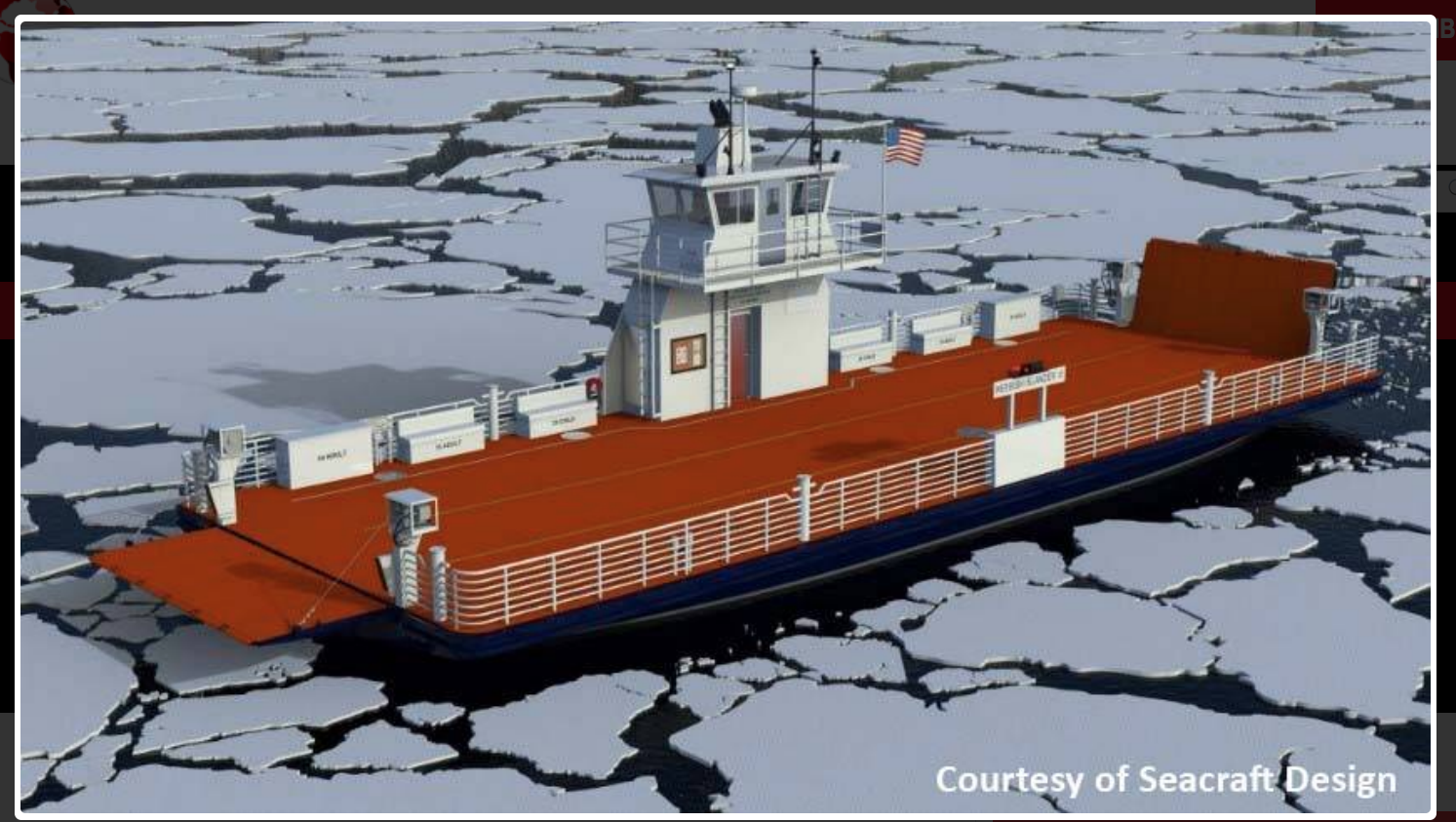
Burger Boat will build new ferry for Upper Peninsula’s Neebish Island
Manitowoc, WI – Manitowoc shipbuilder Burger Boat Company announced it has begun work on a new vehicle and passenger ferry for the Eastern Upper Peninsula Transportation Authority (EUPTA), located in Sault Ste. Marie, Mich.
Due to launch Summer 2022, the 92-foot steel ferry will operate year-round on the St. Marys River in Michigan’s Upper Peninsula between Barbeau, Mich., and Neebish Island. The ferry was designed to operate in the harsh winter environment and through the solid ice conditions it will encounter on its route.
The ferry is designed by Seacraft Design, LLC of Sturgeon Bay, Wis. “Based on the experience of four previous commercial vessel designs built by this shipyard, we know that EUPTA will receive a first-class product from Burger Boat Company, and we look forward to collaborating once again,” said Mark Pudlo, president, Seacraft Design, LLC.
The Eastern Upper Peninsula Transportation Authority, established in 1975, operates three local vehicle and passenger ferries to the nearby islands of Sugar, Neebish, and Drummond.
“We’re grateful to be selected by the Eastern Upper Peninsula Transportation Authority to build their new vessel,” said Jim Ruffolo, president and CEO, Burger Boat Company. “At Burger, our team prizes collaboration, among each other and with our clients, to deliver vessels people can look upon with pride, year after year. Whether it’s a luxury yacht or a hard-working ferry for demanding conditions like those the Neebish Islander III will face, we are committed to delivering tailored, quality vessels that meet and exceed the owner’s vision.”
Marine Link
NOAA grant will ‘supercharge’ Lake Superior beach cleanups, debris removal
Marquette, MI – Lake Superior debris cleanup is getting “supercharged” with an influx of grant funding to help remove plastic and other trash from the shoreline.
The Lake Superior Watershed Partnership and Land Conservancy, a nonprofit group based in Marquette, received $122,000 from the National Oceanic and Atmospheric Administration (NOAA) this year to remove marine debris from Upper Peninsula beaches and harbors.
The group is the only Michigan organization to receive the grant, which is part of $7.3 million in federal funds awarded to 25 agencies, universities and nonprofits working mostly along the ocean coasts to research, prevent and remove debris.
The Council of the Great Lakes Region, a binational nonprofit based in Ontario and Ohio focused on economic development and environmental protection, also received $371,729 for debris prevention and removal from the program.
Carl Lindquist, director of the Lake Superior Watershed Partnership (SWP), said the grant will expand the group’s regular beach cleanup efforts and larger debris removals from shorelines and harbor areas where divers are sometimes needed to help pull junk from the water.
The group will use the NOAA grant to implement cleanups in 2022 and 2023 with coastal communities, tribes and other partners through its Great Lakes Climate Corps (GLCC) and its public Lake Superior Volunteer Corps (LSVC).
“We’ve always done beach cleanups, but we’ll be doing a lot more of them with this grant,” said Lindquist.
Around Lake Superior, the debris problem is “better than most of the other Great Lakes because we don’t have the large population centers, but it’s a growing problem. We’re glad to get this grant to reduce the impact,” Lindquist said. “We’re the headwaters,” he said. “We take that seriously.”
The debris largely comes from illegal dumping, stormwater runoff, littering, industry and unregulated constructed sites.
Large tires once used as shoreline armor, entire vehicles, broken boats and appliances are some of the larger debris items the group has encountered, he said. Large items can interfere with navigation and pose a safety hazard for boaters.
Beach cleanups remove a lot of small litter like single-use plastic food and beverage packaging, cigarette butts and other consumer trash. Michigan’s Upper Peninsula has seen increased tourism in recent years, which has corresponded with increases in litter and trash.
Plastic waste is a growing problem in the Great Lakes, which researchers estimate receive about 22 million pounds of plastic annually across the system. Of that, Lake Superior fares the best, getting about 70,000 pounds on average each year.