MV Nukumi named “Vessel of the Year” at Marine Propulsion Decarbonisation 2023 Awards
We are delighted to announce that MV Nukumi has been honoured as a “Vessel of the Year” at the 2023 Marine Propulsion Decarbonisation Awards. The esteemed award, which was presented in Amsterdam on September 26, acknowledges vessels that pioneer new standards in vessel optimization, maritime decarbonisation, and sustainability. MV Nukumi’s visionary design and superior performance solidified its win.
Purpose-designed for Windsor Salt, MV Nukumi is a diesel-electric self-unloading vessel, emphasizing an eco-friendly approach. The ship boasts multiple innovations aimed at minimizing GHGs, air pollutants, and its environmental impact as a whole. Notably, the vessel is equipped with diesel-electric tier 3 engines, a ballast water treatment system, a waste heat recovery system, and quieter machinery.
In terms of operations, MV Nukumi features a fully automated single-point loading system coupled with a state-of-the-art cargo handling mechanism. This eliminates vessel shifting during the loading process, paving the way for safer and more streamlined operations. Furthermore, its modern hull design and twin-fin diesel-electric propulsion grant the vessel exceptional manoeuvrability. This ensures faster transits through narrow channels, even at lower tides.
MV Nukumi isn’t new to accolades. In 2022, the ship was named the IBJ Bulk Ship of the Year and recognized as a Significant Ship of the Year by the Royal Institution of Naval Architects. Moreover, CSL’s engineering collaborator, EMS-Tech, earned the 2022 IBJ Award for the Best Ship Loading/Unloading System, for MV Nukumi’s advanced cargo handling system.
The Vessel of the Year award was presented to Jakob Hansen, CSL’s Senior Vice-President of Commercial and Transhipment, by Ossi Mettälä of NAPA Shipping Solutions during a gala dinner at the Maritime Decarbonisation, Europe Conference, hosted by Riviera Maritime Media.
Anchoring the story: TV6′s Elizabeth Peterson begins ore boat adventure aboard the Lee A. Tregurtha
MARQUETTE, Mich. (WLUC) – The Lee A. Tregurtha, one of the Great Lakes’ oldest freighters, is departing Marquette Tuesday for its 49th journey this season, and TV6′s Elizabeth Peterson is on board.
The bulk carrier’s history dates back over eighty years. It first operated in 1942 as a World War II Navy tanker, serving under the name USS Chiwawa. With a 501-foot length, 68-foot beam, and 30-foot depth, the vessel traveled to several countries across the Pacific and Atlantic Oceans, including Scotland, Morroco, and Aruba, and was also present in Japan for the Tokyo Bay Surrender Ceremony in 1945.
In the years following its decommissioning in 1946, the freighter underwent a series of ownerships, name changes, and expansions. It was renamed the Walter A. Sterling after its purchase by the Cleveland-Cliffs Iron Company in 1960. The freighter underwent several expansions, measuring up to 826′ x 75′ x 39′ and supported a 29,360-ton capacity. The ship was sold to the Ford Motor fleet in 1985 and was renamed the William Clay. The vessel would be acquired four years later in 1989 by the Interlake Steamship Company. It was christened Lee A. Tregurtha after the wife of the company’s vice chairman.
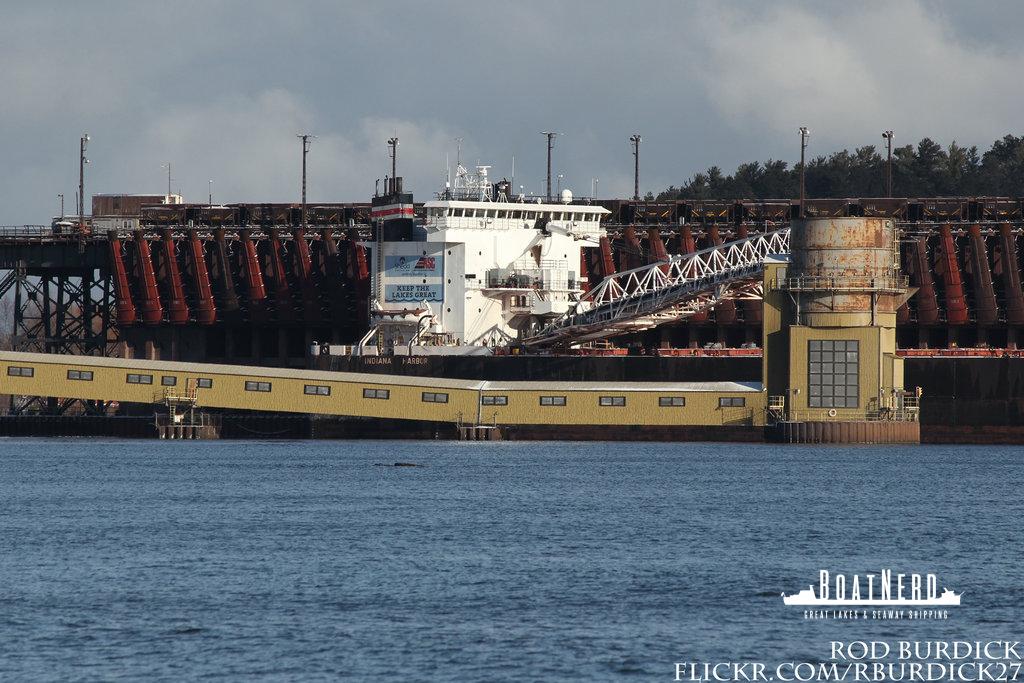
The historic carrier arrived at Marquette’s Ore Dock around 3:30 a.m. on Tuesday after traveling from Dearborn, Michigan. It will carry nearly 26,000 tons of taconite pellets en route to Burn Harbor, Indiana.
Upper Michigan’s Source
Harrowing stories resurface in newly discovered Lake Superior shipwreck
In its final moments trapped in a storm south of Isle Royale, the freighter Henry Steinbrenner listed then surrendered, tossing the crew members still left on deck into the unforgiving grip of Lake Superior.
Adrift amid mountainous and frigid waves, the men who managed to escape the sinking freighter clung to lifeboats — clung to life itself — as the spring storm raged around them.
“My mouth got full of water. I was getting numb. Just then the ship started to go down and the awful suction started pulling me down with it,” a survivor, Bernard Oberoski, told a Duluth Herald reporter the next day. “The water closed over me. I wondered how my mother and father would take the news that I had been lost at sea.”
Oberoski fought his way to the surface and spotted a lifeboat the men had set loose just before the ship went under. As he struggled to make headway in the freezing water, “a giant wave just seemed to push the boat toward me,” he recounted. “It was really a miracle.”
For 17 of his shipmates, however, the miracle never came. Despite heroic efforts from the crews of ships who’d heard the Steinbrenner’s distress call and rushed to help, maneuvering their mammoth steel vessels with remarkable precision to find and pluck the half-frozen survivors from amid the waves, only 14 of 31 of the men aboard the Steinbrenner survived.
The story of the Steinbrenner — a tale of tragedy, survival and heroism on the big lake 70 years ago — was largely lost to time and fading memories. Until now.
The wreck of the Henry Steinbrenner was found earlier this month in 750 feet of water by a pair of Minnesota shipwreck-hunters, shedding new light on the story of the ship, its crew and those who came to save them.
“It’s important to remember these wrecks and the people that worked on the ships,” said Ken Merryman, who along with Jerry Eliason located the Steinbrenner. “When we find the wrecks, it’s a way of keeping the memories alive.”
Minnesota Public Radio