Reduced Great Lakes ice could threaten coastal infrastructure
The Great Lakes have seen record low levels of ice cover this winter. The National Oceanic and
Atmospheric Administration says the percentage of the lakes covered with ice was in the single
digits for much of February, although it rose to 12% by the 19th.
What does the low ice cover mean for the shoreline? U.S. Army Corps of Engineers coastal
engineer Jim Selegean tells us the shoreline is usually protected from erosion in the winter by
the ice cover.
“A complex of ice builds out into the lake as the winter goes on and basically it armors the
shoreline,” Selegean said. “So, it’s like all the shore protection that we see on the Great Lakes
stopping the energy of the waves from hitting the bluffs, which is what we care about because
we built our infrastructure on top. Shore ice has the same effect.”
With less ice cover, Selegean says the coast faces a risk of more erosion. He tells us climate
forecasts anticipate continued dwindling of ice coverage each winter, so ongoing maintenance
along the shoreline to prevent erosion may be needed moving forward.
Selegean adds because of the way sand moves, marinas and harbors may be looking at a need
for more frequent dredging in the future. “For three months out of the year, there’s pretty
much no sediment being deposited in our navigation channels on Lake Michigan. But with less
ice, that’s more months of the year when sand moves around.
Selegean doesn’t know if this winter has seen significant coastal erosion because that’s
measured by aerial photos that haven’t been analyzed yet. He says another drawback of
reduced Great Lakes ice could be related to fish that rely on it for protection.
WSJM
U.S., Canada coast guards sign agreement, collaborating on Great Lakes icebreaking
U.S. and Canadian Coast Guard sectors are teaming up to work on buoy tending and
icebreaking operations throughout shared waters in the Great Lakes.
Coast Guard representatives from both countries came together to sign a new memorandum of
understanding (MOU) earlier this month. This memorandum is a new agreement which includes
some elements of previous agreements to coordinate efforts between the two groups.
The agreement will allow the two organizations will come together for efforts in ice breaking
throughout the main waterways of the lakes, as well as connecting waters like the Georgian
Bay, which connects to Lake Huron, and St. Lawrence River, which connects to Lake Ontario.
The agreement will also allow for collaboration on buoy tending operations.
The agencies will now be able to tend to each others’ floating aids and share buoy tending
resources, improving response times for aid outages or defects, reduce vessel transit times and
cost, and decrease man hours.
With the MOU in place, the agencies will better be able to collect data and help travelers from
both countries.
The shared icebreaking operations will include exchange of personnel, reporting on the
availability of icebreaking facilities, establishing constant means of communication, allocation
of areas of operational mandate and other matters relevant to their cooperation and the
coordination of their icebreaking operations.
“We’re thrilled to have been able to finalize this plan between the Canadian Coast Guard
Central Region and the Ninth Coast Guard District to improve our efficiency with ice breaking
and aids to navigation in the Great Lakes,” said U.S. Coast Guard Rear Admiral Jon Hickey. “A lot
of time and hard work went into putting this MOU in place, and I look forward to seeing the
Marine Transportation System in the Great Lakes region thrive as a result. I’m thankful for this
partnership with the Canadian Coast Guard and can’t wait to see what more we can accomplish
in the future.”
Sault News
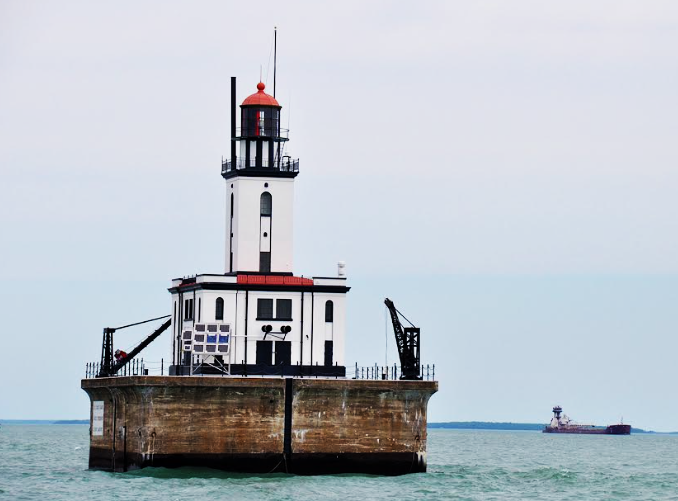
Stay at historic DeTour Reef lighthouse in Lake Huron for $50 a night
If you’re planning a spring or summer trip and are looking for an affordable place to stay on the
Great Lakes, you’re in luck. The DeTour Reef Light in northern Lake Huron has expanded its
lighthouse keeper program, previously only available on weekends, to include weeknight stays
for $50 per person per night, the DeTour Reef Light Preservation Society said.
According to the preservation society’s website, the 83-foot lighthouse, built in 1931, is a
strategic and historic landmark that marks a dangerous reef to help guide ship traffic to and
from Lake Huron and Lake Superior via the St. Marys River.
The DRLPS said it completed a major restoration of the structure in 2004 and began the
overnight keeper program and public tours in 2005. The overnight keeper program helps raise
funds for the continued maintenance and restoration of the light and offers the opportunity to
experience life as a lighthouse keeper.
The DRLPS said a minimum of two keepers is required at all times, with a maximum of six
keepers allowed at one time. While the light cannot be rented by one person for $50 a night, it
can be rented by two people for $100 a night. Two people can also choose to pay $200 a night
to have guaranteed private use of the lighthouse all to themselves for five nights, Sunday-
Thursday, according to the DRLPS website.
The DRLPS says guests must be in good physical condition, capable of making multiple trips up
and down the vertical 20-foot pier ladders and to the top of the lighthouse.
Detroit Free Press
HELP WANTED: S.S. Badger
Once again we are searching for some Navigational Deck/Navigational Engine crew for
our 2024 sailing season. Applications must be filled out on-line by visiting our website
at: www.ssbadger.com and click Join The Team.
Able-Seaman (AB): Performs navigational watch in and around the pilot house, assists
Mate on duty with supervising the deck crew, assists in loading and off-loading
passengers and cargo, proper use and care of deck equipment, supplies and material,
work alongside deck crew, undertaking tasks as necessary, learn fire and lifeboat
stations along with signals and procedures associated with an emergency to properly
carry out a fire and lifeboat drill to US Coast Guard standards, be prepared to live and
work aboard the vessel the duration of the sailing season, from mid-May to mid-Oct.
Room and board provided, employee will stand a 4-hour watch, twice a day, 7 days per
week and eligible for medical, dental, vision and 401K after completing 90-day
probationary period. APPLICANTS FOR THE AB POSITIONS MUST BE QUALIFIED
AND POSSES THE CREDENTIALS NEEDED FOR THIS POSITON.
QMED: Works under the direction of the watch Engineer, employee will stand a 4-hour
watch, twice a day, 7 days per week, be prepared to live and work aboard the vessel
the duration of the sailing season, from mid-May to mid-Oct. (room and board provided).
APPLICANTS FOR THE QMED POSITIONS MUST BE QUALIFIED AND POSSES
THE FIREMAN/OILER/WATERTENDER ENDORSEMENTS ON THEIR MMC. QMED –
Oiler: Assists with operating and maintaining all vessel equipment and systems, assists
with monitoring plant operation, assists with record-keeping, assigned a cleaning
station. QMED – Fireman: Manages the fires in the operating boilers, ensures an
adequate fuel supply to the boilers, assists the Coal passer on duty with ash removal
conveyors, assigned a cleaning station. Qualifications/Certifications required: Valid
Transportation Worker Identification Credential (TWIC), valid Merchant Mariners
Credential issued by the U.S. Coast Guard, endorsement as QMED
Fireman/Oiler/Watertender on MMC, current US Coast Guard Medical Certificate,
legally eligible to be employed in the United States (Proof of identity and eligibility will be
required upon employment.
LICENSED ENGINE OFFICER: Supervise a watch with the assistance and direction
from the Chief Engineer. Responsible for the safety of the personnel assigned to the
watch and their task performance in the operation of the vessel. Assists with the
operation and maintenance of all vessel operating equipment and systems. Maintains
the engine room records as required by various agencies. Conducts periodic safety
inspections of departmental tools and safety equipment as directed. Required to make
descriptive entries of all work performed in the Engineer log. Be prepared to live and
work aboard the vessel the duration of the sailing season, from mid-May to mid-Oct.
(room and board provided). Employee will stand a 4-hour watch, twice daily, 7 days per
week. Eligible for AMO medical, dental, vision and 401K after completing 60-day
probationary period. APPLICANTS FOR LICENSED ENGINEER POSITIONS MUST
BE QUALIFIED AND POSSESS LICENSED ENGINEER OF STEAM VESSELS OF
UNLIMITED ENDORSEMENT OF 4000 HP OR HIGHER. Qualifications/Certifications
Required: Valid Transportation Worker Identification Credential (TWIC), Valid Merchant
Mariners Credential issued by the U.S. Coast Guard with proper endorsements,
including at least Third Assistant Engineer of steam vessels of unlimited horsepower,
current US Coast Guard Medical Certificate and be legally eligible to be employed in the
United States (proof of identity will be required upon employment).
Interlake Steamship Co.