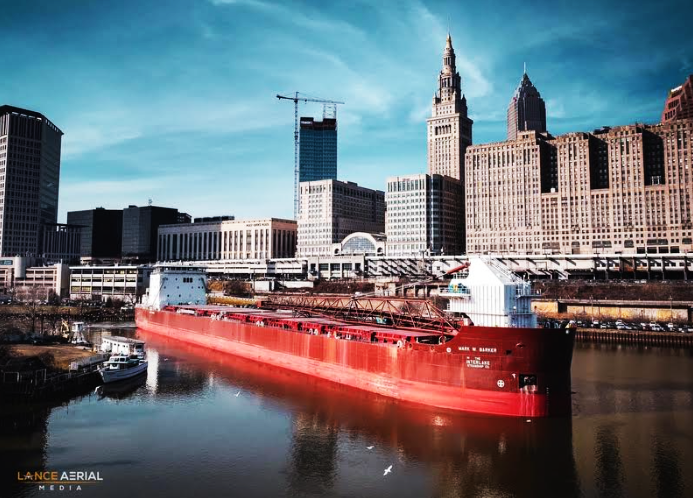
Mark W. Barker starts season with Cleveland ore shuttles
The Mark W. Barker’s 2024-25 shipping season is underway with early-season Cleveland iron
ore shuttles up the Cuyahoga River. She departed her winter lay-up berth in Detroit on Sunday.
In other Lake Erie news, the USCGC Neah Bay was off Cleveland Monday, making her way to
Sault Ste Marie, MI. Northern Venture is now in Ashtabula loading coke for Thessalon, ON.
CCGS Samuel Risley has been tasked with icebreaking at Thessalon in preparation for her
arrival.
Interlake Steamship Co., DRE Designs
Warm winter keeps Great Lakes ice coverage very low
Thunder Bay, ON – An icebreaker may be an unlikely sight in the Port of Thunder Bay this year,
as ice coverage across the Great Lakes remains low. We are having a historically low ice year
and that’s due basically entirely to the fact that we’ve had a really warm winter so far, said Jay
Austin of the University of Minnesota Duluth’s Large Lakes Observatory.
Ice cover is a very, very strong function of average winter air temperatures, he said. We’ve
just really had no conditions that have been conducive to the formation of ice. We had some
cooler air earlier [last] week and there was a bit of an uptick in coastal lake ice, but really very
little, if any, on the open lake.
Austin said that prior to 1998, 50 to 60 per cent of Lake Superior would be covered in ice at this
time of year; in the years after 1998, the normal ice coverage for the lake would be 25 or 30 per
cent.
According to the Great Lakes Environmental Research Laboratory, total ice cover across all the
Great Lakes was 6.1 per cent as of Feb. 22, 2024.
Why the air temperature this winter is as warm as it is can be due to a number of different
factors, Austin said. This is a strong El Niño year, and so that plays a significant role in upper
midwest air temperatures. And of course there are the effects of long-term trends toward
warmer air because of us changing the chemistry of the atmosphere, he said. We pump
carbon dioxide into the atmosphere and we trap more heat.
There are several factors that are contributing to the fact that we’re having this very warm
winter, and it’s going to take some time before we really understand exactly what was
responsible for the anomalous conditions we’re having.
Austin said there are clear ecological impacts when there’s not much ice.The coastal ice
serves as a refuge for spawning fish, he said. Coastal ice can also act as armor against coastal
erosion, and so we will expect there to be enhanced coastal erosion from spring storms this
year.
There are going to be cultural and commercial effects. You don’t have people going over to the
Wisconsin south shore to visit the ice caves. Sitting here in Duluth, we don’t see people ice
fishing off the shore.
The lack of ice could mean an extended shipping season, however, and Austin said ice cover is a
good predictor of conditions coming later in the year.
What we should expect in a year like this, with very little ice cover, is that the the start of the
summer season, where the lake starts forming a warm layer on top, will be considerably earlier
this year, he said. So I predict that instead of the early July onset of those conditions, we
might see that in mid-to-late May this year. That typically leads to warmer water temperatures
through the summer.
It also means there may not be a need for an ice breaker to visit the Port of Thunder Bay in
advance of the 2024 shipping season.
This year, the ice is well-below the normal for this region, said Guillaume Paradis, ice-breaking
superintendent for the central region with the Canadian Coast Guard (CCG). At the approach
of the opening of the Soo Locks, if there is a need, an ice breaker will go [to] Thunder Bay to
help. But at this point, there is not a lot of ice in the bay.
In an email, a CCG spokesperson said that during periods of low ice coverage, coast guard
vessels remain on standby for any ice breaking requests,to keep waterways clear and open to
prevent potential flooding caused by ice jams, as well as respond to any search and rescue
operations or marine pollution incidents.
Ice breaking is getting underway in other places, however, with the CCGS Samuel Risley
scheduled to start breaking ice in the Thessalon, Ont., area on or around Feb. 25.
The purpose of this operation is to break up the ice to allow commercial vessels safe and
efficient movement, the CCG said in a media release.
CBC
Lawmaker to host hearing on expanding icebreaking capacity
Green Bay, WI – A congressional lawmaker is coming to Wisconsin later this week to talk about
an important resource that keeps the Great Lakes region’s economy afloat: icebreaking.
Democratic Sen. Tammy Baldwin is set to host a field hearing in Green Bay on March 1 with
Admiral Linda L. Fagan, Commandant of the U.S. Coast Guard, several other U.S. Coast Guard
officials, and business leaders to testify on the need to expand icebreaking capacity on the
Great Lakes.
Baldwin, who is the chair of the Commerce Subcommittee on Oceans, Fisheries, Climate Change
and Manufacturing, which has jurisdiction over the U.S. Coast Guard, helped negotiate a
measure called the Great Lakes Winter Commerce Act in the National Defense Authorization
Act of 2022. The bipartisan measure authorized $350 million for a new heavy icebreaker for the
lakes.
If the Great Lakes region were a country, it would be the third largest economy in the world
after the U.S. and China, according to the Council for the Great Lakes Region. Shipping is the
backbone of this economy with more than 90 million tons of cargo moving throughout the
Great Lakes each year. Keeping shipping lanes open by icebreaking is an integral part of
commerce in the winter months.
In 1979, the U.S. and Canadian coast guards had 20 icebreakers stationed throughout the Great
Lakes. Now, there are only 11, which must cover more than 2,300 miles from Duluth,
Minnesota, to the Atlantic Ocean and the 94,000 square miles of ice-covered lakes in between.
The U.S. Coast Guard owns nine of these icebreakers.
The Mackinaw is the only icebreaker in the U.S. fleet capable of leaving a wide enough path for
large freighters to pass through. The new heavy icebreaker that was authorized will be similar
in size to the Mackinaw.
While ice may not be on the top of everyone’s mind this winter, the lack of icebreaking capacity
has had costly consequences in some years. For instance, during the 2018-19 ice season, the
Great Lakes maritime industry lost more than a billion dollars and roughly 5,800 jobs.
“If we can’t break the ice on the Great Lakes, our Made in Wisconsin economy suffers,
consumers might not see the goods they need on the shelf, and thousands of jobs are on the
chopping block, Baldwin said.
I’m proud to have secured funding to support a new icebreaker for the Great Lakes, and now
I’m excited to be bringing Washington, D.C., to Wisconsin to show the real impact of the Great
Lakes on Wisconsin’s economy, way of life, and future, she said.
Baldwin and Fagan will be joined by Master Petty Chief Heath Jones, Master Petty Chief of the
U.S. Coast Guard; Rear Admiral Jon Hickey, Ninth District Coast Guard Commander; Master
Chief Mathew Buckman, Ninth District Coast Guard Command Master Chief; Dean Haen,
director of the Brown County Port and Resource Recovery department; Ken Przybyla, vice
president of operations of GLC Minerals; and James Weakley, president of the Lake Carriers’
Association.
Milwaukee Journal-Sentinel
HELP WANTED: S.S. Badger
Once again we are searching for some Navigational Deck/Navigational Engine crew for
our 2024 sailing season. Applications must be filled out on-line by visiting our website
at: www.ssbadger.com and click Join The Team.
Able-Seaman (AB): Performs navigational watch in and around the pilot house, assists
Mate on duty with supervising the deck crew, assists in loading and off-loading
passengers and cargo, proper use and care of deck equipment, supplies and material,
work alongside deck crew, undertaking tasks as necessary, learn fire and lifeboat
stations along with signals and procedures associated with an emergency to properly
carry out a fire and lifeboat drill to US Coast Guard standards, be prepared to live and
work aboard the vessel the duration of the sailing season, from mid-May to mid-Oct.
Room and board provided, employee will stand a 4-hour watch, twice a day, 7 days per
week and eligible for medical, dental, vision and 401K after completing 90-day
probationary period. APPLICANTS FOR THE AB POSITIONS MUST BE QUALIFIED
AND POSSES THE CREDENTIALS NEEDED FOR THIS POSITON.
QMED: Works under the direction of the watch Engineer, employee will stand a 4-hour
watch, twice a day, 7 days per week, be prepared to live and work aboard the vessel
the duration of the sailing season, from mid-May to mid-Oct. (room and board provided).
APPLICANTS FOR THE QMED POSITIONS MUST BE QUALIFIED AND POSSES
THE FIREMAN/OILER/WATERTENDER ENDORSEMENTS ON THEIR MMC. QMED –
Oiler: Assists with operating and maintaining all vessel equipment and systems, assists
with monitoring plant operation, assists with record-keeping, assigned a cleaning
station. QMED – Fireman: Manages the fires in the operating boilers, ensures an
adequate fuel supply to the boilers, assists the Coal passer on duty with ash removal
conveyors, assigned a cleaning station. Qualifications/Certifications required: Valid
Transportation Worker Identification Credential (TWIC), valid Merchant Mariners
Credential issued by the U.S. Coast Guard, endorsement as QMED
Fireman/Oiler/Watertender on MMC, current US Coast Guard Medical Certificate,
legally eligible to be employed in the United States (Proof of identity and eligibility will be
required upon employment.
LICENSED ENGINE OFFICER: Supervise a watch with the assistance and direction
from the Chief Engineer. Responsible for the safety of the personnel assigned to the
watch and their task performance in the operation of the vessel. Assists with the
operation and maintenance of all vessel operating equipment and systems. Maintains
the engine room records as required by various agencies. Conducts periodic safety
inspections of departmental tools and safety equipment as directed. Required to make
descriptive entries of all work performed in the Engineer log. Be prepared to live and
work aboard the vessel the duration of the sailing season, from mid-May to mid-Oct.
(room and board provided). Employee will stand a 4-hour watch, twice daily, 7 days per
week. Eligible for AMO medical, dental, vision and 401K after completing 60-day
probationary period. APPLICANTS FOR LICENSED ENGINEER POSITIONS MUST
BE QUALIFIED AND POSSESS LICENSED ENGINEER OF STEAM VESSELS OF
UNLIMITED ENDORSEMENT OF 4000 HP OR HIGHER. Qualifications/Certifications
Required: Valid Transportation Worker Identification Credential (TWIC), Valid Merchant
Mariners Credential issued by the U.S. Coast Guard with proper endorsements,
including at least Third Assistant Engineer of steam vessels of unlimited horsepower,
current US Coast Guard Medical Certificate and be legally eligible to be employed in the
United States (proof of identity will be required upon employment).
Interlake Steamship Co.