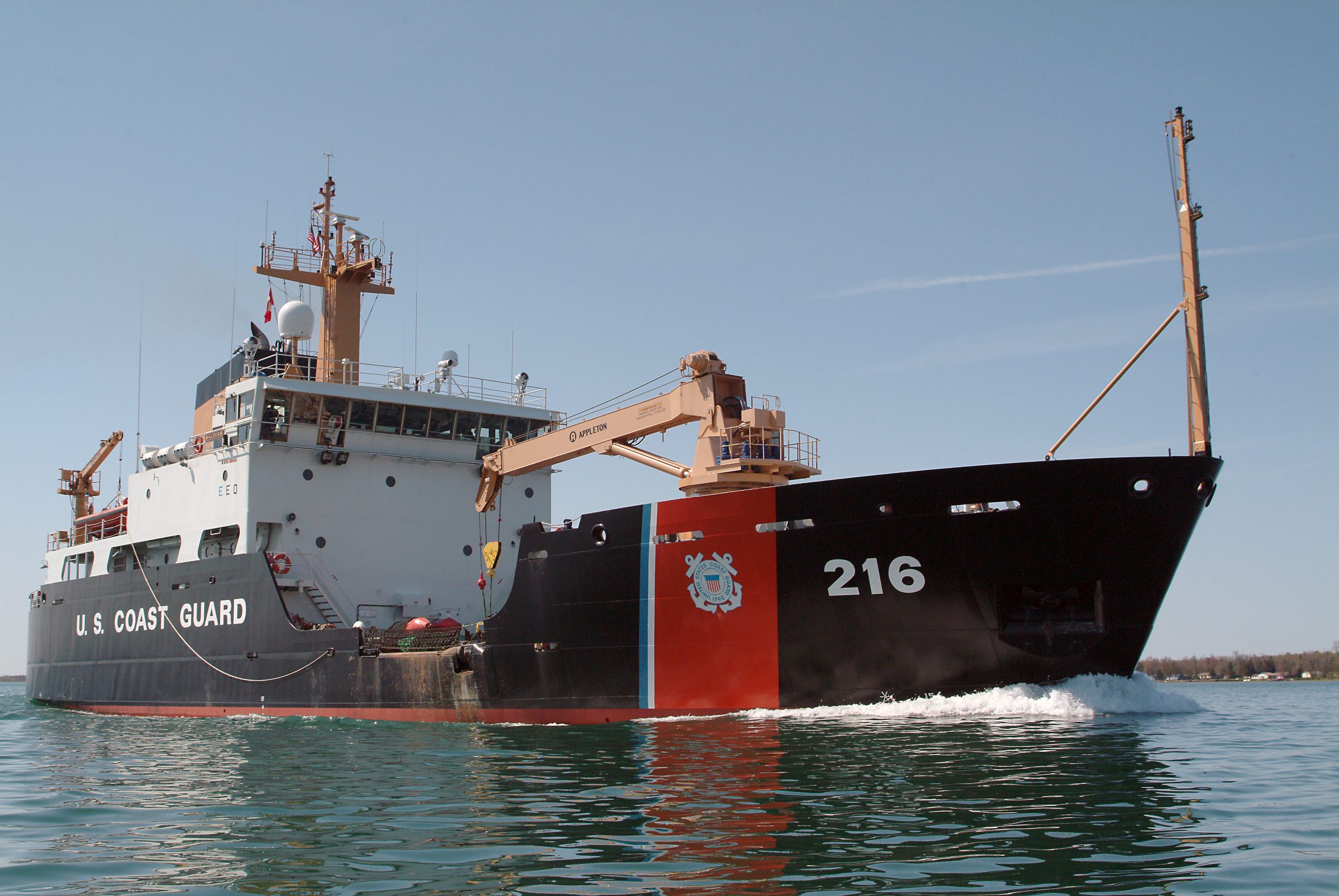
US Coast Guard cutter Alder leaving Twin Ports; Spar will replace
Duluth, MN – The announcement Friday amounted to a swap of assets — with the Alder heading for a year of maintenance and then permanent residency in San Francisco, while USCG cutter Spar will be bound for Duluth in spring 2022.
The United States Coast Guard cutter Alder will depart Duluth and sail under the Aerial Lift Bridge for the last time in July, the Coast Guard announced Friday.
After spending over 16 years homeported in the Twin Ports, Alder and its crew will move to Baltimore for a year of maintenance, before the vessel ultimately resides in its new homeport of San Francisco. Another 225-foot buoy tender, Spar, will replace the Alder in Duluth in spring 2022.
Upon arriving in Duluth, Spar will assume Alder’s current area of responsibility on the Great Lakes, and continue the missions of maintaining aids to navigation, domestic icebreaking, search-and-rescue and law enforcement, the Coast Guard news release said.
“Alder has been an ally to shipping interests in Lake Superior for almost 17 years, and we’ve been grateful to have her stationed in our port,” Duluth Seaway Port Authority Executive Director Deb DeLuca said in a statement reacting to the news. “These cutters and their crews are critical to maintaining the safe and efficient flow of commercial shipping on the Great Lakes. … They are truly key assets. We salute and thank Alder and her crew, and we look forward to the arrival of Spar from Alaska.”
Upon leaving next month, the Alder will transit across the Great Lakes, through the St. Lawrence Seaway, and south along the East Coast to the Coast Guard Yard in Baltimore, the Coast Guard news release said.
Spar, originally homeported in Kodiak, Alaska, was commissioned in August 2001. Spar maintained aids to navigation along the Aleutian Islands and the Bering Sea until fall 2020, when it departed for the Coast Guard Yard in Baltimore for maintenance.
Throughout the Coast Guard, the 225-foot Juniper class buoy tenders are undergoing midlife maintenance updates, the Coast Guard said, during which critical ship systems are evaluated and extensive repairs are made. The ships are expected to continue to service aids to navigation for many years to come.
During the gap between the Alder’s departure and Spar’s arrival, it’s unclear how icebreaking will be conducted in the Twin Ports this fall and winter. The cutter Mackinaw, out of Cheboygan, Michigan, is the only heavy icebreaking asset on the Great Lakes and has made occasional stops in Duluth.
Cutter Hollyhock is assigned to Port Huron, Michigan, and could also be an option, along with possible Canadian assets. The Coast Guard office in Duluth did not respond in time for this report. Alder first arrived in the port of Duluth-Superior on Oct. 17, 2004, replacing the Sundew, which was decommissioned in May 2004.
Superior Telegram
Captain Henry Jackman arrives at Montreal
Montreal, QC – Algoma’s new Captain Henry Jackman arrived at Montreal on Friday.
Rene Beauchamp
Coast Guard plans to close Grand Marais station
Grand Marais, MN – The U.S. Coast Guard plans to close its seasonal station in Grand Marais by next year and will rely instead on its Duluth station more than 100 miles away for severe water emergencies. The plan is part of a wider consolidation of “redundant” Coast Guard stations that was made public last week in the federal register.
“Many stations were established at a time when boats lacked engines and were powered by oars and paddles,” the plan’s summary said. “With modern boat operating speeds and improved direction-finding technology, many calls for Coast Guard assistance can be responded to by multiple units significantly faster than when these boat stations were first established.”
Lt. Paul Rhynard, the Coast Guard’s public information officer for the Great Lakes Region, said that the station in Grand Marais is staffed only in the warmer months by just four people and a boat, all from the larger “parent unit” in Duluth, and has responded to “less than one” emergency per year over the last decade.
“They’re sort of camping out there for a summer and getting about one call a year, it just made sense to bring them back down to the parent unit in Duluth,” Rhynard said. But the plan worried Grand Marais City Council members.
In a June 9 meeting, the council and Mayor Jay Arrowsmith-DeCoux collectively decided to submit comments expressing their concerns. The public may submit comments on the plan through Aug. 3. “Your boats might be fast but not fast enough,” council member Kelly Swearingen said.
Ryhnard wouldn’t say how long it would take for a boat from Duluth to reach the Grand Marais area as a number of factors — weather and size of boat — can change those figures. But he said other agencies in the area could still provide more immediate help on the water, and the area will continue to be served by the Coast Guard’s aircraft based in Traverse City, Michigan.
Chief Deputy Will Sandstrom said the Coast Guard’s departure will mean the agency will need more training and possibly more equipment. “We’re certainly going to have to amp up the training for the big lake … (The search-and-rescue unit) train more on all the inland lakes and they do some training out on Lake Superior, but would have to get our training more up to speed with the big water,” Sandstrom said in an interview with the News Tribune.
It may also mean a bigger boat. He said they currently use “basically a fishing boat” and would look into getting “a vessel to handle the waves.” But he noted that U.S. Border Patrol now has a larger vessel stationed there that is comparable to what the Coast Guard used. “We could team up with them for resources if we know we’re responding to a big emergency,” Sandstrom said.
Sandstrom said the sheriff’s office might respond to six calls per year on Lake Superior, but most are reports of a boat that drifted from shore or an odd object in the water that might look like a person or overturned boat.
He said the last “actual full-blown emergency” on the lake was in 2014 when two men drowned near Bluefin Bay resort. That event was in December, when the Grand Marais station wasn’t staffed for the season, but 11 agencies responded, including a U.S. Coast Guard boat crew and Canadian Coast Guard plane dropping flares to help searchers see at night.
Grand Marais’ Coast Guard station, called Station (Small) North Superior, was established in 1928 and has been staffed on a seasonal basis since 1988. It sits on Artist Point near the walkway to the Grand Marais Lighthouse. According to the Coast Guard’s website, it’s responsible for the area of the lake from Taconite Harbor to the border with Canada, including Isle Royale.
Duluth News Tribune