Boatnerd News

Boatnerd News – November 11, 2022

Edmund Fitzgerald search: Hear call to help after 29 men were lost in Lake Superior

LAKE SUPERIOR, MI – “Things look pretty bad. It looks like she may have split apart at the seams.”

In the hours after the 728-foot Edmund Fitzgerald abruptly vanished from the radar during a gale on Lake Superior the night of Nov. 10, 1975, the attitude of rescue crews quickly switched from incredulity that a freighter so large could just disappear, to asking nearby ships to help with the search.

Forty-seven years ago Thursday night, the search for the Mighty Fitz was just beginning. Its last radio contact with the Arthur M. Anderson was at 7:10 p.m. Minutes later, her crew could not be raised on the ship’s radio.

In these audio recordings, the U.S. Coast Guard at the Sault Ste. Marie station is talking to Capt. Jesse Bernie Cooper from the Arthur M. Anderson, a ship that had been trailing the Fitzgerald for much of that day in fierce seas and waves as high as 25 feet.

The Anderson had been the first to raise the alarm when the Fitzgerald vanished. Now the Anderson’s crew was being asked to go back out into the gale and look for the Fitzgerald and her crew of 29 men.

You can hear the Coast Guard saying it’s “very certain that the Fitzgerald went down,” and is asking nearby ships for assistance. The Coast Guard was hoping ships near Whitefish Point could look for lights in the water, lifeboats, debris – anything signaling there might be survivors.

Earlier in the day, the Edmund Fitzgerald had lost both it radars and the Anderson’s crew had been helping the Fitzgerald’s crew navigate through the storm.

“The last time I talked with him, he said he was ‘holding his own.’ I lost contact after that,” Cooper told the Coast Guard.

Cooper agreed to go back out to the area where he thinks the Fitzgerald disappeared, but you can tell by his voice that he was worried about his own crew, too.

“I’m afraid I’m going to take a hell of a beatin’ out there.”

MLive


Algoma Central Corporation and Furetank double investment in product tankers

ST. CATHARINES, ON – Algoma Central Corporation (TSX: ALC) today announced that it has doubled its investment in the FureBear joint venture, and will construct four additional dual-fuel ice class 1A 17,999 DWT climate-friendly product tankers with their partner Furetank AB (“Furetank”) of Sweden, bringing the total investment to eight vessels. Algoma owns 50% of the joint venture.

 “In our strategic plan, we set out to find sustainable areas to grow our business and deploy capital in the highest and best uses,” said Gregg Ruhl, President and CEO of Algoma. “This investment enables us to further diversify Algoma’s asset base and geographic trading zones in a segment we know well and with partners that share our values,” concluded Mr. Ruhl. 

“The expansion of our FureBear investment with Algoma is exciting news,” said Lars Höglund, CEO of Furetank. “This is yet another endorsement of the environmental benefits and innovative design of our Vinga Series. I look forward to delivering on these benefits with our partner and working together to fulfill the need for modern and efficient tonnage in the markets we serve,” concluded Mr. Höglund. 

Like the initial four vessel order, the additional ships will be constructed at China Merchants Jinling Shipyard in Yangzhou, China, with delivery expected between 2023 and 2025. Two of the four vessels had previously been ordered by Furetank in September and will be transferred to FureBear, and the other two vessels have been placed as new orders bringing the total vessels in the Vinga series to 17. Upon completion, all eight FureBear vessels will be entered into the Gothia Tanker Alliance, and will be operated by Furetank out of Gothenburg, Sweden. 

The Vinga ships are designed with FKAB Marine Design and all have dual-fuel capability and run on LNG/LBG or gasoil and are also fully equipped for shore power. They are designed with a battery hybrid solution and several innovative features that reduce fuel and energy consumption, resulting in extensively lower emissions of CO2, sulphur oxide, nitrogen oxide and hazardous particles. The ships have scored the best Energy Efficiency Design Index or EEDI value in their segment globally, meaning that they are the most energy efficient vessels according to the International Maritime Organization (IMO).

Algoma Central Corporation
Boatnerd News – November 10, 2022

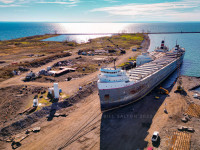
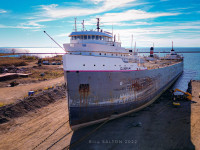
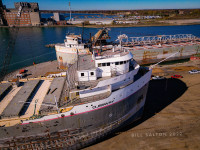
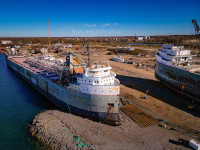
Soon-to-be-scrapped Ojibway hauled ashore

Social media posts show the former Lower Lakes Towing Co. bulk carrier is showing being in inched ashore at Marine Recycling Corp Scrapyard at Port Colborne, ON.

The vessel, built in 1952 as Charles L. Hutchinson (ii) and which sailed for many years as Ernest R. Breech for the Ford Motor Co. fleet, was retired at the end of last season due to needed repairs that could not be economically justified.

Her former fleet mate Manistee is still waiting to feel the scrapper’s torch, as is the retired cement carrier S.T. Crapo.

See photos in the image gallery.


Welland Canal closing Jan. 7, says seaway

For the fourth year, Niagara residents can expect bridges over the canal to stay up into the new year as the St. Lawrence Seaway Management Corp. extends the 2022 shipping season.

It’s part of a five-year pilot program that will see the 43-kilometre-long link between Lake Erie and Lake Ontario stay open until noon Saturday, Jan. 7, 2023.

The Montreal-Lake Ontario section of the seaway will remain open until noon, Saturday, Dec. 31.

The seaway said while preserving the sustainability of the navigation season is very important, it is also mindful that unanticipated environmental conditions may occur during the closing period.

It added that should that happen, the closing dates for the Montreal-Lake Ontario section or Welland Canal may change.

Welland Tribune


Milwaukee secures funding for new cruise ship dock

MILWAUKEE, WI – The Milwaukee Common Council has signed off on a $2 million investment in the South Shore Cruise Dock, in a bid to make the city a must-stop on the Great Lakes cruise circuit.

The city’s 2023 budget, which the council approved on Friday, includes $2 million in funding to redevelop the South Shore Cruise Dock. The dock is located next to the Lake Express ferry landing at 2330 S. Lincoln Memorial Dr.

The city is planning on using $4 million in grants from the Wisconsin Department of Transportation and $1.285 million from the Port of Milwaukee, which sold a tract of riverside land to Komatsu for its new headquarters.

The South Shore Cruise Dock would also be the future port-of-call for Seawaymax vessels such as the Viking Octantis, the city said in a statement on Monday. The Viking Octantis is currently the largest cruise ship on the Great Lakes, a fact the vessel did not shy away from when it docked in downtown Milwaukee last May.

City officials said final construction design for the new dock is underway. A request for proposal is expected to be issued to the Board of Harbor Commissioners sometime early in 2023. Construction could begin in the spring.

“We worked together to complete the financing package for the redevelopment of South Shore Cruise Dock. This investment is valuable to boosting our city’s recreation and tourism market that will grow our economy in the years ahead,” said Milwaukee Mayor Cavalier Johnson in a statement.

The director of the Port of Milwaukee, Adam Tindall-Schlicht, told Urban Milwaukee earlier this year that he expects the redevelopment should last the city more than 50 years. “This really is the one-time investment that we need,” said Tindall-Schlicht.

Tindall-Schlicht also told the news outlet that the city previously considered redeveloping the South Harbor Campus area for cruise docking. But a closer look found that the South Shore Cruise Dock was cheaper to develop.

The project falls within Milwaukee’s 14th District and Ald. Marina Dimitrijevic, who represents the area in the Common Council, described the port area as a “gem for our city.”

“As the Great Lakes cruising industry continues to grow, I couldn’t be more excited that thousands of passengers each year will step off the Viking Octantis and be welcomed to our great city by way of the 14th District,” according to Dimitrijevic, in the statement.

TMJ4


Neebish Islander III christened into service with special ceremony

BARBEAU, MI – Along with a rural public bussing system, the Eastern Upper Peninsula Transportation Authority (EUPTA) also operates three vehicle and passenger ferries to the nearby islands of Sugar, Drummond and Neebish.

On November 8, 2022, EUPTA welcomed their newest ferry into service — the Neebish Islander III.

The Neebish Islander III was built in Manitowoc, WI by the Burger Boat Company and they christened her at their facility back on August 13.

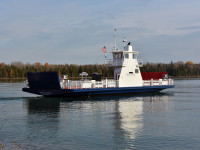
The Islander III is designed to be an ice breaking passenger and vehicle ferry that can carry 15 passenger vehicles. The ferry will be used year-round, carrying people on the St Mary’s River, in Michigan’s Upper Peninsula, between Barbeau and Neebish Island. “We build all different kinds of projects that can be found around the world from research vessels to passenger vessels, now a car ferry, motor yachts of all different sizes,” said Ron Cleveringa, Burger Boat Company Vice President of Sales and Marketing.

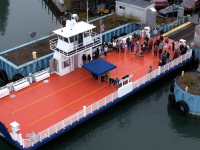
At 1:30pm today, the Neebish Islander II made its final trip as it ferried a truck with a trailer of sugar beets to the island. As it docked on the island, the Neebish Islander III greeted its older sister with a salute to which the crowd responded with cheers as the III came into view. The blue-hulled craft with an orange deck and white side-mounted pilot house docked on the mainland, lowered its ramp and the crowd moved to “ooos” and “wows.” It really is beautiful.

“Public transport is so important across the region and most people only think it happens on the mainland.” said Jean Ruestman, Director of the Office of Passenger Transportation for MDOT. “We recognized the need for islanders to be able to get to the mainland to get the services they needed and take them back to the island. That was most important.”

Father Romeo from the Sault was present to conduct a Maritime Blessing on the Neebish Islander III. Once the blessing was completed, the new vessel went into service while the Neebish Islander II sailed downriver to be docked until it can be sold, no longer to carry vehicles or passengers from the mainland to Neebish Island as it has been since 1944.

EUP News


Obituary: Art LaBrecque, sailed for Huron Cement

Arthur James LaBrecque passed away Nov. 3, one day shy of his 87th birthday. Art was born Nov. 4, 1935, in Alpena to Alphonse and Grace (McIntyre) LaBrecque. After graduating fr

om Catholic Central High School, Art began his Great Lakes sailing career on the Huron Portland Cement boats. He then served in the U.S. Army where he learned to perfect his culinary skills before returning to the cement carriers.

His career on the freighters almost didn’t happen though, as he got seasick on the ferry ride across the Straits of Mackinac (the Bridge wasn’t built yet) on his way to the Soo to get his sailing card! He sailed on the lakes for 40+ years on most of the freighters of the HPC fleet, retiring in 1996 from Inland Lakes Management as Steward of the flagship S.S. Alpena.

Art married Sharon Horal on July 28, 1962, in Alpena. Art and Sharon lived in Alpena during their marriage and celebrated their 60th wedding anniversary in July. They had three boys: Michael, Brad, and Patrick. Art enjoyed many good years of retirement at their cottage on Grand Lake and wintering in Arizona. He was an ardent Detroit sports fan, particularly the Tigers. He continued to support the Lions, hoping the next season would be better than the last.

His family, friends and fellow sailors thought he made the best soups and gravy. His liver paste wasn’t bad either. Surviving is his wife, Sharon; two sons Michael (Kristi), Patrick (Jackie Schaedig); special granddaughter Hannah Gillian LaBrecque; and lots of dear sisters-in-law, brothers-in-law, nieces, and nephews. Art was preceded in death by his son, Brad (or Bradley Arthur if he was in trouble) and all his siblings: Neal, Edward, Robert, and Margaret ‘Monnie’ Hackenberg. 

A celebration of life will take place Sunday, Nov. 13, at JJ’s from 1 p.m. to 4 p.m. Inurnment: Presque Isle Cemetery. Memorial donations can be made to St. Vincent de Paul or your favorite local charity.


#gallery-1 { margin: auto; } #gallery-1 .gallery-item { float: left; margin-top: 10px; text-align: center; width: 33%; } #gallery-1 img { border: 2px solid #cfcfcf; } #gallery-1 .gallery-caption { margin-left: 0; } /* see gallery_shortcode() in wp-includes/media.php */

Boatnerd News – November 8, 2022

Strong prairie grain harvest helps Thunder Bay port

THUNDER BAY, ON – One of the best-ever prairie harvests means more work for people employed in the grainhandling and shipping sectors in Thunder Bay.

The Thunder Bay Port Authority said grain shipments in October rose by 33 per cent from September, and were eight per cent better than October 2021. “So far, so good,” said Chris Heikkinen, the port’s director of business development and communications, in an interview Monday. “During October we had certainly the busiest month we’ve seen this shipping season. It’s a promising fall for grain.”

This marks a return to a more typical volume of grain transiting the port, following a year of decreased shipments. Last year’s harvest was the poorest in over a decade, as it was impacted by drought and heat on the prairies. Grain from the 2021 harvest moved through Thunder Bay from the opening of navigation and into September.

But this year’s harvest is the third largest on record, and grain from this crop is what’s currently being shipped through the port to markets in Europe, Africa and South America.

Although year-to-date grain shipments remain below last year’s totals because of the smaller size of the previous harvest, another important cargo category is showing a dramatic increase in tonnage due to Russia’s war against Ukraine.

Thunder Bay has handled 1.07 million tonnes of potash from Saskatchewan so far, over 150 per cent more than a year ago.

The port authority notes that global supplies of potash, which is an important component of fertilizer, have been stretched by sanctions imposed against Russia and its ally Belarus. Together, the two countries are responsible for almost a third of global production.

Heikkinen said Thunder Bay hasn’t handled this much potash through the port in more than 30 years.

Port facilities include eight grain elevators, three dry bulk terminals, two liquid bulk terminals, Keefer Terminal (general and project cargo) and a shipyard with a dry dock. The port authority is hoping for favorable weather conditions to stall the formation of ice before the shipping season ends in early January.

Heikkinen said “a very strong lineup” of shipments is due to arrive at Keefer Terminal over the next couple of months, bound for western Canada.

The terminal handles general and project cargo including larger structural items such as wind turbines and other steel products. Other port facilities include eight grain elevators, three dry bulk terminals, two liquid bulk terminals, and a shipyard with a dry dock. It’s estimated that shipping-related activity accounts for 900 direct jobs in Thunder Bay and generates an annual economic contribution of $370 million.

So far this year the port has been visited 282 times by cargo vessels including 109 times by overseas-registered ships, 170 Canadian, and three from the U.S.

TB Newswatch


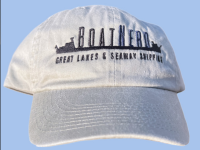
Show your style! New Boatnerd caps now available

We are pleased to debut our stylish new baseball cap, just in time for the holidays. Sales benefit this site. Thanks to our friends at Know Your Ships for letting us order through their site! Order here (scroll down to see the cap).  http://www.knowyourships.com/catalog.html


#gallery-2 { margin: auto; } #gallery-2 .gallery-item { float: left; margin-top: 10px; text-align: center; width: 33%; } #gallery-2 img { border: 2px solid #cfcfcf; } #gallery-2 .gallery-caption { margin-left: 0; } /* see gallery_shortcode() in wp-includes/media.php */

Boatnerd News – November 6, 2022

Heddle Shipyards awarded $135-million contract to refit Coast Guard ship

A multi-year project at Heddle Shipyards’ Port Weller Dry Docks will create more than 200 jobs after the company was awarded a $135.5-million contract to extend the life of Canadian Coast Guard Ship Terry Fox.

A release from Heddle said the nearly three-year project will involve extensive engineering, planning and procurement phases, with shipyard work scheduled to begin December 2023.

“The CCGS Terry Fox vessel life extension project is transformational for Heddle Shipyards and Ontario,” said Shaun Padulo, Heddle’s president and chief executive officer.

The company said it is the largest single project in the history of the Coast Guard’s vessel life extension program, adding it will create broad economic and social benefits for St. Catharines, Niagara region, Ontario and Canada.

“The award of the project marks the conclusion of Phase 1 of our five-year business plan developed in 2021 and will provide Heddle with the platform to become Canada’s partner for future vessel life extension projects and the construction of vessels for the Canadian Coast Guard and Royal Canadian Navy.

“I am extremely proud of our people and excited for our future. Our goal was to bring Ontario into the national shipbuilding strategy in a meaningful way, and the Terry Fox is just the tip of the iceberg,” said Padulo in the release.

Work on the Terry Fox is expected to be complete by the summer of 2025.

Welland Tribune


Seaway lists ’22 season closing dates

In line with offering a predictable Great-Lakes St. Lawrence Seaway trade corridor, the following targeted dates for the closing of the navigation season for the respective sections are being communicated in a timely manner. While preserving the sustainability of the navigation season is very important, we are also mindful that unanticipated environmental conditions may occur during the closing period. Should this happen, the dates outlined below for the Montreal-Lake Ontario Section or the Welland Canal may change.

Closing Dates: Montreal-Lake Ontario Section

The Corporations have decided to waive the operational surcharges on December 21, 22, 23 and 24. Any transit of the Montreal-Lake Ontario Section of the Seaway after 23:59 hours, December 24, if permitted, will be subject to prior written agreement. Arrangements are to be made at the St. Lambert office. Irrespective of operating conditions, all vessels must be clear of the Montreal-Lake Ontario Section at 12:00 hours (noon) on December 31, 2022.

Closing Dates: Welland Canal

Any transits of the Welland Canal after 23:59 hours, December 26, if permitted, will be subject to prior written agreement. Arrangements are to be made at the St. Catharines office. As part of a season pilot program this navigation season, all vessels must be clear of the Welland Canal at 12:00 hours (noon), January 7, 2023, operating conditions permitting.

Closing Dates: Sault Ste. Marie Locks and Canal (United States)
Closing of the Sault Ste. Marie Locks (U.S.A.) is currently scheduled for January 15, 2023.


Sault Ste. Marie city commission continues work on Carbide Dock project

SAULT STE. MARIE, MI – During a recent meeting, the Sault Ste. Marie City Commission approved two more grant applications for the ongoing Carbide Dock project.In 2017, the commission approved the dock rehabilitation project. The project will make all parts of the dock usable, as currently the portions of the dock closest to the water are in too much disrepair.

The project will replace approximately 1,100 linear feet of the existing condemned dock structure to create a working waterfront. There will also be several updates to the dock, including secure storage areas, improved storm water management facilities, and a critical connection from the Easterday Avenue truck route to the riverfront.

The city has been applying for grants ever since approving the project. In 2018, the city commission estimated the city would need at least $20 million in total to complete the entire project.

The city has still not received a bid to take over the project as the projected cost is too high. In the years since the project was introduced, the city commission has applied to several different grants to raise the needed funds.

The commission made several decisions to help the project decrease costs and raise funding. First, the commission approved the leasing of a Carbide Dock slip to Kokosing Alberici Traylor, LLC. The slip is currently condemned and was originally considered in the cost of the project. Kokosing Alberici Traylor, LLC has agreed to a seven-year lease on the slip and in that time will make their own renovations, which would have cost the city more than $4 million.

In addition to cutting the cost of the slip by leasing out the property, the city commission also applied to two separate grants.

Recently, the budget for the project was decreased to increase the chances of securing a grant, but additional funding is still required. The commission approved the application of a grant to the U.S. Department of Transportation’s Reconnecting Communities Pilot Program. MDOT has agreed to match $1 million in order to qualify for the grant.

If the grant application is successful, the project will receive an extra $5 million from the U.S. Department of Transportation.

The second grant application was to the Fuel Transformation Program for the addition of shore power. This grant did not have a specific dollar amount but will cover the cost of adding safety lights to the dock area. The addition of power to the docks and shore is necessary for the dock. This work will also help the slip reconstruction proposed by Kokosing Alberici Traylor, LLC.

Sault News

New Neebish Island ferry to be dedicated Nov. 9

SAULT STE. MARIE – The Eastern Upper Peninsula Transportation Authority (EUPTA) is hosting a dedication ceremony Wednesday, Nov. 9 to commemorate the Neebish Islander III officially entering service.

The Neebish Island ferry is one of the only ways for Neebish Island residents and tourists to get back and forth between Neebish Island and the mainland, and its current ferry has been in service for decades.

Originally constructed in 1944, the Neebish Islander II has carried thousands of cars, people and other luggage to and from Neebish Island for years. After almost 80 years of service, officials said the Neebish Islander II is reaching a point where it’s too run down to continue for much longer. While the ship still works safely, the cost of repairing and maintaining the old ship has grown too high, causing EUPTA to introduce its successor, the Neebish Islander III.

“The Neebish Islander II was built in 1944 and has long outlived its useful service life,” said Pete Paramski, director of EUPTA. “The new one can haul 160,000 pounds and has no height limitations for what it can carry.”

While only slightly larger than its predecessor, the new ferry is made by modern standards and is a considerable upgrade to the previous ship. With a carrying capacity of 160,000 pounds, the new ferry will be able to carry more people and more vehicles to and from the island with every trip and will cost less to maintain.

In addition to its increased capacity, the new ferry will be more effective at breaking through ice, making for faster and safer trips in the winter months.

“It’s going to be much more ice worthy,” said Paramski. “The old one was kind of fragile, whereas this one is built a lot stronger with thicker steel.”

The new ferry will go into service, pushing the previous ferry into retirement, as soon as it is cleared for use after the dedication ceremony. The ship still has to pass test trips with the U.S. Coast Guard and will require the crew to be retrained to use the upgraded ship. The new ferry will begin its service sometime next week.

Construction on the ship began in October 2021 and finished last month before being shipped off to its new home port in Barbeau, Michigan, where EUPTA will host its dedication ceremony.

The ceremony, which begins at 2 p.m. on Wednesday, Nov. 9, will be the ship’s first introduction into the world. EUPTA will unveil it at the Neebish Island Ferry dock in Barbeau.

Sault News

Boatnerd News – November 5, 2022

DTE speeds coal exit, adds natural gas and renewable energy under 2042 plan

Under a new 20-year plan, DTE Energy Co. would accelerate the retirement of its remaining coal plants and replace them with more natural gas and renewable energy production to balance reliability, affordability and sustainability.

The 2042 plan projects a $9 billion investment in the next 10 years to support 25,000 jobs and savings of $1.4 billion to its 2.3 million customers mostly in Southeast Michigan and the Thumb over the long term compared to its previous plan issued in 2019.

“We’re working,” DTE CEO Jerry Norcia said during a virtual briefing, “to get as clean as we can as fast as we can, while keeping our focus on improving reliable and affordable energy to the customers and communities we serve.”

The plan calls for the accelerated retirement of the Monroe Power Plant, the country’s fourth-largest coal-fired plant that provides 30% of DTE’s energy, according to the company. Two units that had been scheduled for retirement in 2040 will go offline in 2028 instead. The final two of DTE’s coal-fired units will end generation in 2035 instead of 2040.

Additionally, the 24/7 coal-fired Belle River Power Plant would convert to a natural gas-powered peaker plant used for times of the year when there is elevated demand like the summer and when there’s extreme weather. The conversion of the two burners takes 90 days each. One will be converted in 2025 with the next to follow in 2026 without noticeable effect to customers, said Trevor Lauer, president and chief operating officer of DTE Electric. The plant had been set to end coal use in 2028.

“That’s going to be really important at times when we have extreme weather or high demand,” Lauer said, “to make sure that if the sun isn’t shining and the wind isn’t blowing we can make sure we’re providing the power that our residential, commercial and business customers need.”

The Monroe plant property is in a strategic location for the company, Norcia said. The company will examine opportunities for future 24/7 generation there as well as renewables. DTE sees opportunity to use the former St. Clair Power Plant site for its a large-scale energy storage array and potentially renewable energy generation, as well.

The Detroit News


Adam Tindall-Schlicht named Seaway Administrator

The White House announced President Biden’s appointment of former Milwaukee port director, Adam Tindall-Schlicht, as the next Administrator of the Great Lakes St. Lawrence Seaway Development Corporation (GLS). Mr. Tindall-Schlicht resigned his position at Port Milwaukee on October 19.

An agency of the U.S. Department of Transportation, the GLS is responsible for operation of U.S. portions of the St. Lawrence Seaway. It works in partnership with it’s Canadian counterpart to maintain a safe, reliable and environmentally responsible deep draft waterway connecting Great Lakes ports with world markets and global trade. The agency also works closely with ports to market the Seaway system, develop trade, and enhance commerce in the region.

The U.S. Seaway has been without an Administrator since 2016 when former Ohio Congresswoman Betty Sutton left the post. In April, 2022, forty members of the House and Senate wrote to President Biden urging that the position be filled. Mr. Tindall-Schlicht will be the first Great Lakes port director to serve as Administrator since Dave Oberlin, former Executive Director of the Duluth Seaway Port Authority. Mr. Oberlin was

Seaway Administrator from 1969-1983.

AGLPA

Boatnerd News – November 3, 2022

Lakes Limestone Up 10.7 Percent in October

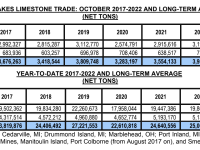
CLEVELAND — Shipments of limestone on the Great Lakes totaled 3.9 million tons in October, an increase of 10.7 percent compared to a year ago.  Limestone cargos were also above the month’s 5-year average by 10.9 percent.

Loadings from U.S. quarries totaled 3.2 million tons, an increase of 9.7 percent.  Shipments from Canadian quarries totaled 736,157 tons, an increase of 15.3 percent.

Year-to-date the limestone trade stands at 25 million tons, an increase of 1.5 percent compared to 2021.  Loadings from Michigan and Ohio quarries total 19.9 million tons, an increase of 2.2 percent.  Shipments from Ontario quarries total 5.1 million tons, a decrease of 1.1 percent.

Lake Carriers’ Association 


Great Lakes cruise ship visits on Island new record in 2022, more next year

MANITOULIN ISLAND—The cruise ship industry in the Great Lakes has rebounded significantly after COVID-19, industry leaders tell The Expositor.

“This is a very exciting time for the cruise ship industry,” stated Stephen Burnett, of the Great Lakes Cruise Association (GLCA). “It has been a challenging, but wonderful year on the Great Lakes, and there has been a significant increase in the number of visitors and ships on the Great Lakes, with even more next year.”

“From COVID-19 two years ago and zero business to a very successful year. It was a great year,” echoed Bruce O’Hare of Little Current, president of Lakeshore Excursions. “It probably increased by about 40 percent and we had many new ships coming into Little Current and the Great Lakes, and more expected in the future.”

“It’s been a good year, but a difficult year as well,” said Mr. Burnett. “In the past couple of years during COVID, many cruise ship lines had to reduce staff. Now they have had to ramp up. This is a complex industry, the cruise ships are like moving Marriott Hotels, where people have to plan to be on them 16-22 months ahead of their actual sailing time.”

“Worldwide some cruise lines have done very well and some have struggled,” said Mr. Burnett. “In many ways the cruise ship industry is one of the most resilient businesses there are. The industry had to be shut down during COVID, and companies lost revenues. But looking at it globally, it is astonishing how well the industry has done this year.”

“It is a very dynamic time in the history of the cruise ship industry,” said Mr. Burnett. “We had eight or nine ships cruise the Great Lakes this year, next year there will probably be between 10-12, including a second Viking ship.”

The region ports of call include Little Current, Parry Sound, Sault Ste. Marie and they all reported increases in numbers of visitors. Killarney had its first passenger ship stop there in about 80 years with the Viking Octantis visiting this year.

Mr. O’Hare pointed out passengers are looking for destinations to visit and the local partnership with Wiikwemkoong Tourism and the Ojibwe Cultural Foundation really pulls this all together on the Island as visitors receive an Indigenous experience, one they crave.

Visitors also visit Kagawong for kayaking, Bridal Veil Falls, the Manitoulin Chocolate Factory and have the opportunity to hike the Cup and Saucer Trail and support conservancy. “It’s a Manitoulin Island initiative, not just a benefit for Little Current,” said Mr. O’Hare.

“I’ve been talking with five new cruise lines, with three more ships expected next summer,” said Mr. Burnett. He feels the number of boats sailing through the region could grow from nine to 18 in the coming years.

“The future of the cruise ship industry is very good and is only going to grow,” added Mr. O’Hare.

The Manitoulin Expositor


120-year-old shipwreck discovered in Lake Superior

A Lake Superior shipwreck that has eluded searchers for decades has been found.

The Great Lakes Shipwreck Historical Society (GLSHS) announced on Oct 12 the discovery of Barge 129, which sank in a storm on Lake Superior on Oct 13, 1902.

For GLSHS Director of Marine Operations Darryl Ertel Jr., it was the end

of a long search. “I’ve looked for this ship for so long because it was a Whaleback. I was pretty excited. I couldn’t wait to get the cameras on it”.

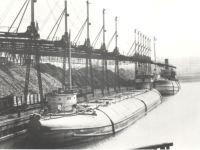
Barge 129 was one of only 44 “whaleback” ships ever constructed. The peculiar design had curved sides, similar to a large pontoon, with tapered bows with flat ends like a pig’s snout. The ships were constructed from 1887 to 1898 to ferry grain and ore around the Great Lakes. The design was to increase the ships’ stability on high seas. “Whaleback” refers to the ship’s appearance in the water when fully loaded.

On Oct 13, 1902, Barge 129 was being towed by the steamer Maunaloa. The 292-foot barge was loaded with 2,300 tons of iron ore when the gales of October struck (sound a little familiar?). The force of the waves snapped the tow line between the two vessels. Barge 129 was tossed about with the waves. The Maunaloa turned around and attempted to reconnect the two ships. The two boats slammed together. 

The Maunaloa’s anchor ripped into Barge 129’s starboard side. As the whaleback began to sink, the Maunaloa’s captain and crew raced to launch their lifeboat for the barge’s crew. As Barge 129’s crew was helped aboard the Maunaloa, the whaleback dipped below the surface and dove 650 feet to the bottom, 35 miles from Vermilion Point.

Barge 129 was the last undiscovered whaleback wreck in the Great Lakes. The wreckage was initially found along with eight other wrecks in 2021 by the GLSHS in partnership with Marine Sonic Technology using Side Scan Sonar. Side Scan Sonar – Marine Sonic Technology. Barge 129 was positively identified in August 2022.

When the Shipwreck Society put their ROV down on the wreck site this past summer, they were surprised by the devastation of the ship. “It’s totally destroyed on the bottom. It’s nowhere near intact. It’s at least 4 to 5 big pieces and thousands of little pieces. It’s just disintegrated,” Ertel said.

“The whalebacks were pretty unusual ships,” stated Shipwreck Society Executive Director Bruce Lynn. “When we had the ROV on it, you could clearly see the distinctive bow with a part of the towline still in place…that was an incredible moment!”

The Sun Times

#gallery-3 { margin: auto; } #gallery-3 .gallery-item { float: left; margin-top: 10px; text-align: center; width: 33%; } #gallery-3 img { border: 2px solid #cfcfcf; } #gallery-3 .gallery-caption { margin-left: 0; } /* see gallery_shortcode() in wp-includes/media.php */

Boatnerd News – November 2, 2022

Professional Mariner 2023 Ship of the Year is Mark W. Barker

The Interlake Steamship Co. has been moving freight on the Great Lakes for generations. Its newest ship, Mark W. Barker, will build on that tradition for years to come.

The 639-by-78-foot Mark W. Barker is the first U.S.-flagged Great Lakes freighter built in almost 40 years, and it’s the first ship operating on the Lakes with EPA Tier 4 engines. The self-unloading bulk carrier is the lead ship in Interlake’s River class.

Fincantieri Bay Shipbuilding built the steel-hulled ship using a collaborative design from Bay Engineering Inc. and Interlake’s in-house engineering department. The ship was designed around a flat-bottomed cargo hold that increases capacity and versatility compared to a traditional laker outfitted with sloped holds. Load-bearing hatch covers above deck can carry windmill parts and shipping containers.

“This box-shaped cargo hold allows the ship to carry cargoes that may not traditionally move on the Great Lakes,” Mark W. Barker, president of Interlake Steamship and the ship’s namesake, said during its christening on Sept. 1 in Cleveland. “It is important that we can move new types of cargo to meet the changing supply chains of the future.”

Interlake Steamship is the largest privately held American shipping company on the Great Lakes. The company operates 10 ships, four of which are more than 1,000 feet long. The 1,013-foot Paul R. Tregurtha, as the longest active freighter on the Great Lakes, carries the title “Queen of the Lakes.” Mark W. Barker is Interlake’s first new ship since the late 1970s.

Based just outside Cleveland in Middleburg Heights, Ohio, Interlake Steamship can trace its shipping roots to the late 1880s. Chairman James R. Barker took the firm private in 1987 and led it for another 20 years before his son, Mark W. Barker, succeeded him as president. These days, the company transports a wide range of bulk cargo that includes iron ore, stone, coal and salt

Read more and view images here: https://professionalmariner.com/article/2023-ship-of-the-year-mark-w-barker/?fbclid=IwAR1rs2DTpydQ_ow1eV0QKpJgM1f0S-gHqE_MXCbhcEaz5pfNYTpXxFmlZUg


WorkBoat names Mark W. Barker one of 2022’s 10 Significant Boats

WorkBoat has announced its 10 Significant Boats of 2022. From these 10 boats, the Boat of the Year will be announced on Wednesday, Nov. 30, the first day of the 2022 International WorkBoat Show in New Orleans.

Some years WorkBoat’s Boat of the Year is selected by the readers of WorkBoat magazine and workboat.com by voting online. In alternate years, WorkBoat’s editors pick the Boat of the Year. This year the Boat of the Year will once again be chosen by our readers by voting online. (An announcement concerning when the voting page will go live is imminent.)

Last year’s Boat of the Year was the Staten Island Ferry Michael H. Ollis built at Eastern Shipbuilding Group.

Choosing the 10 Significant Boats each year is subjective, with many boats deserving of making the list each year. However, there are certain parameters that the editorial staff does follow in its efforts to give all boats that qualify a chance. For example, we try to select at least one boat from each sector of the industry that WorkBoat covers — inland towboats and barges, tugs, offshore service vessels, passenger vessels, etc. In addition, if possible, we try to select one boat from each region of the U.S. — East Coast, West Coast, Gulf Coast, and the Great Lakes.

Furthermore, while design is the most important ingredient in selecting a Significant Boat, it is not the only one. This is not a list based on naval architecture and marine engineering only. What makes a boat “Significant” can be that it’s a first of its kind, a successful series build, or where it operates and who it serves, or how it helps advance new workboat frontiers like wind energy.

View the complete list here: https://www.workboat.com/shipbuilding/workboat-names-its-10-significant-boats-of-2022?fbclid=IwAR0_H5ih8xXAyTK9BqjzxtJSpNGUEdZqYEVVMjrzkKAv8tCgmvFJhpboOY0


Boatnerd News – November 1, 2022

Roger Blough tow arrives in Conneaut

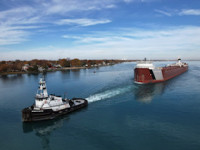
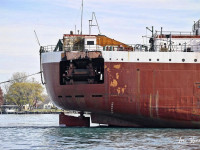
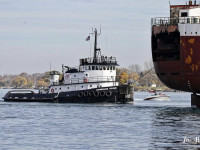
CONNEAUT, OH – The tow of the fire-damaged Roger Blough arrived at Conneaut just after 9 a.m. Tuesday. The trip originated from Sturgeon Bay, WI, and was handled by Ashton Marine’s tugs Meredith Ashton and Candice Elise. Although nothing official has been released, it is expected the Blough will continue in lay up until her final disposition is determined by operator Great Lakes Fleet and owner CN.


Port of Monroe receives $11M in funding from federal government

MONROE, MI – The Port of Monroe has been awarded $11,051,586 through the Port Infrastructure Development Program, a federal grant awarded through the United States Maritime Administration (MARAD).

The award will go toward the port’s Lake Erie Renewable Energy Resilience Project, funding four components: riverfront work, turning basin work, maritime readiness slip construction and shore power infrastructure.

Riverfront work will include replacing the surface of the existing wharf, constructing a second riverfront wharf to be used exclusively for vessel transfer of wind energy cargoes, and reinforcing shoreline stabilization. Turning Basin work will include rehabilitating the concrete dock cap, bollard and fender installation, and replacing roughly 390 feet of failed sheet pile. Small Boat “Maritime Readiness Slip” construction will include demolishing and rehabilitating an existing small boat slip to be used by harbor assist vessels. Shore Power infrastructure will include removing existing overhead lines and providing shore power to the riverfront wharves.

“There are but a few rare moments in the port’s history which can be considered monumental,” said Port of Monroe Director Paul LaMarre III. “This grant award represents the single largest investment in the Port of Monroe’s infrastructure since the organization’s creation in 1932, and will have profound effects on the sustainability and enhancement of our maritime infrastructure, which supports the Port of Monroe’s continued growth as a regional hub for both domestic and international renewable energy cargoes.”

The port’s application for this federal funding was supported by U.S. Sen. Gary Peters, Chairman of the Commerce Subcommittee Surface Transportation, Maritime, Freight, and Ports. MARAD is an agency of the U.S. Department of Transportation.

“The Port of Monroe is not only a critical resource for manufacturers in Michigan and across the Great Lakes region, but it also plays a crucial role in ensuring efficient trade and transport of products that families and businesses rely on every day,” Peters said. “I was pleased to support the port’s effort to secure this funding, which will expand cargo capacity, increase economic activity for the region and strengthen supply chains. I’ll keep fighting to make sure the port is treated fairly, has the resources necessary to compete on a level playing field and reaches its full potential.”

“Senator Peters is the Port of Monroe’s champion,” LaMarre added. “His unequivocal support for the Great Lakes maritime industry and Michigan’s role as the ‘Great Lakes State’ is second to none. His support of this grant and our continued efforts is humbly appreciated and will have far-reaching effects on our port’s future.”

The Monroe News


National Museum of the Great Lakes final fall lecture offers a retrospective look at the J.W Westcott company

See the media gallery below for the event flyer

#gallery-4 { margin: auto; } #gallery-4 .gallery-item { float: left; margin-top: 10px; text-align: center; width: 33%; } #gallery-4 img { border: 2px solid #cfcfcf; } #gallery-4 .gallery-caption { margin-left: 0; } /* see gallery_shortcode() in wp-includes/media.php */

Boatnerd News – October 31, 2022

Roger Blough tow on the way to Conneaut

On Sunday, the Roger Blough tow passed under the Blue Water Bridges at Port Huron/Sarnia after pausing to allow the Sam Laud to pass upbound. 

See the gallery for images.


Neebish Islander III ferry arrives at her new home

BARBEAU, MI – The new, 92-foot-long ferry Neebish Islander III was delivered from builder Burger Boat Co. in Manitowoc, WI, Sunday afternoon to her owner, the Eastern Upper Peninsula Transportation Authority, at Barbeau, MI. She arrived in the late afternoon and tied up to a Corps of Engineers dock at the lower end of the rock cut. After crew training and trials, she is expected to enter service between the island and the mainland after a dedication ceremony Nov. 9. It is not known what will happen with the current ferry Neebish Islander II.

Roger LeLievre 

Happy Halloween!

– Boatnerd

#gallery-5 { margin: auto; } #gallery-5 .gallery-item { float: left; margin-top: 10px; text-align: center; width: 33%; } #gallery-5 img { border: 2px solid #cfcfcf; } #gallery-5 .gallery-caption { margin-left: 0; } /* see gallery_shortcode() in wp-includes/media.php */

Boatnerd News – October 30, 2022

Roger Blough tow in St. Clair River

Mid-morning Sunday the tow passed under the Blue Water Bridges after pausing to allow the Sam Laud to pass upbound. Most of the earlier fog has lifted.  Please send photos to news@boatnerd.net

Jump to a Date:

Archives