Boatnerd News

Boatnerd News – November 24, 2022

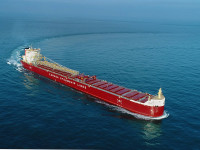
CSL’s MV Nukumi named bulk ship of the year 2022

MONTREAL, QC – Canada Steamship Lines has announced that its latest newbuild self-unloading vessel, MV Nukumi, was named Bulk Ship of the Year 2022 last Monday evening at the prestigious International Bulk Journal (“IBJ”) Awards in Rotterdam, Netherlands.

Presented to the year’s most outstanding bulk ship or newly built vessel, the award recognizes the many innovations built into the design of MV Nukumi to enhance safety, efficiency and performance, and to reduce the vessel’s overall environmental footprint.

“I am honoured to accept this award on behalf of our newbuild teams who custom designed and built such an outstanding ship to service our customer, Windsor Salt,” said Louis Martel, CSL President and CEO. “IBJ’s notable acknowledgment underscores CSL’s ongoing commitment to providing our customers with the most advanced, safe and sustainable bulk shipping solutions.”

The cutting-edge 26,000 DWT MV Nukumi is the first diesel-electric laker and the first single point loader to operate in Canada. The ship features a unique hull design, quieter machinery, a single point of loading system and a shuttle boom.

CSL partner EMS-Tech Inc. was also recognized by IBJ, receiving the Best Ship Loading or Unloading System award for its contribution in delivering MV Nukumi’s state-of-the-art self-loading and self-unloading systems.

CSL


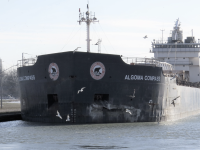
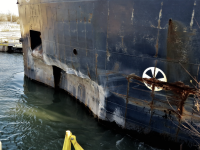
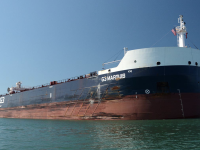
Algoma Compass mini photo album

See the gallery below for pictures of the Algoma Compass’ damage from its incident this week.

#gallery-1 { margin: auto; } #gallery-1 .gallery-item { float: left; margin-top: 10px; text-align: center; width: 33%; } #gallery-1 img { border: 2px solid #cfcfcf; } #gallery-1 .gallery-caption { margin-left: 0; } /* see gallery_shortcode() in wp-includes/media.php */

Boatnerd News – November 23, 2022

USCG Cutter Mackinaw will soon make trek as Christmas Tree Ship

CHEBOYGAN COUNTY, Mich. – A special delivery will soon be heading to Chicago.

On Tuesday, the U.S. Coast Guard Cutter Mackinaw was loaded with its annual shipment of 1,200 Christmas Trees to deliver holiday cheer to families in need.

This is the 23rd year of carrying on the tradition of the schooner Rouse Simmons, which sank in Lake Michigan in 1912 with a cargo full of Christmas Trees.

More than 30 volunteers helped load the Cutter Mackinaw.Cutter Mackinaw will leave its dock in Cheboygan on November 26.

It’s scheduled to arrive in Chicago around December 1 and will participate in the tree offload and ceremony at Navy Pier, Chicago on Saturday, December 3.

UpNorthLive


Bell from Lake Erie’s deadliest shipwreck goes on display at Toledo museum

While its wreck has been for 172 years the deadliest disaster in Lake Erie’s maritime history, the National Museum of the Great Lakes lacked any reference to the 1850 burning of the passenger steamer G.P. Griffith off the Willoughby, Ohio shore… Until now.

The museum recently added the Griffith’s bell, donated last year by the family of a diver who recovered it back in 1974, to its gallery of Great Lakes shipwreck artifacts.

Several hundred people are believed to have been on board – the exact number and victims’ names are unlikely to ever be known – when the vessel caught fire off the Ohio coast.

“The bell from the Griffith is significant because it represents the worst wreck on Lake Erie in its history,” said Chris Gillcrist, the museum’s executive director. “Also because the wreck occurred near shore, there are no remains left to explore, making the bell one of only a few artifacts from Griffith known to exist.”

A historical marker has long been posted along Lake Erie’s shore in Willowick to commemorate the disaster.

Local diver Louis Key found the bell in 1974 in relatively shallow water and kept it. They were contacted last year by Mr. Key’s relatives after his passing, said Carrie Sowden, the maritime museum’s archaeological director.

“The family was lovely to work with,” she said, and there proved to be just enough space available in the museum’s shipwrecks section to add the bell in a way that blended in.

“It’s exciting to be able to tell this story,” Ms. Sowden said.

The Griffith had left Buffalo on June 16, 1850, and was sailing along Lake Erie’s southern coast toward Toledo when its wheelsman observed sparks coming from around its smokestack that indicated a fire, according to the museum’s historical account.

Charles Roby, its captain, ordered the stricken ship to head toward land in hopes of beaching it, which would allow its passengers to escape. But the Griffith became stranded on a sandbar about a half mile from the shore, and only about 40 of those on board survived.

Any information about who perished was lost with the ship, Ms. Sowden said, and in those days the degree of record-keeping may only have been a log of how many tickets were sold.

Many of the passengers were likely European immigrants traveling by boat to various Great Lakes cities after arriving over land in Buffalo, she said. Most probably did not know how to swim, and they may also have been laden with heavy clothing for the trip even though it was June.

“It’s just this horrific story,” Ms. Sowden said before noting that it was the deadliest disaster on the entire Great Lakes until 1915, when the S.S. Eastland rolled onto its side while docked in Chicago, killing 844 of the more than 2,500 people on board awaiting a brief voyage to northern Indiana.

Ms. Sowden noted that rather than being polished, the Griffith’s bell has a weathered appearance consistent with having been under water for well over a century.

“We chose that deliberately” so that museum-goers could see how the underwater environment affected it, she said.

Toledo Blade

Boatnerd News – November 22, 2022

Wreckage of doomed steamer “Phoenix” found off Sheboygan, 175 years after tragedy

The Wisconsin Maritime Museum announced the discovery of wreckage from the “Phoenix” off Sheboygan, on the 175th anniversary of the doomed steamer’s sinking when as many as 300 people perished. There were some survivors.

The “Phoenix” was carrying between 200 and 300 crew and passengers, nearly all Dutch immigrants, to Sheboygan on Nov. 21, 1847, when overheated boilers caused a fire. The fire spread quickly and the ship sank, but no one was sure where.

The museum says in late July, shipwreck hunter Steve Radovan was taking part in the filming of a documentary by Omroep Gelderland, a journalism group from the Netherlands, when they found a smokestack in 85 feet of water off Sheboygan.

Wisconsin Maritime Museum staff and underwater archeologists from the Wisconsin Historical Society confirmed the smokestack was part of the “Phoenix.”

On Monday, Omroep Gelderland released a five-part podcast series, “De Ramp met de Phoenix,” on Spotify, Apple podcasts, and Google podcasts, to coincide with the anniversary of the tragedy.

The Wisconsin Maritime Museum’s display in Manitowoc includes a bible printed in Amsterdam in 1693, a personal artifact that washed ashore after the “Phoenix” sank.

WBay


Algoma Compass update

At this time there is no new update on the status of the Algoma Compass following her incident. Please refer to yesterdays news post for the latest update.

https://boatnerd3.jasonbowlerdesign.com/boatnerd-news-november-21-2022/

Boatnerd News – November 21, 2022

Algoma Compass hits Welland Canal bridge

Vessel traffic on the Welland Canal and road traffic in Port Colborne were not affected after a 207-metre-long laker struck an abutment near Bridge 21 Monday morning.

Poirier-Quesnel, S.t Lawrence Seaway Management Corp. manager of government and community relations, said Algoma Compass made contact with the southwest bridge abutment at about 5:45 a.m.

“The incident was reported to our operations centre, and a team of regional ship inspectors dispatched to the site.” He said no one on board the St. Catharines-based Algoma Central Corp. self-unloading vessel was injured. “There was no pollution, and the crew was not at risk.”

Poirier-Quesnel said the vessel, which listed its destination as Hamilton, moved to the west wall of the canal above Bridge 19A and Lock 8, under power. “It navigated to the wall without issue.”

The abutment struck by the vessel stretches south nearly 75 metres from the bridge and Clarence Street and holds a small parkette used by residents and tourists to watch ships travelling up and down the canal.

Welland Tribune


Boatnerd News – November 20, 2022

Weather halts traffic at the Soo

Gale warnings and heavy snow sent most vessels in the St Marys River system to anchor Saturday night. Edgar B. Speer, Gardno and Stewart J. Cort were anchored off Paradise at 10 p.m. Saturday. Federal Franklin  and Sam Laud were on the hook off of Bay Mills, although the Laud was there awaiting dock space at Algoma Steel. Arthur M. Anderson, Algoma Harvester, Rt. Hon. Paul J. Martin and Atlantic Huron were stopped a  Potagannissing Bay above DeTour. Vessels on Lake Superior were taking the north shore course Saturday night to avoid the worst of the weather.

Roger LeLievre

Boatnerd News – November 19, 2022

64 years ago, Lake Michigan claimed the Carl D. Bradley

ROGERS CITY, MI – Less than 45 miles northwest of Northport and 16 miles southwest of Lake Michigan’s Gull Island lies the remains of the Great Lakes freighter the Carl D. Bradley.

The freighter broke apart in 40-foot waves 64 years ago Friday.

The Bradley’s sinking claimed the most significant Great Lakes crew loss in 70 years, with 33 lives. The 1975 sinking of the Edmund Fitzgerald claimed 29 lives.

Launched in 1927, the 638-foot Bradley was then the largest and most sophisticated freighter on the lakes. The ship’s frequent homeport was Rogers City and owner was Michigan Limestone and Chemical Co.

On Nov. 17, 1958, after depositing a limestone load, the Bradley departed Gary, Indiana en route to Manitowoc, Wisconsin. There, the freighter was to undergo winter season upgrades and repairs. Mid-route, the captain was directed to return to Rogers City for one last load.

A sudden, every-100-years storm blew in over Lake Michigan causing the empty Bradley to twist and heave between the massive waves. The two survivors, Frank Mays and Elmer Fleming, revealed crewmen could literally hear the rivets popping from the hull.

As it neared 5:30 p.m., Mays recalled he heard a loud thud and then a second thud. From the pilot house, an urgent rescue call was given, “This is the Carl D. Bradley. Mayday! We are going down.”

The Bradley’s final voyage was coming to an end. With a separated bow and stern, the ship plunged 375 feet to Lake Michigan’s bottom. The sinking is estimated to have occurred in less than 15 minutes.

Crewmembers in the pilot house, on deck, and below deck scrambled for their lives. Mays and Fleming were able to make it to an 8-by-10-foot liferaft. Two other crew members joined them, but, through the night, the massive waves and 36-degree water claimed those other crew members.

Mays and Fleming literally held onto the raft’s wooden floor with fingers in between each slat.

With radio and television stations broadcasting the Bradley news, during the night, dozens of emotional Rogers City residents drove their vehicles from their Lake Huron coast to the Lake Michigan shoreline. There, with their vehicle headlights shining on the roaring lake, they looked for Bradley survivors.

The U.S. Coast Guard dispatched an Albatross search-and-rescue plane and the cutter Sundew. As the morning’s sun rays broke, the Sundew’s crew spotted the two survivors on the liferaft. The rescue was very tricky in the 20- to 25-foot waves and frigid winds.

Once Mays and Fleming were rescued, along with retrieving the liferaft, the Sundew headed to Charlevoix, which had the nearest hospital. Eighteen crew member bodies were recovered and 15 were never found.

Read more at this link:

https://www.thealpenanews.com/news/local-news/2022/11/64-years-ago-lake-michigan-claimed-the-carl-d-bradley/


Great Lakes/ St. Lawrence ‘green’ corridor initiative announced at U.N. conference 

CLAYTON, NY – Under an initiative announced at a United Nations climate gathering last week, preliminary plans are in the works for a “Great Lakes-St. Lawrence Seaway System Green Shipping Corridor Network.”

The announcement noted that the U.S. Department of Transportation, the U.S. Department of State, and Transport Canada will work with state, provincial, local communities, private-sector and non-governmental leaders, and Indigenous Peoples of Canada and the U.S. to host consultations with ports and other stakeholders. The goal: facilitating the establishment of a Great Lakes Green Shipping Corridor Network.

“It’s a grand initiative if they follow up with it,” said John M. Peach, executive director of the Clayton-based nonprofit environmental advocacy group Save the River. “There’s a lot of initiatives coming out of the COP27. What we have to see is, what’s the follow through?”

“COP27” is the 27th Conference of the Parties to the United Nations Framework Convention on Climate Change, being held in Egypt. The conference began Nov. 6 and concludes on Friday.

“I’d like to see more from them,” Mr. Peach said. “This is a pretty brief announcement of the initiative, and I haven’t seen a lot more.”

A joint statement issued by the American and Canadian embassy and consulates said that the Green Shipping Corridor Network builds on the work launched under the “Joint Statement by the U.S. Department of Transportation and Transport Canada on the Nexus between Transportation and Climate Change,” of February 2021.

The embassies said that green shipping corridors are a key means of spurring the early adoption of zero-emission fuels and technologies to place the shipping sector on a pathway to align with the goal of limiting global temperature rise to 1.5 degrees Celsius.

The 1.5 °C (2.7 degrees Fahrenheit) target is the goal of the 2015 Paris Agreement, which calls for countries to take action to reduce greenhouse gas emissions in order to limit global warming.

“Through the Great Lakes-St. Lawrence Seaway System Green Shipping Corridor Network Initiative, Canada and the United States will work with industry to help facilitate the establishment of green corridors throughout the region, including by convening stakeholders and contributing to assessments and analyses relating to alternative fuels and power options within the system,” according to the joint statement.

Read more at this link: https://www.nny360.com/news/stlawrencecounty/great-lakes-st-lawrence-green-corridor-initiative-announced-at-u-n-conference/article_4f40d19a-39b9-508b-aece-e91dfc3bf28f.html


New Lock at the Soo Phase 3 contractor mobilizes

SAULT STE. MARIE, MI – The U.S. Army Corps of Engineers kicks off Phase 3 construction for the New Lock at the Soo as the contractor mobilizes to the Soo Locks.

Kokosing Alberici Traylor, LLC (KAT), a joint venture headquartered in Westerville, Ohio began moving major equipment to the site via a barge in the Poe Lock on November 3 in between shipping traffic. Mobilization of equipment for Phase 3 marks a big milestone for the project.

The Soo Locks will remain operational during construction of the New Lock at the Soo and without interruptions to shipping traffic.

“KAT started their major mobilization this week with moving project trailers to the site,” Rachel Miller, New Lock at the Soo Supervisory Civil Engineer said. “They previously moved smaller pieces of equipment and have worked over the summer preparing the grounds for upcoming work.”

U.S. Army Corps of Engineers

Boatnerd News – November 17, 2022

Great Lakes shipping cargoes remain down for 2022

Great Lakes shipping remains down, depressed by 5.15% so far this year despite an increase in transits.

Total cargo on the Great Lakes and the St. Lawrence Seaway totaled 27.55 million tons through the end of October, down from 29.05 million through the same period last year, according to the Great Lakes Seaway Partnership. Transits rose 2.95% to 3,102, up from 3,013 through the same period last year.

Five ports got steel shipments in October, including the Port of Indiana-Burns Harbor and the Port of Chicago.

“The high number of steel shipments through the Seaway System last month is the latest example of how this reliable supply chain directly benefits the North American economy,” said Adam Tindall-Schlicht, administrator of the Great Lakes St. Lawrence Seaway Development Corp. “The steel that Great Lakes ports are moving continues to uplift the U.S. manufacturing sector and provide quality jobs in the industry.”

Ports on the Great Lakes traded with 18 countries around the world in October, up from 15 in September, according to the seaway development corporation.

About 934,000 tons of U.S. grain have passed through the Great Lakes and St. Lawrence Seaway so far this shipping season. That’s a 25% increase as compared to the first 10 months of 2021.

“Agricultural commodities farmed in the Great Lakes states are some of the highest quality in the world,” Tindall-Schlicht said. “The Seaway System has long served as an important shipping corridor for exporting grain given global high demand, and that trend has well continued thus far in 2022.”

Shipments of coke are up 18%, potash 190%, salt 22%, petroleum products 37% and other general cargo 197% so far this year, according to the Great Lakes Seaway Partnership.

“The productive year we’ve been having in Chicago continued in October,” said Erik Varela, executive director of the Illinois International Port District. “I’m particularly proud of the role that our port district is playing to ensure that Lake Michigan is a reliable shipping destination for key cargoes like steel and lumber.”

Shipments topped 4.2 million tons in October, due to increases in grain, potash, salt and dry bulk cargo. Grain shipments totaled 1.5 million tons amid a strong harvest.

“It’s great to see these positive numbers for the late harvesting of grain in the U.S. and Canada,” said Bruce Burrows, president and CEO of the Chamber of Marine Commerce. “The promising trend for grain continues to show the important role the Seaway plays in exporting goods from the Great Lakes to the rest of the world. There has also been a significant increase in the number of vessel transits, another demonstration of the vitality of waterborne transportation throughout the region.”

The Great Lakes will soon ice over during winter, putting an end to the shipping season.

NWI Times


Marine transportation safety investigation report for M/V Tecumseh

Click on this link to access the full MTSB investigation report regarding the M/V Tecumseh’s fire in late 2019: https://www.bst-tsb.gc.ca/eng/rapports-reports/marine/2019/M19C0403/M19C0403.html?fbclid=IwAR1o7JU6V5C9CBhV-WrNzokD18jczjCPBWnzEV4jQ3tHqVV62tcfKSSOQJM

Marine Transportation Safety Board of Canada

Boatnerd News – November 16, 2022

The legend lives on: New Edmund Fitzgerald book reveals new information after 47 years

In his new book, author Ric Mixter claims to have uncovered new information about the sinking of the doomed Edmund Fitzgerald, which sank 47 years ago Thursday.

Titled “Tattletale Sounds,” Mixter reports new information about the wreck. Some believe the last chapter of the Fitzgerald was written when the bell was raised from the depths of Lake Superior in 1995, but Mixter has found 300 pages of new material to share on the story.

“Tattletale Sounds” borrows its name from Gordon Lightfoot’s famous ballad, which gave the freighter worldwide name recognition. The six-minute dirge is a staple of maritime museums on the Great Lakes, but as Mixter points out, many of Lightfoot’s lyrics are incorrect.

Mixter says his book is told from the perspective of over a dozen eyewitnesses he has interviewed since 1994.

“I’ve interviewed shipyard workers, sailors and over a dozen people directly involved in the history of the Fitzgerald. This is really their perspective, I just put it in a text that’s easy to understand,” he said.

Mixter himself dove the wreck site in the Delta submersible in July of 1994.

“Tattletale Sounds” is an exclusive look at not only the Fitzgerald, but the Detroit River’s role in shipbuilding that ended with two other ships after the Fitzgerald.

“This includes two people who lost their lives building the largest freighter on the Great Lakes, which has not been published in other books,” Mixter said. “The new book also shares highlights from hours of previously unreleased commentary by Coast Guard investigators in 1976.”

“Tattletale Sounds” is the first book to share Mixter’s exclusive interview with the cook from the Fitzgerald, who left the ship just a few weeks before the sinking. He provides insight into the structural problems of the ship that were investigated by the Coast Guard. It also has the only comments from Capt. Bernie Cooper, who was the last to see the Fitzgerald on Lake Superior.

“There are so many secrets that have yet to come to the surface,” Mixter said. “I’ve been lucky to find such amazing people who have shared their personal experience with the legendary ship.”

“Tattletale Sounds” is available online at many maritime museums or at Mixter’s website www.shipwreckpodcast.com.

The Sault News


USS The Sullivans no longer sinking, but set for more repairs

The naval warship named after five Iowa brothers killed together while serving in World War II no longer is sinking at a ship museum after more than $2 million in repairs and cleanup.

Iowans helped raise money for those repairs, wanting to make sure the USS The Sullivans can continue its mission of educating thousands of people each year about military service.

But what’s next for the retired destroyer-turned-museum ship?

“We have a lot to learn from the ships themselves and the veterans who served on them,” said Paul Marzello Sr., president of the Buffalo and Erie County Naval & Military Park, the New York museum where the ship is docked. “The mission is very simple, but it’s difficult because it’s all about the amount of money you can bring in” to preserve the ships.

The USS The Sullivans is named after Waterloo’s five Sullivan brothers — Albert, George, Francis, Joseph and Madison — who died after their light cruiser, USS Juneau, was struck by a Japanese torpedo Nov. 13, 1942, and sank in the South Pacific during the Battle of Guadalcanal.

Their deaths remain the largest combat-related loss of life by a single family at one time in American military history.

USS The Sullivans was commissioned Sept. 30, 1943, and christened by Alleta Sullivan, the men’s mother, from Waterloo.

After serving in both World War II and the Korean War, the Fletcher-class destroyer became a training ship with the 6th Fleet before being decommissioned Jan. 7, 1965. The Navy donated the USS The Sullivans to the military park in Buffalo, where it is one of the star attractions.

But in April, crews found 15,000 to 20,000 gallons of water had poured into the engineer’s room through tiny holes below the waterline. The warship listed, reaching a near 45-degree angle and coming close to sinking. Crews sprang into action, pumping out water and trying to save artifacts displayed on the ship. They applied epoxy coating to the hull and installed a cathodic protection system to prevent further erosion, Marzello told the Waterloo-Cedar Falls Courier.

Veterans from around the world, including in Iowa, donated to the effort to save the ship, Marzello said. Videos of some of the repair work are shown on the park’s YouTube channel, which has nearly 9,000 subscribers.

Now the military park is trying to figure out how to preserve the ship for future generations.

After securing a congressional commitment of $7.5 million, park staff are bringing in Joe Lombardi, a naval architect with Houston-based Ocean Technical Services, later this month or early December to examine the integrity of the hulls of the USS The Sullivans, USS Little Rock and USS Croaker — all docked at the same site.

“He has several things to respond to, mainly to analyze the integrity of the hull of all three ships we have in the water and to determine what, if any, remaining product is in any of the ships,” Marzello said.

When the military turns over ships to cities to become floating museums, there often are fluids, such as diesel fuel or oil from machinery, in the vessels, he said. If the ship springs a leak, those fluids can pollute the water.

Lombardi also will give his opinion whether it’s warranted to haul one or more ships to a dry dock for repairs, Marzello said. If that’s the recommendation, tug boats would have to move the Croaker and the Little Rock out of the way to free The Sullivans to be towed 18 hours across Lake Erie to a dry dock.

“He’ll give us at least three proposals of what could be done: Dry docking, building a coffer dam or making the repairs in situ, or where it is,” Marzello said.

Park staff hope to have those recommendations by February or March.

Historians with the Buffalo park visited Waterloo this past summer to see artifacts at the Sullivan Brothers Iowa Veterans Museum. Museum staff also took the visitors to the cemetery where the brothers’ parents and sister, Genevieve, are buried and visited a local Sullivan historian, Mike Magee, said Pat Kinney, oral historian for the Grout Museum District, which includes the veterans museum.

“The linchpin between the Buffalo military park and our museum is Kelly Sullivan, Albert Sullivan’s granddaughter, who is the official Navy sponsor of the current USS The Sullivans DDG-68, as her great-grandmother Alleta was of the ship in Buffalo, the USS The Sullivans DD-537,” Kinney said in an email.

That’s right, there are two USS The Sullivans. The second, an Arleigh Burke-class destroyer, was commissioned in 1997.

Stars and Stripes

Boatnerd News – November 15, 2022

Grain, dry bulk and petroleum products lead a strong month of shipping on the Great Lakes – St. Lawrence Seaway system

Shipping across the Great Lakes – St. Lawrence Seaway system topped 4.2 million tons in October, led by strong gains in grain as well as potash, salt and other dry bulk cargos. Overall grain shipments reached 1.5 million tons, a reflection of the strong late harvest in various regions of the Great Lakes.

“It’s great to see these positive numbers for the late harvesting of grain in the U.S. and Canada,” said Bruce Burrows, President & CEO of the Chamber of Marine Commerce. “The promising trend for grain continues to show the important role the Seaway plays in exporting goods from the Great Lakes to the rest of the world.”

Burrows added, “There has also been a significant increase in the number of vessel transits, another demonstration of the vitality of waterborne transportation throughout the region.”

Overall shipping on the seaway system through October was 27.6 million tons, which represents a steady improvement over the past few months.

Meanwhile, dry bulk shipments remain strong with potash up 190% over last year, salt up 22.3% and petcoke running 18% ahead of 2021 year-to-date totals. Shipments of petroleum products have also been robust, showing a 37% increase over 2021.

An example of the compelling results this month are the numbers from the Port of Toledo, with year-to-date cargo shipments topping 9.5 million tons at the end of October, a 5.5% increase over the same period in 2021. “Grain, iron ore, coal and general cargo are all exceeding last year’s pace,” said Joseph Cappel, VP of Business Development for the Toledo-Lucas County Port Authority. “It’s great to see a parade of lakers and ocean vessels sailing up the Maumee River through downtown Toledo this time of year to load grain at The Andersons and ADM. We also have a lot of activity at the mouth of the river where iron ore, aluminum, steel, coal, and bulk products are handled at CSX and Midwest Terminals.”

More than 3.1 million short tons of maritime cargo transited the Port of Duluth-Superior in October 2022, lifting season-to-date tonnage past 23.4 million. Inbound general cargo shipments are tracking toward their highest tonnage total in almost 40 years, providing a high-value economic boost on the working waterfront.

Led by shipments of wind energy cargo and massive industrial pieces, general cargo tonnage neared 24,000 tons for the month of October and 96,000 tons for the season. The last time Duluth-Superior topped 90,000 tons of general cargo in a single season was 1991 (98,645).

“It’s been a very strong year for general cargo shipments, which feature outsized economic value per ton in comparison to bulk cargo, and also help support development of industry and greener energy sources.” said Deb DeLuca, executive director of the Duluth Seaway Port Authority.

Chamber of Marine Commerce


Port Of Oswego Makes $3.5 Million In Dock Upgrades

OSWEGO, NY – Anyone in the city of Oswego over the last year and a half has seen cranes, trucks and local construction workers heading for the port.

In the last 18 months, the port has invested over $3.5 million in dock upgrades and that number will double by the end of next year, said William Scriber, executive director, CEO, Port of Oswego Authority (POA).

“We are committed to making the port an efficient and modern facility which will support our existing and future customers,” Scriber said. “By investing in these enhancements, we are better able to meet the needs of customers like Novelis and Anderson Grain, and perhaps new clients like Micron.”

At times this season, the port has had two ships at dock engaged in loading and unloading products like grain, aluminum, potash, and wind turbine parts. The improvements under way to the port’s east dock, will expand the number of vessels that can dock there at one time, and enable two ships and a barge to tie up simultaneously.

“We are planning for a short sea container shipping service, and we are in the final stages of a grant application for a multi-million-dollar rail and warehouse upgrade that will include shore power and green energy,” Scriber said. “Clearly,  our investments to the port of over  $21 million in the last several years are gaining notice in the Great Lakes with a number of new customers looking to come to Oswego, which means jobs for our local economy.”

The Port of Oswego’s strategic location at the crossroads of the Northeastern North American shipping market, puts them less than 350 miles from 60 million people. As one of the most productive ports in the Great Lakes, the port supports 209 local jobs, $26.7 million in economic activity, and $13.8 million in personal income and local consumption expenditures.

Oswego County Today


Detroit church remembers sailors lost on the Great Lakes

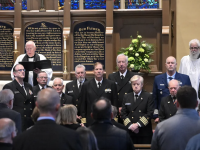
DETROIT – Bells tolled at Mariners’ Church of Detroit on Sunday in memory of sailors who have lost their lives at sea on the Great Lakes.

The annual Great Lakes Memorial service was held at the historic church, which sits along the Detroit River in downtown Detroit.

An estimated 30,000 deaths and roughly 6,000 shipwrecks have occurred on Lakes Superior, Michigan, Huron, Erie and Ontario. Thursday was the 47th anniversary of possibly the most notable wreck: the Nov. 10, 1975, sinking of the S.S. Edmund Fitzgerald.

Mariners’ Church previously held a memorial service focused on the S.S. Edmund Fitzgerald but has expanded to include all sailors lost at sea. Also honored this year were military personnel who lost their lives, said the Rev. Francis J. Bateman, deacon at Mariners’ Church.

“This is an evolution, an expansion of that service and we decided to add the military to it as well,” Bateman said. “People who lost their lives in defense of our freedom.”

Rear Admiral Gerard Achenbach of the Great Lakes Maritime Academy; Coast Guard Auxiliary and Chaplain James Faile; U.S. Army Corps. of Engineers; U.S. Navy League; and members of Yacht and Boating clubs.

Members of the International Shipmasters’ Association tolled the bell.

In 1976, a year after the Edmund Fitzgerald was lost, a memorial service was held at Mariners’ Church and included the ringing of the church’s “Brotherhood” bell 29 times, one for each crewman aboard the freighter.

The freighter was carrying a load of iron ore pellets to a Detroit steel mill when it plunged to the bottom of Lake Superior during a storm, 17 miles from Whitefish Point in Michigan’s Upper Peninsula.

To protect the wreck site, in 2006 the Canadian government extended the perimeter around the Edmund Fitzgerald to 500 meters. Divers without a permit face a hefty fine. It was an effort that took 30 years, said Ken Morse, a trustee at Mariners’ Church.

“It is protected waters now,” he said. “So divers can’t just go down there and do things.”

The Great Lakes Memorial Service every November closes out the shipping season, Bateman said. The church opens the shipping season in the spring with a Blessing of the Fleet service.

“The Great Lakes represent a rich bounty for the entire country, and especially for those of us fortunate enough to live by their shores,” said the Rev. Jeffrey Hubbard, pastor of Mariners’ Church of Detroit. “But they can become treacherous and unpredictable.”

“Six thousand shipwrecks, and more we aren’t even aware of yet, and the 30,000 lives lost in them are all the proof we need of that,” Hubbard said. “That’s why we take the time each year to reflect on those lives and to pray that there will be no more wrecks and no more deaths on the lakes in the future.”

Mariners’ Church was founded in 1842 as a place of prayer and reflection for sailors. It now is listed in the National Register of Historic Places.

Detroit News


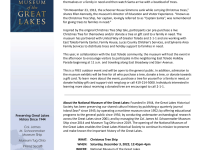
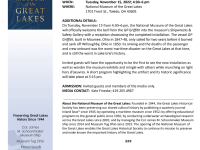
‘Christmas Tree Ship’ sets return to Toledo

The National Museum of the Great Lakes has begun taking both reservations and donation requests for Christmas trees to be delivered to the waterfront museum by tugboat in early December.

Trees delivered during the museum’s Christmas Tree Ship event Dec. 3 cost $55 and may be purchased for oneself, a family in need, or both. Orders may be placed through the nmgl.org website or by calling 419-214-5000.

The event commemorates the 1912 voyage to Chicago by the schooner Rouse Simmons to deliver Christmas trees for needy families. Toledo’s tree-delivering tugboat is scheduled to arrive at the museum’s dock at 1 p.m. on Dec. 3, and will be streamed on Facebook Live starting at 12:45 p.m.

4

Toledo Blade


World Ship Society report of casualties, demolitions

Vessels with a Great Lakes / Seaway connection reported as a casualty or sold for demolition. Taken from November 2022 issue of Marine News – Journal of the World Ship Society.

Casualties: Sail training ship DANMARK collided with U.S. Navy’s Freedom-class littoral combat ship MINNEAPOLIS-SAINT PAUL (LCS-21) on 11 September during Maryland Fleet Week at Baltimore

TERRY FOX (8127799; Canada) – 4,169 / 1983 – coast guard – 1st seaway transit 2018 – Canadian Coast Guard vessel had a fire in generator room on 16.08.2022 while anchored in Batty Bay off Somerset Island, Canada.  She was taken to St. John’s Newfoundland for repairs but damage is heavy.

Sold for Demolition: CYNTHIA NICOLE (5083394; United States of America) (CYNTHIA MORAN-04 – 1st seaway transit 1963 – 239 / 1957 – tug – by undisclosed interests, to unknown shipbreakers USA for break-up – commenced 1.00.2022

New Construction: Construction of CONSTELLATION (FFG-62), the lead ship of the navy’s latest class of warship, began 31 August at Finncantieri Marinette Marine’s shipyard at Marinette, Wisconsin

VIKING POLARIS (98683209; Nor) was launched from Vard Tulcea Sa, Tulcea – launch date 24.07.2021, with a delivery date 27.09.2022 – completed  by Vard Soviknes) – managed by Viking Ocean Cruises Ltd. (destined to enter the Great Lakes in 2023)

   Report prepared by Barry Andersen and René Beauchamp


National Museum of the Great Lakes flyers

See gallery below


#gallery-2 { margin: auto; } #gallery-2 .gallery-item { float: left; margin-top: 10px; text-align: center; width: 33%; } #gallery-2 img { border: 2px solid #cfcfcf; } #gallery-2 .gallery-caption { margin-left: 0; } /* see gallery_shortcode() in wp-includes/media.php */

Boatnerd News – November 12, 2022

U.S. and Canada Launch Green Shipping Corridor for Great Lakes – St. Lawrence Seaway

The United States and Canada have launched an initiative to establish a “green shipping corridor” for the Great Lakes – St. Lawrence Seaway System.

Under the Initiative, the U.S. Department of Transportation, the U.S. Department of State, and Transport Canada will work with state, provincial, local communities, private-sector and non-governmental leaders, and Indigenous Peoples of Canada and the United States to host consultations with ports and other stakeholders, with the goal of facilitating the establishment of a Great Lakes Green Shipping Corridor Network.

The green corridor was announced to coincide with the UN COP27 climate change conference taking place this week in Egypt and is one of several announced during the event.

Green corridors have been growing in popularity since last year’s COP26 conference in Glasgow. They are seen as a means to help the shipping industry decarbonize and involve setting up specific trade routes between major port hubs where zero-emission solutions are demonstrated and supported.

They are viewed as a key means of spurring the early adoption of zero-emission fuels and technologies that will put the shipping sector on a pathway to align with the goal of limiting global temperature rise to 1.5 degrees Celsius.

During last year’s COP26, a coalition of countries launched the Clydebank Declaration, agreeing to create zero emissions shipping routes to speed up the decarbonization of the global ocean shipping industry, which accounts for nearly 3% of the world’s CO2 emissions.

The binational Great Lakes – St. Lawrence Seaway System is a unique commercial waterway reaching into the heartland of North America, extending more than 2,000 miles and containing more than 110 ports. More than 200 million tons of cargo travel on the waterway each year.

“Through the Great Lakes – St. Lawrence Seaway System Green Shipping Corridor Network Initiative, Canada and the United States will work with industry to help facilitate the establishment of green corridors throughout the region, including by convening stakeholders and contributing to assessments and analyses relating to alternative fuels and power options within the system,” the U.S. and Canada said in a joint statement.

The Green Shipping Corridor Network Initiative builds on the work launched under the “Joint Statement by the U.S. Department of Transportation and Transport Canada on the Nexus between Transportation and Climate Change,” issued February 25, 2021.

“The governments view the Great Lakes – St. Lawrence Seaway System Green Shipping Corridor Network Initiative as an important element in catalyzing development of the fuels and infrastructure needed to make the transition to low- and zero-emitting shipping, and, on both sides of the border, creating the jobs to make the fuel available and infrastructure development a reality.  In the future the Initiative may expand to support green shipping corridors on U.S. and Canadian routes along both countries’ coasts, leverage experience from similar initiatives in other regions, and supplement regional and global efforts already underway,” the countries said.

gCaptain


Potash, grain on the move at port

Shipments of potash are at multi-decade highs, and western Canadian grain movement is on target and has risen in volume at the Port of Thunder Bay.

“Grain is certainly stronger now than it was in the summer,” said Tim Heney, chief executive officer of the Thunder Bay Port Authority.

Grain costs climbed again early this month and Heney doesn’t think it will affect Canadian exports immediately.

“Depending on the markets. If the price is up, in eastern markets eventually move more grain in this direction but it’s likely we’ll not see much immediate impact because (the shipments) are already starting anyway,” he said. “I don’t think it’s going to adjust how they move it that much because prices are set to the end of the year.”

As the fall grain harvest moves through the supply chain from Manitoba to the Thunder Bay port and onto its destination, local grain elevators handled 840,000 tonnes of wheat, canola, and other grains in October. Grain shipments for the month increased by 33 per cent compared to September and were eight per cent more than October of 2021.

The 2021 grain harvest suffered as a result of drought and high temperatures in the Prairies. This year’s increase in grain shipments reflects a more typical volume of grain at the port. Heney says there is an estimated 93.5 million tonnes of Prairie grain harvested this year, which equates to the third largest harvest on record.

Fertilizer shipments exported from Saskatchewan have levelled off at the Port.“The Russia and Ukraine situation has already affected exports quite dramatically,” Heney said. “They’re up in a big way in Thunder Bay this year. It’s kind of levelled off now, but it’s basically double what it was last year.”

Potash cargoes have also been strong throughout the 2022 shipping season with more than one million tonnes shipped through the port as of Oct. 31. Heney says that’s the most in more than 30 years. Potash is a vital component of fertilizer input and has been strained by global sanctions on Russian and Belarus products, which alone comprise 32 per cent of global production capacity.

Other shipments passing through the Thunder Bay port include pipe, which is used for the oil and gas industry in Alberta. 

“There’s a lot of pipe this year,” Heney said. “There are three more ships of pipe still coming up.”

And he says they have “quite a bit” of steel rails from Europe stored at the terminal to be shipped out via rail cars. As for wind turbine components, Heney says that’s finished for the year and he expects shipments to pick up next year.

There are a couple more project-cargo shipments coming before the end of the year as well, he said.

They involve big components for either mines or mills out west. He added that they have seen a few shiploads of equipment come through this year that were destined for the Beardmore mining sector.

The Chronicle Journal

Jump to a Date:

Archives